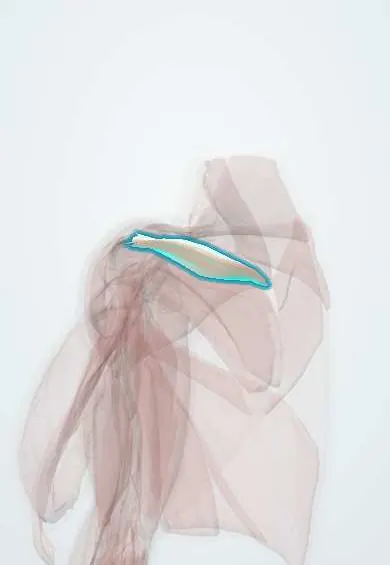
Subacromial impingement syndrome !
Subacromial impingement is shoulder pain from the rotator cuff tendons and bursa being pinched under the roof of the shoulder as the arm is raised.
Updated 2026-10-29
Structures involved
Tap one to see what it is and open it in 3D.
- Supraspinatus
- Subacromial bursa
- Coracoacromial ligament
- Scapula
- Humerus
- Biceps (long head)
- Infraspinatus
- Middle deltoid
- AC capsule
In the clinical exam
What it is
Shoulder pain caused by compression and irritation of the rotator cuff tendons (mainly supraspinatus) and the subacromial bursa beneath the coracoacromial arch when the arm is raised.
Who gets it
One of the most common causes of shoulder pain in adults seen in primary care, frequent in people who work or play sport with the arm overhead.
Causes
- Repetitive overhead activity in work or sport
- Structural narrowing of the subacromial space: curved or hooked acromion, acromioclavicular osteophytes, thickened coracoacromial ligament
- Functional causes: rotator cuff weakness, scapular dyskinesis, glenohumeral instability
- Age-related degeneration of the rotator cuff tendons
Risk factors
- Overhead work or sports (swimming, volleyball, throwing)
- Age over 40
- Hooked or downward-sloping acromion
- Acromioclavicular joint arthritis
- Poor posture and weak scapular stabilisers
Pathophysiology
The coracoacromial arch (acromion, coracoacromial ligament and coracoid process) forms a rigid roof over the supraspinatus tendon and subacromial bursa. When the space narrows, raising the arm compresses these tissues, causing bursitis and tendinopathy. Repeated compression can progress to fibrosis, bone spurs and partial or full-thickness cuff tears.
Classification
- Primary (structural, outlet) vs secondary (functional, from instability or scapular dyskinesis)
- Neer stages: I oedema and haemorrhage; II fibrosis and tendinitis; III bone spurs and tendon tear
- Acromion shape (Bigliani): type I flat, II curved, III hooked
Symptoms and signs
- Pain over the front and side of the shoulder, often radiating to the deltoid region
- Painful arc, typically between about 60 and 120 degrees of abduction
- Pain with overhead activity and reaching
- Night pain, especially lying on the affected shoulder
- Weakness that is mostly due to pain
Diagnosis
- Clinical
- Neer sign (pain on passive forward flexion with the scapula stabilised) and Hawkins-Kennedy test (pain on internal rotation with the shoulder and elbow flexed to 90 degrees); a painful arc; relief after subacromial local anaesthetic (Neer impingement test).
- Tests
- No laboratory test is needed; tests are used only if infection or inflammatory disease is suspected.
- Imaging
- X-rays (including an outlet view) show acromion shape, spurs and acromioclavicular arthritis; ultrasound or MRI assess the bursa and cuff tendons for tears.
Differential diagnosis
- Rotator cuff tear
- Frozen shoulder (adhesive capsulitis)
- Acromioclavicular joint arthritis
- Calcific tendinitis
- Long head of biceps tendinopathy
- Cervical radiculopathy
Goal of treatment
Relieve pain, restore normal shoulder and scapular mechanics, and prevent progression to rotator cuff tearing.
Treatment
- Conservative
- Relative rest and modification of overhead activities, with ice in the acute phase.
- Medical
- Non-steroidal anti-inflammatory drugs for short periods to control pain.
- Rehabilitation
- Physiotherapy to strengthen the rotator cuff and scapular stabilisers and correct posture; the mainstay of treatment.
- Procedure
- Subacromial corticosteroid injection for short-term relief when pain limits rehabilitation.
- Surgical
- Arthroscopic subacromial decompression (acromioplasty) when prolonged rehabilitation fails; its benefit over physiotherapy is debated.
Complications
- Partial or full-thickness rotator cuff tear
- Chronic shoulder pain and loss of function
- Secondary shoulder stiffness
- Complications of injection or surgery (infection, tendon weakening)
Prognosis
Most patients improve with activity modification and a structured exercise programme over several months. Recurrence is common if overhead loading resumes without correcting the mechanics.
Prevention
- Progressive strengthening of the rotator cuff and scapular muscles
- Good technique and posture in overhead sport and work
- Gradual increase in overhead training load
Test yourself
Think of the answer, then tap the question to see it.
Which three structures form the coracoacromial arch?
The acromion, the coracoacromial ligament and the coracoid process.
How is the Hawkins-Kennedy test performed?
Shoulder and elbow flexed to 90 degrees, the examiner internally rotates the arm; pain suggests subacromial impingement.
What does the Neer sign involve?
Passive forward flexion of the internally rotated arm while the scapula is stabilised; pain suggests impingement.
Which rotator cuff tendon is most often affected in subacromial impingement?
The supraspinatus tendon, which runs under the coracoacromial arch.
What is the painful arc of impingement?
Pain during mid-range abduction, typically about 60 to 120 degrees, that eases above and below that range.
Related conditions
- Rotator cuff tear
- Frozen shoulder (adhesive capsulitis)
- Cervical radiculopathy
- Biceps tendon rupture
- Winged scapula
Educational information, not medical advice. For any symptom, see a health professional.
Sources: Shoulder Impingement Syndrome (StatPearls (NCBI Bookshelf), 2026).
Spotted a mistake?We are always improving for the community. Tell us what is wrong and our team will review it.Report a mistake
Representative model, for educational purposes only.