Essential tremor !
The most common movement disorder: a rhythmic shaking of the hands, head or voice during action, often running in families. It is not Parkinson disease.
Updated 2026-11-01
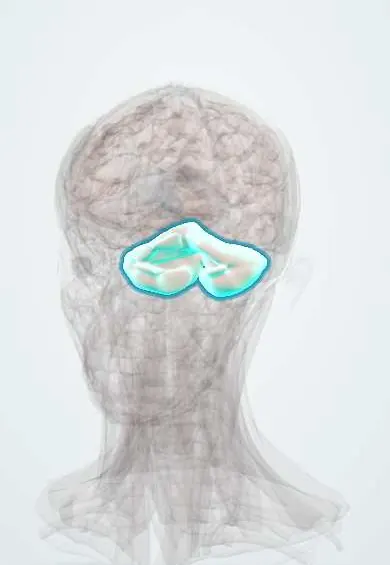
Structures involved
Tap one to see what it is and open it in 3D.
Why it happens
What it is
A chronic, often inherited movement disorder causing a bilateral postural and kinetic (action) tremor, mostly of the hands and forearms, sometimes of the head and voice, without other neurological signs.
Who gets it
The most common adult movement disorder, increasing with age, with peaks in young adulthood and after 60. About half of cases have a family history.
Causes
- Familial, often autosomal dominant, with no single gene identified
- Sporadic cases without family history
- Dysfunction of the cerebello-thalamo-cortical circuit
Risk factors
- Family history of tremor
- Older age
Pathophysiology
Abnormal rhythmic activity in the circuit linking the cerebellum, thalamus (ventral intermediate nucleus) and motor cortex produces an oscillation of 4–12 Hz during posture and movement. Changes in cerebellar Purkinje cells have been described. Alcohol temporarily reduces the tremor in many patients.
Symptoms and signs
- Bilateral tremor of the hands when holding a posture or moving (writing, drinking, eating)
- Little or no tremor at rest
- Head tremor ("yes-yes" or "no-no") and voice tremor
- Worse with stress, fatigue, caffeine and some drugs; better with alcohol in many
- Mild tandem-gait difficulty in some patients
- No bradykinesia or rigidity
Diagnosis
- Clinical
- Clinical diagnosis: bilateral action tremor of the upper limbs for at least three years, with or without head or voice tremor, and no other neurological signs. Examination includes holding the arms outstretched, the finger-to-nose test, drawing a spiral and writing.
- Tests
- Thyroid function to exclude hyperthyroidism; review of drugs and caffeine; copper and ceruloplasmin in people under 40 to exclude Wilson disease; glucose and electrolytes when relevant.
- Imaging
- Not routinely needed. A dopamine transporter SPECT (DaT scan) is normal and helps separate it from Parkinson disease in doubtful cases.
Differential diagnosis
- Parkinson disease (rest tremor, bradykinesia, rigidity)
- Enhanced physiological tremor (hyperthyroidism, caffeine, anxiety, hypoglycaemia, drugs such as lithium, valproate or beta-agonists)
- Dystonic tremor
- Cerebellar (intention) tremor, e.g. multiple sclerosis
- Wilson disease
- Alcohol withdrawal tremor
Goal of treatment
Reduce tremor enough to restore daily activities such as eating, writing and work; treatment is symptomatic and is offered only when tremor causes disability.
Treatment
- Lifestyle
- Reducing caffeine and other aggravating factors, weighted utensils and adaptive devices; reassurance when tremor is mild.
- Medical
- First-line drugs: the non-selective beta-blocker propranolol or the anticonvulsant primidone; second-line options include topiramate, gabapentin and benzodiazepines.
- Procedure
- Botulinum toxin injections for head or voice tremor, and in selected hand tremor.
- Surgical
- For severe, drug-resistant tremor: deep brain stimulation or focused ultrasound or radiosurgical thalamotomy targeting the ventral intermediate nucleus of the thalamus.
Complications
- Disability in eating, writing, dressing and work
- Social embarrassment, anxiety and depression
- Adverse effects of drugs (bradycardia, fatigue, sedation)
Prognosis
Slowly progressive over years but does not shorten life. Most patients keep functioning with treatment; a minority develop disabling tremor needing surgery.
Test yourself
Think of the answer, then tap the question to see it.
What type of tremor is typical of essential tremor?
A bilateral postural and kinetic (action) tremor of the hands, often with head or voice tremor.
How does essential tremor differ from Parkinson tremor?
Essential tremor appears with posture and action and lacks bradykinesia and rigidity; Parkinson tremor is mainly at rest.
Which substance temporarily improves essential tremor in many patients?
Alcohol.
Which two drugs are first line for essential tremor?
Propranolol and primidone.
Which thalamic nucleus is targeted by surgery for refractory essential tremor?
The ventral intermediate (Vim) nucleus of the thalamus.
Related conditions
- Parkinson disease
- Graves disease (hyperthyroidism)
- Wilson disease
- Multiple sclerosis
- Alcohol withdrawal and delirium tremens
- Lithium toxicity
- Hypoglycaemia (including insulin-induced)
Educational information, not medical advice. For any symptom, see a health professional.
Sources: Essential tremor: MedlinePlus Genetics (MedlinePlus (U.S. National Library of Medicine), 2026).
Spotted a mistake?We are always improving for the community. Tell us what is wrong and our team will review it.Report a mistake
Representative model, for educational purposes only.