Conditions · Metabolism (biochemistry)
Farber disease (Farber lipogranulomatosis) !
In Farber disease a fat called ceramide builds up around the joints, in the larynx and under the skin, starting in infancy.
Updated 2026-11-01
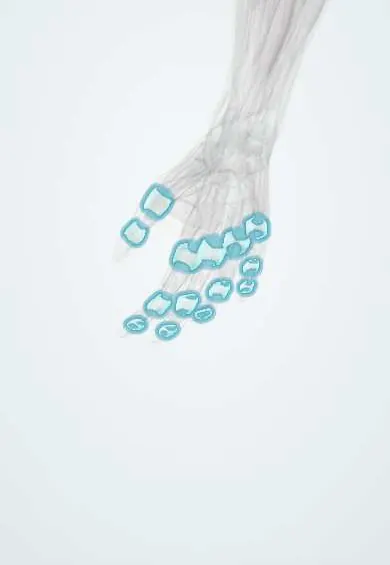
Structures involved
Tap one to see what it is and open it in 3D.
In biochemistry
What it is
An autosomal recessive lysosomal storage disease caused by acid ceramidase deficiency (ASAH1 gene), with ceramide build-up in joints, larynx, skin and many organs.
Who gets it
Very rare: a little over 150 cases have been reported worldwide. We found no published frequency for Colombia or Latin America.
Causes
- Biallelic variants of the ASAH1 gene (autosomal recessive)
- Acid ceramidase activity usually falls below one tenth of normal
Risk factors
- Both parents are carriers
- Consanguinity
- An affected sibling
Pathophysiology
Acid ceramidase is the last lysosomal step of sphingolipid breakdown: it splits ceramide into sphingosine and a fatty acid. Without it, ceramide accumulates in macrophages and other cells of synovium, cartilage, larynx, skin, liver, spleen, lungs and, in severe forms, the nervous system. Lipid-laden macrophages form inflamed nodules (lipogranulomas), which explain the swollen joints, the hoarse cry and the lumps under the skin.
Classification
- A spectrum rather than separate types: severe neonatal forms with large liver and spleen and early death
- Classic infantile form with the triad and often neurological involvement
- Milder forms with mainly joint and skin signs and longer survival
- ASAH1 variants also cause a different condition: spinal muscular atrophy with progressive myoclonic epilepsy (SMA-PME)
Symptoms and signs
- Hoarse voice or weak cry
- Firm lumps under the skin, near joints and pressure points
- Swollen, painful joints that become stiff
- Breathing and feeding difficulties
- Enlarged liver and spleen
- Developmental delay or seizures in severe forms
Diagnosis
- Clinical
- An infant with the triad of hoarse cry, subcutaneous nodules and painful joint swelling; it is often first mistaken for juvenile idiopathic arthritis.
- Tests
- Low acid ceramidase activity in white blood cells or skin fibroblasts; raised ceramide in blood or tissue; ASAH1 gene testing; biopsy of a nodule showing foamy, lipid-laden macrophages.
- Imaging
- Joint ultrasound or MRI with synovial thickening and masses around the joints; chest imaging for lung infiltrates; brain MRI in neurological forms.
Treatment
- Procedure
- Haematopoietic stem cell transplant in selected children without severe nervous system involvement improves joint and skin disease.
- Medical
- Control of pain and inflammation; enzyme replacement and gene therapy are under research.
- Surgical
- Removal of nodules that block the airway or limit function.
- Rehabilitation
- Physiotherapy to keep joints moving.
- Conservative
- Genetic counselling, nutritional support and palliative care when needed.
Complications
- Joint contractures
- Airway obstruction
- Aspiration pneumonia
- Respiratory failure
- Osteoporosis
Prognosis
Children with the severe and classic forms usually do not survive past childhood; milder forms can reach adulthood.
Prevention
- Genetic counselling for families with an affected child
- Carrier testing and prenatal diagnosis when the family variants are known
Test yourself
Think of the answer, then tap the question to see it.
Which enzyme is deficient in Farber disease?
Acid ceramidase (ASAH1 gene), which splits ceramide into sphingosine and a fatty acid.
What is the classic triad of Farber disease?
Hoarse voice or weak cry, nodules under the skin and swollen, painful joints.
Which childhood disease is Farber disease often mistaken for?
Juvenile idiopathic arthritis, because of the swollen, painful joints.
What other condition can ASAH1 variants cause?
Spinal muscular atrophy with progressive myoclonic epilepsy (SMA-PME).
Related conditions
- GM1 gangliosidosis
- Niemann–Pick disease
- Krabbe disease (globoid cell leukodystrophy)
- Gaucher disease
- Osteoporosis
- Hydrocephalus
Educational information, not medical advice. For any symptom, see a health professional.
Sources: Farber lipogranulomatosis: MedlinePlus Genetics (MedlinePlus, US National Library of Medicine, 2026); ASAH1 gene: MedlinePlus Genetics (MedlinePlus, US National Library of Medicine, 2026); Textbook of Biochemistry for Medical Students, 6th ed. (Jaypee Brothers Medical Publishers (Vasudevan DM, Sreekumari S, Vaidyanathan K), 2011).
Spotted a mistake?We are always improving for the community. Tell us what is wrong and our team will review it.Report a mistake
Representative model, for educational purposes only.