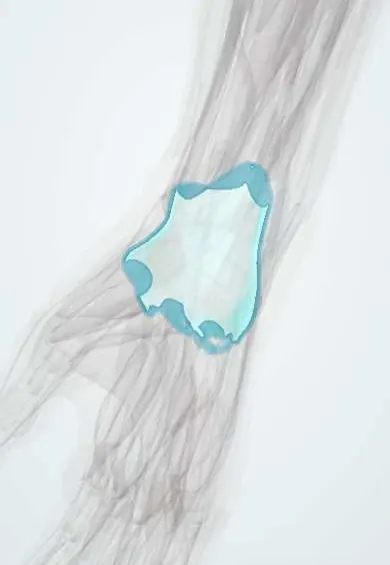
Joints and ligaments · Upper limb
Wrist capsule !
The wrist capsule is the sleeve that seals the joint between the radius and the wrist bones; ganglion cysts often grow from it.
Official name: Wrist (radiocarpal) joint capsule
Opens in the Durgical app, no sign-up needed.
What it is
The bag of tissue around the joint between the radius and the wrist bones; the wrist ligaments are its thickenings.
What it does
Seals the joint; ganglion cysts often grow from it.
Key facts
- Attaches
- Distal radius and the ulnar disc (TFCC) to the proximal carpal row
- Function
- Encloses the radiocarpal joint; thickened by the palmar and dorsal radiocarpal ligaments
Relations
- In front
- Flexor tendons in the carpal tunnel with the median nerve, under the flexor retinaculum; the radial artery and flexor carpi radialis on the radial side
- Behind
- Extensor tendons in their six compartments under the extensor retinaculum; the end of the posterior interosseous nerve lies on the capsule in the floor of the fourth compartment
- Lateral
- Radial artery crossing the floor of the anatomical snuffbox over the scaphoid and capsule
- Medial
- TFCC and ulnocarpal ligaments; the extensor carpi ulnaris (ECU) tendon in its groove
How to find it
With the wrist slightly flexed, the dorsal radiocarpal joint line is felt as a dip just distal to Lister's tubercle; the 3-4 arthroscopy portal sits there, between the EPL and extensor digitorum tendons. On the front, the radiocarpal joint line lies at about the proximal wrist flexion crease, between the two styloid processes.
On imaging
Ultrasound shows a ganglion as a fluid-filled cyst with a neck running to the joint, and checks the radial artery before a volar ganglion is aspirated. MRI or MR arthrography shows ganglion stalks and ligament or TFCC tears. On X-ray, a displaced pronator quadratus fat line can hint at a distal radius fracture.
Clinical notes
- A dorsal capsulotomy (often a ligament-sparing split) is the route to the carpal bones; the posterior interosseous nerve on the capsule may be divided at the same time to reduce dorsal wrist pain
- Septic arthritis of the wrist can mimic gout or pseudogout (CPPD, which favours the TFCC); aspiration with crystal analysis and culture separates them
- Ganglion excision includes the stalk and a small cuff of capsule, which lowers recurrence
Anatomical variants
- A communication with the distal radioulnar joint through a perforated TFCC disc is common in older adults and often painless (some texts: about 2 in 5 wrists)
Related conditions
- Chikungunya
- Rheumatoid arthritis
- Juvenile idiopathic arthritis
- Adult-onset Still disease
- Ganglion cyst
- Rheumatoid arthritis of the hand and wrist
Test yourself
Think of the answer, then tap the question to see it.
Where do most dorsal and volar wrist ganglia arise?
Dorsal ones from the capsule over the scapholunate ligament; volar ones beside the radial artery, between it and the FCR tendon.
What does a communication between the radiocarpal and midcarpal joints on arthrography suggest?
A ligament tear (or a TFCC tear for the DRUJ), since the wrist capsule compartments normally do not communicate.
What lowers recurrence after excision of a wrist ganglion?
Removing the stalk together with a small cuff of wrist capsule.
Educational information, not medical advice. For any symptom, see a health professional.
Its names
- Official Latin (TA2)
- capsula articularis articulationis radiocarpeae TA2 1536
- Official Spanish (DeCS)
- Cápsula articular de la articulación radiocarpiana
- English (TA2)
- Wrist (radiocarpal) joint capsule
Related
Sources: Terminologia Anatomica (TA2); Anatomy, Shoulder and Upper Limb, Hand Radiocarpal Joint; Anatomy, Shoulder and Upper Limb, Wrist Joint; Anatomía humana (4.ª ed.), tomo 1, cap. 58: Mano.
Spotted a mistake?We are always improving for the community. Tell us what is wrong and our team will review it.Report a mistake
Representative model, for educational purposes only.