Conditions · Surgery and trauma
Hand infections (paronychia, felon, flexor tenosynovitis) !
Hand infections range from a red, sore nail fold to pus in a tendon sheath that can destroy a finger. Deep infections need urgent surgery.
Updated 2026-11-01
Structures involved
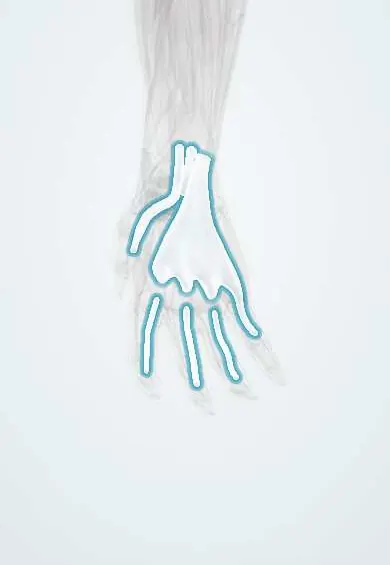
Tap one to see what it is and open it in 3D.
- Flexor tendon sheaths
- Distal phalanx, index finger
- Middle phalanx, index finger
- Proximal phalanx, index finger
- Distal phalanx, thumb
- Distal phalanx, middle finger
- Palmar aponeurosis
- Lumbricals
- 3rd metacarpal
- Skin
Why it happens
What it is
Bacterial (and sometimes viral or fungal) infections of the hand's closed spaces. The classic exam entities are paronychia (infection of the nail fold), felon (abscess of the fingertip pulp), herpetic whitlow (viral infection of the fingertip), pyogenic flexor tenosynovitis (pus inside a flexor tendon sheath) and deep space infections, including bite wounds. The hand's compartments are tight and close to tendons, bones and joints, so delay can cost function.
Who gets it
Hand infections are very common in emergency and primary care. Paronychia is the most frequent; pyogenic flexor tenosynovitis accounts for a small share of acute hand infections but carries the most risk. Manual workers, farmers and people with diabetes are often affected, and in Colombia agricultural and occupational puncture wounds and animal bites are common entry routes.
Causes
- Staphylococcus aureus (including methicillin-resistant strains) and streptococci in most cases
- Candida and other fungi in chronic paronychia
- Herpes simplex virus in herpetic whitlow
- Mixed mouth flora such as Eikenella corrodens after human bites and fist-fight injuries; Pasteurella multocida after cat and dog bites
- Neisseria gonorrhoeae in disseminated gonococcal tenosynovitis
- Entry through hangnails, nail biting, manicures, splinters, needle sticks and penetrating injuries
Risk factors
- Diabetes mellitus
- Immunosuppression, kidney failure and peripheral vascular disease
- Frequent hand immersion in water (dishwashers, cleaners)
- Nail biting and cuticle trimming
- Penetrating trauma, bites and injection drug use
Pathophysiology
Bacteria enter through a break in the skin and multiply in a confined space. In a felon, fibrous septa that anchor the pulp skin to the distal phalanx create small compartments, so pus raises pressure, causes throbbing pain and can lead to necrosis or osteomyelitis. The flexor tendon sheath is a closed synovial tube; once infected, swelling and pus raise the pressure, impair the tendon's blood supply and can spread proximally to the palm and the forearm, and later cause adhesions or tendon necrosis.
Classification
- Acute paronychia (bacterial, sudden) versus chronic paronychia (more than six weeks, often fungal or irritant)
- Felon: pulp space abscess of the distal phalanx
- Herpetic whitlow: viral vesicles on the fingertip, not to be incised
- Pyogenic flexor tenosynovitis: infection of the flexor tendon sheath
- Deep space infections: thenar, midpalmar and web-space (collar-button) abscesses; septic arthritis and osteomyelitis of the hand
- Bite wounds: human (including clenched-fist injury) and animal
Symptoms and signs
- Red, swollen, painful skin around the nail with pus under the fold (paronychia)
- Tense, throbbing, very painful fingertip pulp (felon)
- Grouped painful vesicles on the finger, often with burning beforehand (herpetic whitlow)
- Swollen, tender finger held slightly bent and painful to straighten (flexor tenosynovitis)
- Fever, red streaks up the arm and swollen axillary nodes in spreading infection
Diagnosis
- Clinical
- Diagnosis is mainly clinical: location of swelling, fluctuance, Kanavel signs, range of motion, a careful history of bites, punctures and occupation, and a sensory and vascular examination of the finger.
- Tests
- Culture of pus from any drainage. White cell count, ESR and CRP support deep infection but a normal result does not exclude it. Viral PCR or Tzanck test for suspected herpetic whitlow; blood glucose in all patients.
- Imaging
- Radiographs for foreign bodies, gas, fractures (fight bites) and osteomyelitis. Ultrasound can show fluid in the tendon sheath or an abscess; MRI for unclear deep infection or osteomyelitis.
Differential diagnosis
- Herpetic whitlow (viral, must not be incised)
- Cellulitis without an abscess
- Gout or pseudogout of a finger joint
- Trigger finger or inflammatory tenosynovitis
- Retained foreign body reaction
Goal of treatment
Drain pus and control infection early enough to preserve tendon gliding, finger movement and sensation.
Treatment
- Conservative
- Early acute paronychia without pus: warm soaks several times a day, elevation and, when cellulitis is present, oral antibiotics active against staphylococci and streptococci.
- Procedure
- Paronychia or felon with an abscess: incision and drainage under digital block, avoiding the pad of the finger and the neurovascular bundles; partial nail removal when pus lies under the nail.
- Medical
- Antibiotics guided by the setting: anti-staphylococcal agents for most infections, coverage for mouth flora (for example a beta-lactam with a beta-lactamase inhibitor) for bites, and antivirals for herpetic whitlow.
- Surgical
- Pyogenic flexor tenosynovitis: hand surgery referral, intravenous antibiotics, splinting and elevation; if not improving quickly or seen late, open or closed irrigation of the tendon sheath. Deep space abscesses and fight bites need surgical exploration and washout.
- Follow-up
- Nursing priorities: elevate the hand above heart level, check finger colour and capillary refill, record the spread of redness, assess pain, control blood glucose, and give tetanus prophylaxis; teach wound care after drainage.
- Rehabilitation
- Early hand therapy and active movement after deep infections to limit tendon adhesions and stiffness.
Complications
- Tendon adhesions, stiffness and loss of finger movement
- Tendon necrosis or rupture
- Osteomyelitis of the distal phalanx and septic arthritis
- Spread to the palm and forearm (horseshoe abscess)
- Chronic nail deformity
- Amputation of the finger, especially with diabetes and late treatment
Prognosis
Superficial infections such as paronychia heal well with drainage and care. Flexor tenosynovitis leaves some stiffness in a sizeable minority even with prompt treatment; delay, diabetes, ischaemia, renal failure and older age raise the risk of amputation.
Prevention
- Avoid biting nails and cutting cuticles
- Wear gloves for wet work and when handling soil and animals
- Clean and seek care early for puncture wounds and bites
- Good glucose control in diabetes
Test yourself
Think of the answer, then tap the question to see it.
What are Kanavel's four signs of pyogenic flexor tenosynovitis?
Fusiform swelling, finger held in flexion, tenderness along the flexor sheath and pain on passive extension (often the earliest sign).
What is a felon?
An abscess of the closed fibrous compartments of the fingertip pulp.
Why should a herpetic whitlow not be incised?
It is a viral infection; incision does not help and risks bacterial superinfection and spread.
Which organism is classically linked to human bite and clenched-fist injuries?
Eikenella corrodens, together with other mouth flora.
Which organism is classically linked to cat and dog bite infections?
Pasteurella multocida.
Related conditions
- Abscess, furuncle and carbuncle
- Genital herpes (herpes simplex infection)
- Mammalian bites (dog, cat, human)
- Necrotizing soft tissue infection (necrotizing fasciitis, gas gangrene)
- Osteomyelitis
- Type 2 diabetes mellitus
- Gonorrhoea
- Trigger finger
Educational information, not medical advice. For any symptom, see a health professional.
Sources: Pyogenic (Suppurative) Flexor Tenosynovitis: Assessment and Management (Eplasty, 2016); Paronychia: MedlinePlus Medical Encyclopedia (MedlinePlus (U.S. National Library of Medicine), 2024).
Spotted a mistake?We are always improving for the community. Tell us what is wrong and our team will review it.Report a mistake
Representative model, for educational purposes only.