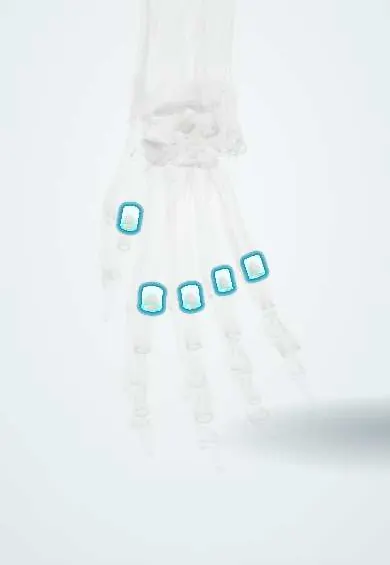
Trigger finger !
Trigger finger is when a finger's flexor tendon catches on a thickened pulley at its base, so the finger clicks, locks bent or snaps straight.
Updated 2026-10-29
Structures involved
Tap one to see what it is and open it in 3D.
- A1 pulleys
- FDS tendons
- FDP tendons
- Flexor tendon sheaths
- Finger pulleys
- FPL
- 3rd metacarpal
- Proximal phalanx, middle finger
- Digital nerves
What it is
Stenosing tenosynovitis in which a flexor tendon catches at a thickened A1 pulley at the base of the finger, so the finger clicks, locks in flexion or snaps straight.
Who gets it
One of the most common hand problems in adults, more frequent in women in their 50s and 60s, and much more common in people with diabetes. The ring finger and thumb are affected most often.
Causes
- Thickening and narrowing of the A1 pulley at the metacarpal head
- Nodular swelling of the flexor tendon
- Repetitive gripping and local mechanical stress
- Associated systemic disease
Risk factors
- Diabetes mellitus
- Rheumatoid arthritis and other inflammatory arthritis
- Carpal tunnel syndrome and De Quervain tenosynovitis
- Female sex and age 40 to 60 years
- Hypothyroidism, gout and amyloidosis
- Occupations with repetitive forceful gripping
Pathophysiology
The A1 pulley sits over the metacarpophalangeal joint. Repeated friction causes fibrocartilaginous change in the pulley and a nodule or swelling in the tendon. The mismatch makes the tendon catch as it glides, then pass with a snap, and later lock the finger in flexion.
Classification
- Green (modified Quinnell): grade I pain or tenderness at A1 without catching
- Grade II catching, but the finger still extends actively
- Grade III locking that needs passive extension, or inability to flex fully
- Grade IV fixed flexion contracture
Symptoms and signs
- Painful click or catching when bending or straightening the finger
- Finger locked in flexion, released with a snap, worse in the morning
- Tender palpable nodule at the distal palmar crease over the A1 pulley
- Pain at the base of the finger or thumb
- Stiffness or flexion contracture in long-standing cases
Diagnosis
- Clinical
- Clinical diagnosis: tenderness and a nodule over the A1 pulley, with catching or locking reproduced on active flexion and extension.
- Tests
- Blood glucose or HbA1c may be checked when diabetes is suspected; otherwise no tests are needed.
- Imaging
- Usually unnecessary; ultrasound can show the thickened pulley and tendon, and X-rays help if arthritis or another cause is suspected.
Differential diagnosis
- Dupuytren contracture
- Ganglion of the flexor tendon sheath
- Metacarpophalangeal joint locking or arthritis
- Flexor tendon injury
- De Quervain tenosynovitis (for thumb pain)
Goal of treatment
Abolish catching and locking, relieve pain, and restore full, smooth finger motion.
Treatment
- Conservative
- Activity modification and splinting of the affected joint to rest the tendon, mainly in mild cases.
- Medical
- Non-steroidal anti-inflammatory drugs for short-term pain relief.
- Procedure
- Corticosteroid injection into the flexor tendon sheath at the A1 pulley; first-line for most patients, though less effective and more often repeated in diabetes.
- Surgical
- Release of the A1 pulley, open or percutaneous, when injections fail or the finger stays locked; the A2 pulley is preserved.
Complications
- Recurrence after injection
- Tendon bowstringing if the A2 pulley is injured
- Digital nerve injury, especially at the thumb
- Persistent stiffness or flexion contracture
- Infection or skin changes after injection
Prognosis
Many cases settle with one or more steroid injections. Surgical release has a high success rate and low recurrence; results are less favourable in diabetes and in long-standing contractures.
Test yourself
Think of the answer, then tap the question to see it.
Which pulley is involved in trigger finger?
The A1 pulley, at the level of the metacarpophalangeal joint.
Which systemic disease is most strongly associated with trigger finger?
Diabetes mellitus; rheumatoid arthritis and hypothyroidism are also associated.
What is the usual first-line procedure for trigger finger?
A corticosteroid injection into the flexor tendon sheath at the A1 pulley.
Which pulley must be preserved during trigger finger release, and why?
The A2 pulley, to prevent bowstringing of the flexor tendons.
Which digits are most commonly affected by trigger finger?
The ring finger and the thumb.
Related conditions
- De Quervain tenosynovitis
- Carpal tunnel syndrome
- Dupuytren contracture
- Flexor tendon injury
- Ganglion cyst
- Mallet finger
- Rheumatoid arthritis of the hand and wrist
Educational information, not medical advice. For any symptom, see a health professional.
Sources: Trigger Finger (StatPearls (NCBI Bookshelf), 2024).
Spotted a mistake?We are always improving for the community. Tell us what is wrong and our team will review it.Report a mistake
Representative model, for educational purposes only.