Long QT syndrome and torsades de pointes !
Long QT means the heart takes too long to recharge after each beat. It can trigger a twisting rhythm called torsades that causes fainting or sudden death.
Updated 2026-11-01
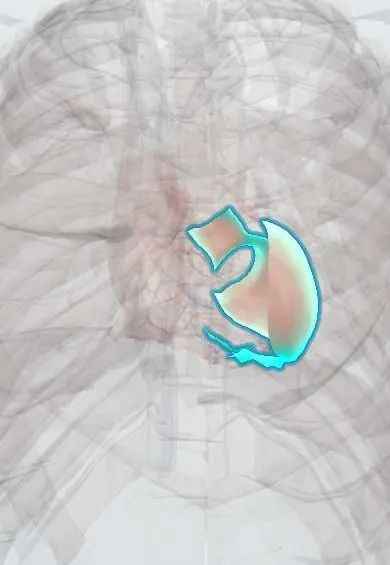
Structures involved
Tap one to see what it is and open it in 3D.
Why it happens
- Mendelian inheritance: autosomal dominant, recessive and X-linked
- Sudden infant death syndrome: what is known
- The ventricular action potential
- Ion channels and gating
- How arrhythmias arise
- The ECG in potassium and calcium disorders
What it is
A disorder of ventricular repolarisation with a prolonged corrected QT interval on the ECG. It may be congenital (ion channel mutations) or acquired (drugs, electrolyte disorders). Its main danger is torsades de pointes, a polymorphic ventricular tachycardia that twists around the baseline and can turn into ventricular fibrillation.
Who gets it
The congenital form affects about 1 in 2,000 people. The acquired form is far more common in hospitals, where QT-prolonging drugs are often combined with hypokalaemia, hypomagnesaemia or bradycardia, especially in older women. In Colombia, as elsewhere, many common drugs (some antibiotics, antiemetics, antipsychotics and antimalarials) are known causes.
Causes
- Congenital: mutations in potassium channels (KCNQ1, KCNH2) or sodium channels (SCN5A); Romano-Ward syndrome (autosomal dominant) and Jervell and Lange-Nielsen syndrome (autosomal recessive, with congenital deafness)
- Drugs: class IA and III antiarrhythmics, macrolides and fluoroquinolones, some antipsychotics and antidepressants, methadone, ondansetron, chloroquine and hydroxychloroquine
- Electrolytes: hypokalaemia, hypomagnesaemia, hypocalcaemia
- Bradycardia and high-grade atrioventricular block
- Other: hypothyroidism, hypothermia, starvation (anorexia nervosa), intracranial haemorrhage
Risk factors
- Female sex
- Combination of two or more QT-prolonging drugs
- Low potassium or magnesium (diuretics, vomiting, diarrhoea)
- Bradycardia, heart failure or structural heart disease
- Kidney or liver failure that raises drug levels
- Family history of sudden death, unexplained drowning or fainting
Pathophysiology
Reduced outward potassium current or persistent inward sodium current lengthens the ventricular action potential. Repolarisation becomes uneven across the wall, and early afterdepolarisations can trigger premature beats. A pause followed by a premature beat (short-long-short sequence) typically launches torsades de pointes. Triggers differ by genotype: exercise and swimming (type 1), sudden noise or emotion (type 2), rest or sleep (type 3).
Classification
- Congenital: LQT1, LQT2, LQT3 (most common types) and rarer forms
- Acquired: drug-induced, electrolyte-related, bradycardia-related
- Rhythm: torsades de pointes (polymorphic ventricular tachycardia with QT prolongation)
Symptoms and signs
- Sudden fainting, often triggered by exercise, emotion, noise or during sleep
- Palpitations
- Seizure-like episodes (sometimes misdiagnosed as epilepsy)
- Cardiac arrest or sudden death
- Many carriers are asymptomatic
Diagnosis
- Clinical
- Suspect it in patients with unexplained syncope, seizures or arrest, in those taking QT-prolonging drugs, and in relatives of young people who died suddenly.
- Tests
- 12-lead ECG with heart-rate-corrected QT (QTc); values above about 470 ms in men and 480 ms in women are considered prolonged, and above 500 ms carries high risk. Serum potassium, magnesium and calcium; thyroid function; review of all medications. Holter monitoring, exercise testing and genetic testing for congenital forms; screening of first-degree relatives.
- Imaging
- Echocardiography to exclude structural heart disease.
Differential diagnosis
- Epilepsy
- Vasovagal syncope
- Catecholaminergic polymorphic ventricular tachycardia
- Brugada syndrome
- Polymorphic ventricular tachycardia from ischaemia (normal QT)
Goal of treatment
Terminate torsades, remove triggers (drugs, electrolyte disorders, bradycardia) and prevent sudden death with long-term therapy in congenital forms.
Treatment
- Acute
- Torsades de pointes: intravenous magnesium sulfate first line, even when magnesium is normal; immediate defibrillation if pulseless or unstable.
- Acute
- Stop all QT-prolonging drugs and correct potassium and magnesium; increase the heart rate with temporary pacing or isoproterenol when torsades is pause-dependent.
- Medical
- Congenital long QT: non-selective beta-blockers (such as propranolol or nadolol) are first-line long-term therapy, especially for type 1.
- Procedure
- Implantable cardioverter-defibrillator after cardiac arrest or recurrent syncope despite beta-blockers; left cardiac sympathetic denervation in selected cases.
- Lifestyle
- Avoid QT-prolonging drugs (lists are kept up to date), replace electrolytes during vomiting or diarrhoea, and limit genotype-specific triggers such as competitive swimming or sudden alarm sounds.
- Follow-up
- Nursing priorities: measure QTc before and after starting high-risk drugs, keep potassium and magnesium in range, continuous ECG monitoring in high-risk patients and defibrillator readily available.
Complications
- Torsades de pointes
- Ventricular fibrillation and sudden cardiac death
- Recurrent syncope with injuries
- Inappropriate shocks or device complications
Prognosis
Untreated symptomatic congenital long QT carries a high risk of sudden death; with beta-blockers, trigger avoidance and a defibrillator when indicated, most patients live normally. Acquired forms usually resolve once the drug is stopped and electrolytes are corrected.
Prevention
- Check the ECG and electrolytes before and during treatment with QT-prolonging drugs
- Avoid combining QT-prolonging drugs
- Family screening with ECG and genetic testing when a congenital case is found
Test yourself
Think of the answer, then tap the question to see it.
What is the first-line drug for torsades de pointes?
Intravenous magnesium sulfate; defibrillate if the patient is pulseless or unstable.
Which three electrolyte disorders prolong the QT interval?
Hypokalaemia, hypomagnesaemia and hypocalcaemia.
Which inherited long QT syndrome is associated with congenital deafness?
Jervell and Lange-Nielsen syndrome (autosomal recessive).
Which drug class is first-line long-term therapy for congenital long QT syndrome?
Beta-blockers, preferably non-selective (propranolol, nadolol).
Which QTc value marks a high risk of torsades?
A QTc above about 500 ms.
Related conditions
- Cardiac arrest (VF, pulseless VT, asystole, PEA)
- Ventricular tachycardia
- Syncope (vasovagal, orthostatic hypotension, cardiac)
- Hypomagnesaemia
- Anorexia nervosa
- Sudden infant death syndrome (SIDS)
- Atrioventricular (heart) block
- Sinus node dysfunction (sick sinus syndrome) and symptomatic bradycardia
- Hypertrophic cardiomyopathy
Educational information, not medical advice. For any symptom, see a health professional.
Sources: Long QT Syndrome (National Heart, Lung, and Blood Institute (NHLBI), NIH, 2026); Romano-Ward syndrome (MedlinePlus Genetics, US National Library of Medicine, 2026).
Spotted a mistake?We are always improving for the community. Tell us what is wrong and our team will review it.Report a mistake
Representative model, for educational purposes only.