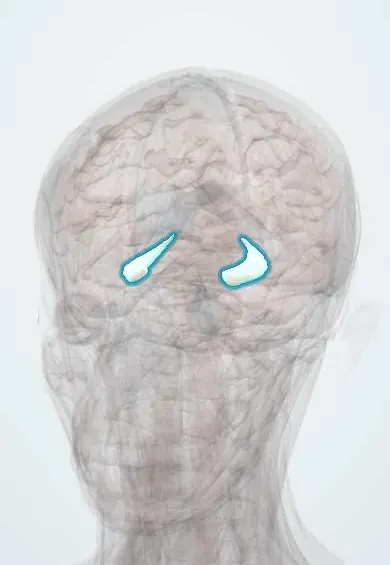
Mild cognitive impairment !
Memory or thinking decline beyond normal ageing that still lets a person manage daily life. It may stay stable, improve or progress to dementia.
Updated 2026-11-01
Structures involved
Tap one to see what it is and open it in 3D.
Why it happens
What it is
A syndrome of objective decline in one or more cognitive domains (memory, attention, language, executive or visuospatial function), noticed by the person or others and confirmed by testing, with independence in daily activities essentially preserved. In current terminology it corresponds to mild neurocognitive disorder.
Who gets it
Prevalence rises with age, from about 7% at 60–64 years to about a quarter at 80–84 years, per the American Academy of Neurology guideline. Roughly 10–15% of people with MCI progress to dementia each year, more than people of the same age without it. With rapid population ageing and low schooling in older cohorts in Colombia and Latin America, MCI is a growing primary care problem, and education level must be considered when interpreting screening scores.
Causes
- Early Alzheimer disease (most common cause of amnestic MCI)
- Cerebrovascular disease (vascular cognitive impairment)
- Lewy body disease and Parkinson disease
- Early frontotemporal lobar degeneration
- Potentially reversible contributors: depression, hypothyroidism, vitamin B12 deficiency, sleep apnea, medicines with anticholinergic or sedative effects, alcohol
Risk factors
- Advanced age
- APOE e4 carrier status
- Hypertension, diabetes, dyslipidemia, obesity and smoking
- Low education and low cognitive activity
- Physical inactivity and social isolation
- Hearing loss and depression
- Prior stroke or head injury
Pathophysiology
MCI is a clinical stage on the path of several neurodegenerative and vascular diseases. In Alzheimer-type MCI, amyloid plaques and tau tangles first damage the entorhinal cortex and hippocampus, which encode new memories, so recent memory fails first. The brain compensates for a time (cognitive reserve), which keeps daily function intact until damage spreads to association cortices and dementia appears.
Classification
- Amnestic MCI: memory is the main domain affected; highest risk of Alzheimer dementia
- Non-amnestic MCI: language, executive or visuospatial domains affected; associated with vascular, Lewy body or frontotemporal causes
- Single-domain or multiple-domain
Symptoms and signs
- Forgetting recent conversations, appointments or events more than before
- Repeating questions, losing objects more often
- Difficulty finding words or following complex conversations
- Slower planning or trouble with complex tasks (finances, medicines), with extra effort but still independent
- Concern expressed by the person or family
Diagnosis
- Clinical
- History from the patient and an informant documenting change from previous level, plus functional assessment (instrumental activities of daily living largely preserved). Cognitive screening with tools such as MoCA or MMSE, adjusted for education, and neuropsychological testing when doubtful. Screen for depression, hearing and vision problems and review medicines.
- Tests
- Blood count, metabolic panel, thyroid function, vitamin B12 and, depending on risk, syphilis and HIV serology. Amyloid and tau biomarkers in cerebrospinal fluid or blood, or amyloid PET, can identify MCI due to Alzheimer disease in specialised settings.
- Imaging
- Brain MRI (or CT) excludes structural causes and shows vascular lesions or hippocampal atrophy.
Differential diagnosis
- Normal cognitive ageing
- Mild dementia (function already impaired)
- Delirium
- Depression with cognitive complaints
- Medication effects, hypothyroidism or B12 deficiency
Goal of treatment
Identify and correct reversible causes, reduce vascular and lifestyle risk factors, preserve function and safety, and monitor for progression to dementia.
Treatment
- Conservative
- Regular aerobic and strength exercise, recommended by the American Academy of Neurology; cognitive training and social engagement may also help.
- Conservative
- Control of hypertension, diabetes and other vascular risk factors; correction of hearing loss; treatment of depression and sleep disorders; stopping anticholinergic and sedative drugs where possible.
- Medical
- No drug is proven to prevent progression of MCI; cholinesterase inhibitors are not routinely recommended. Anti-amyloid antibodies are used in selected patients with biomarker-confirmed early Alzheimer disease in specialised centres.
- Follow-up
- Re-evaluate cognition and function every 6 to 12 months; plan ahead early (advance directives, finances, driving) and support the family.
Complications
- Progression to dementia
- Medication errors and financial mistakes
- Higher risk of delirium during illness or surgery
- Driving and safety risks
- Anxiety and depression after the diagnosis
Prognosis
Variable: a proportion of patients revert to normal cognition, especially when a reversible cause is treated, some stay stable, and others progress to dementia. Amnestic subtype and positive Alzheimer biomarkers predict progression.
Prevention
- Physical activity, education and lifelong cognitive and social activity
- Control of blood pressure, diabetes and cholesterol; not smoking
- Treating hearing loss and depression
- Limiting alcohol and avoiding unnecessary sedatives
Test yourself
Think of the answer, then tap the question to see it.
What distinguishes MCI from dementia?
In MCI independence in daily activities is preserved; in dementia it is lost.
Which MCI subtype carries the highest risk of Alzheimer dementia?
Amnestic MCI.
Which intervention does the AAN guideline recommend for patients with MCI?
Regular exercise.
Which three reversible causes should be checked in a patient with cognitive complaints?
Depression, hypothyroidism and vitamin B12 deficiency (also medicines and sleep apnea).
Approximately what proportion of people with MCI progress to dementia per year?
About 10–15%.
Related conditions
- Dementia (major neurocognitive disorder)
- Alzheimer disease
- Parkinson disease
- Hypothyroidism
- Megaloblastic anaemia (B12 or folate deficiency)
- Polypharmacy and potentially inappropriate medications in older adults
Educational information, not medical advice. For any symptom, see a health professional.
Sources: Practice guideline update summary: Mild cognitive impairment: Report of the Guideline Development, Dissemination, and Implementation Subcommittee of the American Academy of Neurology (Neurology, 2018); Mild Cognitive Impairment (MCI) (Alzheimer's Association, 2025).
Spotted a mistake?We are always improving for the community. Tell us what is wrong and our team will review it.Report a mistake
Representative model, for educational purposes only.