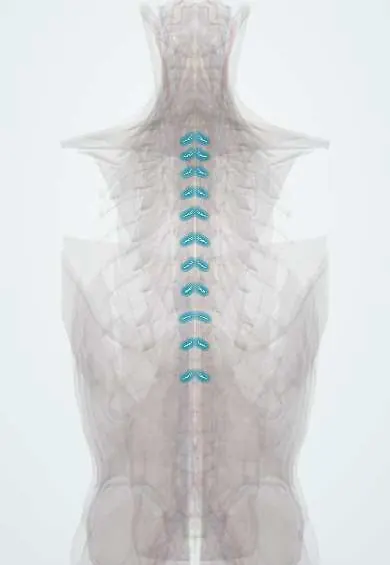
Mid-back nerve roots !
The thoracic nerve roots leave the mid-back spine and become the intercostal nerves, giving feeling in bands around the chest and abdomen.
Official name: Anterior root of spinal nerve
Opens in the Durgical app, no sign-up needed.
What it is
The nerve roots of the mid-back, which become the intercostal nerves running along the ribs.
What it does
Carry movement for the chest wall and sensation in bands around the chest and abdomen.
Key facts
- Roots
- T1–T12; each exits below its numbered vertebra; ventral rami form intercostal nerves (T12: subcostal)
- Moves
- Intercostal muscles; anterolateral abdominal wall (T7–T12); deep back muscles via dorsal rami; T1 to hand via brachial plexus
- Feeling from
- Bands around trunk: T4 nipple, T10 umbilicus, T12 suprapubic; T1 medial arm/forearm
Relations
- Course
- Each root runs a short way down the canal and leaves below its own pedicle; the ventral ramus enters the intercostal space and the dorsal ramus turns back to the deep back muscles and skin
- In front
- The disc, the vertebral body and the head of the rib at the costovertebral joint
- Behind
- The facet joint and lamina
- Lateral
- The sympathetic trunk, in front of the rib heads, linked to each nerve by white and grey rami communicantes
How to find it
They cannot be felt. Each one leaves the canal under the pedicle of the vertebra with the same number and continues as the intercostal nerve below the rib of that number; in a costotransversectomy the intercostal nerve is followed back medially to find the root and its foramen.
Examination
- ISNCSCI sensory points on the trunk lie in the midclavicular line, one per segment; there are no thoracic key muscles, so the motor level there is taken from the sensory level
- Beevor sign: lifting the head from lying flat makes the umbilicus move up when the abdominal muscles below T10 are weak
- Superficial abdominal reflexes (T8–T12): stroking each quadrant pulls the umbilicus toward it; loss on one side suggests an upper motor neuron or thoracic root lesion
On imaging
Roots are not seen on radiographs. MRI shows thoracic disc herniations and cord compression; level counting is hard here, so a whole-spine scout with rib counting is used. CT shows the calcified discs typical of this region. A nerve sheath tumour widens the foramen on radiographs or CT and appears on MRI as a dumbbell mass inside and outside the canal.
Common problems
- Pinching is uncommon; shingles often follows one of these nerves as a painful band of rash.
How it is diagnosed
Exam of strength, reflexes and feeling in the arm (each root has its own pattern); MRI; sometimes nerve tests (EMG).
Treatment
- Treated according to the cause.
Clinical notes
- Diabetic thoracic radiculopathy (truncal neuropathy): band-like burning pain and sometimes a bulge of the weakened abdominal wall
- Thoracic discs are approached from the side (costotransversectomy, transthoracic or thoracoscopic routes) rather than by laminectomy alone, to avoid retracting the cord
- A T1 root lesion weakens the small hand muscles and may come with Horner syndrome, as in a Pancoast tumour at the lung apex
Related conditions
Test yourself
Think of the answer, then tap the question to see it.
Which thoracic dermatomes mark the nipple, umbilicus and suprapubic region?
T4 at the nipple, T10 at the umbilicus and T12 suprapubic.
What is Beevor sign?
On lifting the head from lying flat, the umbilicus moves up because the abdominal muscles below T10 are weak.
Why can thoracic radiculopathy be mistaken for visceral disease?
It causes band-like pain around the chest or abdomen that can mimic heart, gallbladder or kidney disease.
Why is thoracic disc herniation uncommon, and what can it cause?
The rib cage limits movement; when it happens it can press on the spinal cord as well as the root, giving myelopathy.
Educational information, not medical advice. For any symptom, see a health professional.
Its names
- Official Latin (TA2)
- radix anterior nervi spinalis; radix posterior nervi spinalis; nervi thoracici TA2 6145
- Official Spanish (DeCS)
- Raíces nerviosas espinales DeCS D013126
- English (TA2)
- Anterior root of spinal nerve
- Also called
- motor root of spinal nerve · ventral root of spinal nerve · sensory root of spinal nerve · dorsal root of spinal nerve · spinal nerves T1-T12
Related
Sources: Terminologia Anatomica (TA2); DeCS; Neuroanatomy, Spinal Nerves.
Spotted a mistake?We are always improving for the community. Tell us what is wrong and our team will review it.Report a mistake
Representative model, for educational purposes only.