Guillain-Barré syndrome !
Guillain-Barré syndrome is an immune attack on the nerves, often after an infection; it causes fast-spreading weakness that starts in the legs.
Updated 2026-10-30
Structures involved
Tap one to see what it is and open it in 3D.
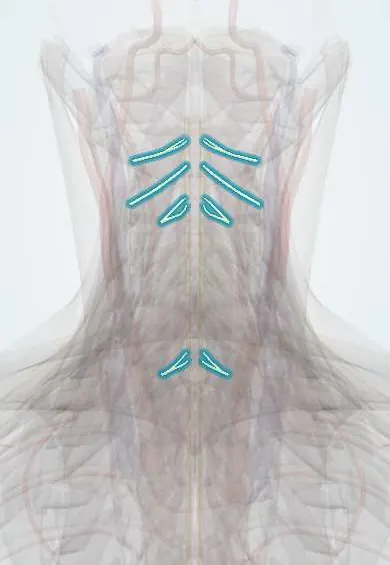
- Neck nerve roots
- Mid-back nerve roots
- Cauda equina
- Dorsal root ganglia
- Diaphragm
- Intercostal nerves
- Vagus nerve
- Sciatic nerve
- Femoral nerve
- Dura (dural sac)
Microorganisms that cause it
In immunology
- Molecular mimicry and post-infectious autoimmunity
- Events after vaccination (ESAVI) and how they are reported
In histology
- Glial cells: astrocytes, oligodendrocytes, microglia, Schwann cells
- Peripheral nerve: endoneurium, perineurium, epineurium; myelin
- Neuromuscular junction: motor end plate and acetylcholine receptors
In embryology
In the clinical exam
- Motor examination: bulk, tone and strength grading
- Deep tendon reflexes and their grading
- Upper vs lower motor neuron syndrome
In physiology
- Impulse conduction and myelin
- Upper versus lower motor neuron lesions
- Mechanics of breathing: pressures and muscles
- Hypoxemic and hypercapnic respiratory failure
Why it happens
What it is
Acute immune-mediated polyradiculoneuropathy that causes rapidly progressive, usually symmetrical weakness with loss of reflexes, often after an infection.
Who gets it
The most common cause of acute flaccid paralysis worldwide, at any age, slightly more in men. Cases rose in Latin America during the Zika epidemic: in Colombia, 453 Zika-associated cases were reported from October 2015 to June 2017 (41.9 per 10,000 Zika cases). The axonal form is relatively more common in Latin America and Asia.
Causes
- Preceding infection in most patients: Campylobacter jejuni diarrhoea, respiratory infections, cytomegalovirus, Epstein-Barr virus
- Arboviruses such as Zika
- Rarely after vaccination or surgery
Risk factors
- Recent gastrointestinal or respiratory infection
- Recent Zika infection
- Older age
Pathophysiology
Antibodies made against an infection cross-react with gangliosides and myelin in peripheral nerves and roots (molecular mimicry). Complement and macrophages damage the myelin (demyelinating form) or the axon itself (axonal form). Involvement of nerve roots raises protein in the cerebrospinal fluid.
Classification
- Acute inflammatory demyelinating polyneuropathy (AIDP)
- Acute motor axonal neuropathy (AMAN) and acute motor and sensory axonal neuropathy (AMSAN), often after Campylobacter
- Miller Fisher syndrome: ophthalmoplegia, ataxia and areflexia, with anti-GQ1b antibodies
Symptoms and signs
- Ascending, symmetrical weakness that starts in the legs, reaching its worst within four weeks
- Reduced or absent tendon reflexes (areflexia)
- Tingling of the hands and feet, with little objective sensory loss
- Back or limb pain, often early
- Facial weakness (often both sides) and swallowing problems
- Autonomic dysfunction: swings in blood pressure, arrhythmias, urinary retention
- Breathing muscle weakness
Diagnosis
- Clinical
- Progressive weakness of more than one limb with reduced reflexes, reaching its worst within four weeks, with other causes excluded; Brighton or NINDS criteria guide the diagnosis.
- Tests
- Lumbar puncture: albuminocytologic dissociation (high protein with a normal cell count), often normal in the first week. Nerve conduction studies show demyelinating or axonal patterns. Spirometry (vital capacity) and ECG; antiganglioside antibodies in some variants; Zika testing when relevant.
- Imaging
- Spine MRI is not needed for diagnosis but helps exclude cord compression and may show enhancement of the nerve roots and cauda equina.
Differential diagnosis
- Acute spinal cord compression or transverse myelitis
- Myasthenia gravis
- Botulism
- Hypokalaemia and other electrolyte disorders
- Critical illness neuropathy or myopathy
- Chronic inflammatory demyelinating polyneuropathy (CIDP)
Goal of treatment
Support breathing and autonomic function during the acute phase, shorten the disease with immunotherapy, prevent complications and restore function.
Treatment
- Follow-up
- Admission with close monitoring of vital capacity, swallowing, heart rhythm and blood pressure; ICU and mechanical ventilation when breathing fails (criteria such as the 20/30/40 rule guide this).
- Medical
- Intravenous immunoglobulin (IVIG), in patients who cannot walk unaided, ideally within the first two weeks. Corticosteroids alone are not effective.
- Procedure
- Plasma exchange, equally effective as IVIG; the two are not usually combined.
- Acute
- Supportive care: venous thrombosis prevention, pain control, bladder and bowel care, nutrition, pressure sore prevention and psychological support.
- Rehabilitation
- Early and prolonged rehabilitation with physiotherapy and occupational therapy.
Complications
- Respiratory failure
- Autonomic instability and arrhythmias
- Deep vein thrombosis and pulmonary embolism
- Aspiration pneumonia
- Chronic pain, fatigue and residual weakness
Prognosis
Most patients recover, many fully, over weeks to months; a minority are left with major disability and a small proportion die, mainly from respiratory or autonomic complications. Older age, preceding diarrhoea and severe weakness predict worse outcomes (Erasmus GBS outcome score).
Test yourself
Think of the answer, then tap the question to see it.
What is the classic CSF finding in Guillain-Barré syndrome?
Albuminocytologic dissociation: high protein with a normal cell count. It may be normal in the first week.
What is the typical pattern of weakness in Guillain-Barré syndrome?
Ascending, symmetrical flaccid weakness starting in the legs, with absent or reduced reflexes, reaching its worst within four weeks.
Which two treatments are effective in Guillain-Barré syndrome?
Intravenous immunoglobulin and plasma exchange, which are similarly effective. Corticosteroids alone do not help.
Which infection most often precedes the axonal form of Guillain-Barré syndrome?
Campylobacter jejuni gastroenteritis.
What triad defines Miller Fisher syndrome?
Ophthalmoplegia, ataxia and areflexia, usually with anti-GQ1b antibodies.
Related conditions
Educational information, not medical advice. For any symptom, see a health professional.
Sources: Guillain-Barre Syndrome (StatPearls (NCBI Bookshelf), 2026); Zika virus disease, microcephaly and Guillain-Barré syndrome in Colombia: epidemiological situation during 21 months of the Zika virus outbreak, 2015-2017 (Archives of public health, 2017) · adapted, CC BY 4.0.
Spotted a mistake?We are always improving for the community. Tell us what is wrong and our team will review it.Report a mistake
Representative model, for educational purposes only.