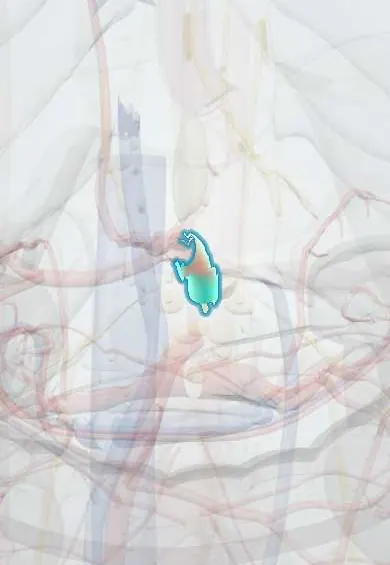
Cardiovascular system · Abdomen
Celiac trunk !
The celiac trunk is a short, wide artery from the aorta that splits into three to feed the stomach, liver, spleen and part of the pancreas.
Opens in the Durgical app, no sign-up needed.
What it is
A short, wide branch from the front of the aorta just below the diaphragm (at T12), splitting into the left gastric, common hepatic and splenic arteries.
What it does
Supplies the stomach, liver, gallbladder, spleen and part of the pancreas and duodenum.
Key facts
- Origin
- Anterior abdominal aorta at T12, just below the aortic hiatus
- Branches
- Left gastric, splenic and common hepatic arteries
- Supplies
- Foregut: lower esophagus to duodenum at major papilla; liver, gallbladder, spleen, part of pancreas
Relations
- Course
- Leaves the front of the aorta as the aorta emerges from the aortic hiatus, runs forward for only a centimetre or two above the upper border of the pancreas and divides behind the lesser sac
- Above
- Median arcuate ligament and the crura of the diaphragm; the caudate lobe of the liver lies above and to the right
- Below
- Upper border of the pancreas and the splenic vein; the superior mesenteric artery leaves the aorta just below
- In front
- Lesser sac (omental bursa) and the lesser omentum, with the stomach in front of them
- Lateral
- The celiac ganglia and celiac plexus surround it on both sides; the right and left crura of the diaphragm lie lateral and behind
How to find it
Too deep to feel: it lies in the epigastrium a little above the transpyloric plane. On a transverse ultrasound of the upper abdomen, the common hepatic and splenic arteries branching from it look like a bird with spread wings (the seagull sign).
On imaging
CT angiography with sagittal reformats shows the celiac trunk and superior mesenteric artery leaving the aorta one above the other; a hooked, narrowed celiac origin that worsens in expiration suggests median arcuate ligament compression. Doppler ultrasound measures flow velocity at its origin.
Common problems
- Abdominal aortic aneurysm (AAA): a silent widening, more common in older men who smoke; rupture is life-threatening.
How it is diagnosed
Ultrasound screening; CT.
Treatment
- Monitoring of small aneurysms; repair with a stent-graft through the groin arteries or open surgery for large ones.
Clinical notes
- Median arcuate ligament syndrome (Dunbar syndrome): pain after meals, weight loss and an epigastric bruit from compression of the trunk; a diagnosis of exclusion, treated by dividing the ligament
- Celiac plexus block or neurolysis, guided by CT or endoscopic ultrasound at the level of the trunk, is used for the pain of pancreatic cancer
- When the celiac origin is narrowed, the liver and stomach can fill backwards from the superior mesenteric artery through the gastroduodenal artery; this flow is checked before the gastroduodenal artery is tied in a pancreatoduodenectomy
Anatomical variants
- Two branches instead of three, for example a hepatosplenic trunk with the left gastric artery arising separately
- Celiacomesenteric trunk: the celiac trunk and superior mesenteric artery share a single origin (rare); one stenosis there can threaten both territories
- The inferior phrenic arteries may arise from it instead of from the aorta
Development
It comes from one of the ventral (vitelline) branches of the dorsal aorta; persistence of the longitudinal channel that briefly links these branches explains the celiacomesenteric trunk.
Memory aid
Its three branches: Left Hand Side (Left gastric, Hepatic, Splenic).
Related conditions
Test yourself
Think of the answer, then tap the question to see it.
At what level does the celiac trunk arise, and what are its three branches?
From the front of the aorta at T12, just below the aortic hiatus; it divides into the left gastric, common hepatic and splenic arteries.
Which territory does the celiac trunk supply, and where is pain from it felt?
The foregut: lower esophagus to the duodenum at the major papilla, plus liver, gallbladder, spleen and part of the pancreas; foregut pain is felt in the epigastrium.
What is median arcuate ligament syndrome?
Compression of the celiac trunk by a low median arcuate ligament: pain after meals, weight loss and an epigastric bruit; a diagnosis of exclusion, treated by dividing the ligament.
Why is slow narrowing of the celiac trunk usually silent?
The pancreaticoduodenal arcades link it to the superior mesenteric artery, so the liver and stomach can fill from that side.
What is the seagull sign on ultrasound?
On a transverse view of the upper abdomen, the common hepatic and splenic arteries branching from the celiac trunk look like a bird with spread wings.
Educational information, not medical advice. For any symptom, see a health professional.
Its names
- Official Latin (TA2)
- truncus coeliacus TA2 4211
- Official Spanish (DeCS)
- Arteria celíaca DeCS D002445
- English (TA2)
- Celiac trunk
- Also called
- celiac artery · arteria coelica · arteria celiaca · Haller's tripus
Related
Sources: Terminologia Anatomica (TA2); DeCS; Anatomy, Abdomen and Pelvis: Celiac Trunk.
Spotted a mistake?We are always improving for the community. Tell us what is wrong and our team will review it.Report a mistake
Representative model, for educational purposes only.