Cardiovascular system · Lower limb
Fibular artery !
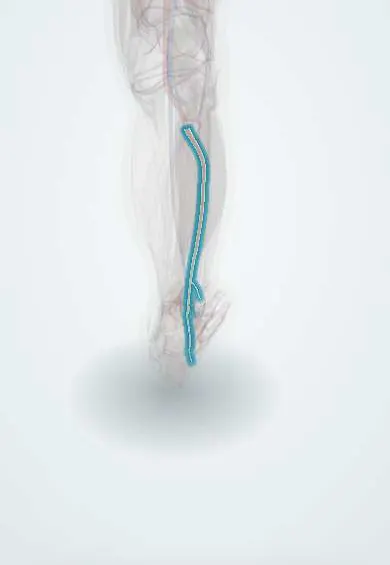
The fibular artery is a branch of the posterior tibial artery that runs along the fibula, deep in the back of the leg.
Opens in the Durgical app, no sign-up needed.
What it is
A branch of the posterior tibial artery that runs deep along the fibula.
What it does
Supplies the muscles on the outer and back parts of the leg and the fibula.
Key facts
- Origin
- Posterior tibial artery, about 2–3 cm below popliteus
- Branches
- Muscular, nutrient artery of fibula, perforating, communicating and lateral calcaneal branches
- Supplies
- Lateral and deep posterior leg muscles, fibula, lateral ankle and heel
Relations
- Course
- Leaves the posterior tibial artery below the popliteus, runs down and laterally to the fibula and descends along its medial crest, between the tibialis posterior and flexor hallucis longus or within the latter, ending behind the lateral malleolus in calcaneal branches
- Lateral
- The fibula, which receives its nutrient artery
- Superficial
- The soleus and flexor hallucis longus
- Deep
- The tibialis posterior and the interosseous membrane
How to find it
Not palpable. In flap harvest it is reached from the lateral side of the leg, behind the fibula, between the lateral and posterior compartments; CT angiography shows it running alongside the fibula.
Examination
- Before a fibula flap, the ankle pulses and their Doppler signals are checked; weak or absent signals raise concern that the foot depends on this artery
On imaging
With no pulse of its own it is judged on imaging: CT or catheter angiography before a fibula flap confirms that both tibial arteries reach the foot, and duplex can follow it along the back of the fibula.
Clinical notes
- The fibula flap can carry a skin paddle on small perforators from this artery that run in the posterior crural septum
- Because three arteries feed the leg, losing the fibular artery alone is usually tolerated, unless it is the dominant artery of the foot
Anatomical variants
- Peroneal magnus: in up to about 5% it is the dominant supply of the foot, replacing a small or absent posterior or anterior tibial artery; harvesting it would then endanger the foot
- May arise from the anterior tibial artery, or straight from the popliteal artery as part of a trifurcation
Development
It keeps part of the path of the embryonic axial (sciatic) artery, the limb's first main vessel, later replaced by the femoral system. Rarely the sciatic artery persists and tends to form aneurysms.
Related conditions
Test yourself
Think of the answer, then tap the question to see it.
Where does the fibular artery arise, and where does it run?
From the posterior tibial artery about 2–3 cm below the popliteus; it descends along the medial crest of the fibula.
Which major reconstructive flap is based on the fibular artery?
The free fibula flap, the main bone flap for rebuilding the jaw.
Which branch of the fibular artery can replace a missing dorsalis pedis artery?
The perforating branch, which pierces the interosseous membrane above the lateral malleolus.
What is a «peroneal magnus», and why does it matter?
A fibular artery that is the dominant supply of the foot; harvesting it for a flap would endanger the foot.
Which embryonic vessel survives in part as the fibular artery?
The axial (sciatic) artery, the first main artery of the lower limb.
Educational information, not medical advice. For any symptom, see a health professional.
Its names
- Official Latin (TA2)
- arteria fibularis TA2 4727
- Official Spanish (DeCS)
- Arteria fibular
- English (TA2)
- Fibular artery
- Also called
- peroneal artery
Related
Sources: Terminologia Anatomica (TA2); Anatomy, Bony Pelvis and Lower Limb: Peroneal Artery; 20.5 Circulatory Pathways (OpenStax (Rice University), 2022) · adapted, CC BY 4.0; Anatomy of the Human Body (20th ed.): The Arteries of the Lower Extremity (Lea & Febiger (Gray's Anatomy, 1918), 1918) · adapted, Public domain.
Spotted a mistake?We are always improving for the community. Tell us what is wrong and our team will review it.Report a mistake
Representative model, for educational purposes only.