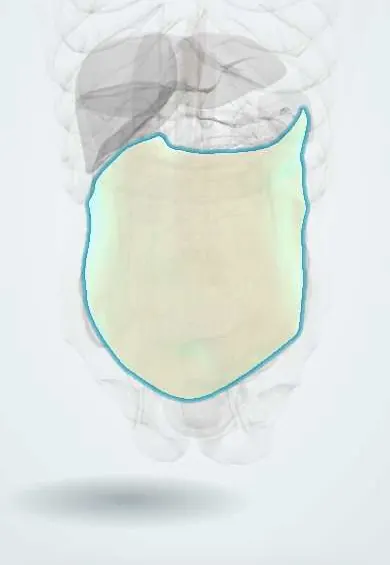
Greater omentum !
The greater omentum is a fatty apron of peritoneum hanging from the stomach over the intestines; it moves to wall off infection and inflammation.
Opens in the Durgical app, no sign-up needed.
What it is
An apron of fatty peritoneum hanging from the stomach over the intestines.
What it does
Stores fat and moves to wall off infections (the 'abdominal policeman'); the first thing seen when the abdomen is opened.
Key facts
- Where
- Four-layered apron hanging from greater curvature of stomach over transverse colon and small intestine
- Attaches
- Greater curvature and first part of duodenum; posterior layers fuse with transverse colon; includes gastrocolic, gastrosplenic and gastrophrenic ligaments
- Function
- Stores fat; immune milky spots; adheres to and walls off inflammation ('abdominal policeman'); carries gastroepiploic vessels
Relations
- Above
- Greater curvature of the stomach and the first part of the duodenum; to the left it continues as the gastrosplenic ligament
- Behind
- Transverse colon and transverse mesocolon, then coils of small intestine
- In front
- Parietal peritoneum of the anterior abdominal wall
- Contents
- Right and left gastroepiploic (gastro-omental) vessels along the greater curvature, fat, lymph nodes and milky spots
How to find it
At laparotomy it lies in front of the bowel; lifting it upward with the transverse colon exposes the small intestine. In appendicitis or a perforation, the place where it is stuck often marks the source.
On imaging
On CT, nodular or sheet-like thickening of the fat under the anterior abdominal wall (omental cake) suggests peritoneal carcinomatosis. Omental infarction shows a fatty mass with stranding, usually on the right, and can mimic appendicitis.
Common problems
- Peritonitis: infection or inflammation, usually from a burst organ (appendix, ulcer); severe pain and a rigid abdomen. An emergency.
How it is diagnosed
Examination, blood tests, CT.
Treatment
- Treat the source (often surgery) and antibiotics.
Clinical notes
- Omental patch (Graham patch): a tongue of omentum is sewn over a perforated duodenal ulcer
- Omental flap: based on a gastroepiploic artery, it can be moved to fill chest or infected sternal wounds
- Omentectomy is part of the staging and debulking surgery for ovarian cancer
Development
It develops from the dorsal mesogastrium, which grows to the left and downward as the stomach rotates, folding over the transverse colon.
Related conditions
Test yourself
Think of the answer, then tap the question to see it.
Why is the greater omentum called the «abdominal policeman»?
It moves toward and sticks to inflamed areas, walling off appendicitis or a perforation; it is short and less effective in young children.
Which vessels run in the greater omentum?
The right and left gastroepiploic (gastro-omental) vessels along the greater curvature of the stomach.
What is an «omental cake» on CT?
Nodular or sheet-like thickening of the greater omentum from peritoneal metastases, especially from ovarian and gastric cancer.
Educational information, not medical advice. For any symptom, see a health professional.
Its names
- Official Latin (TA2)
- omentum majus TA2 3757
- Official Spanish (DeCS)
- Omento mayor DeCS D009852
- English (TA2)
- Greater omentum
Related
Sources: Terminologia Anatomica (TA2); DeCS; Anatomy, Abdomen and Pelvis, Peritoneum.
Spotted a mistake?We are always improving for the community. Tell us what is wrong and our team will review it.Report a mistake
Representative model, for educational purposes only.