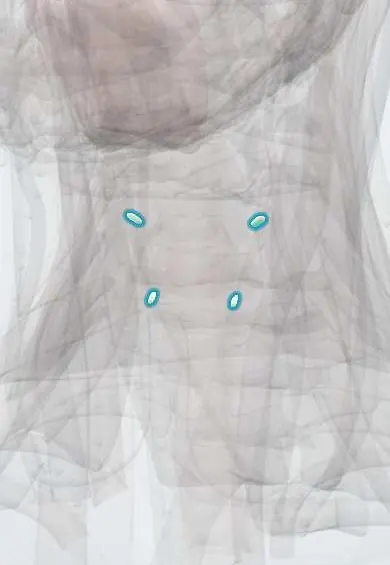
Primary hyperparathyroidism !
Primary hyperparathyroidism is when a parathyroid gland, usually a benign tumour, makes too much hormone and raises blood calcium.
Updated 2026-10-29
Structures involved
Tap one to see what it is and open it in 3D.
In biochemistry
In histology
In physiology
- Calcium regulation: PTH, vitamin D and calcitonin
- Bone remodeling
- Phosphate and FGF-23
- Renal handling of calcium, phosphate and magnesium
Why it happens
- Pathologic calcification: dystrophic vs metastatic
- Hereditary cancer syndromes: the table to know
- Frozen section: the intraoperative consultation
- Hyperplasia: physiologic and pathologic
What it is
Excess parathyroid hormone made by one or more parathyroid glands, usually a single benign adenoma, causing high blood calcium.
Who gets it
A common cause of hypercalcaemia in outpatients, most often found by chance on routine blood tests; more frequent in postmenopausal women.
Causes
- Single parathyroid adenoma (most cases)
- Hyperplasia of all four glands (including MEN 1 and MEN 2A)
- Parathyroid carcinoma (rare)
Risk factors
- Female sex and older age
- Neck irradiation
- Long-term lithium therapy
- Inherited syndromes (MEN 1, MEN 2A)
Pathophysiology
Autonomous PTH secretion raises calcium by increasing bone resorption, renal calcium reabsorption and vitamin D activation (more intestinal absorption). PTH also lowers renal phosphate reabsorption. The calcium load filtered by the kidney rises, favouring stones, and bone loss affects cortical bone most.
Classification
- Hypercalcaemic (classic)
- Normocalcaemic
- Symptomatic versus asymptomatic
Symptoms and signs
- Often none (found on routine tests)
- Kidney stones and polyuria
- Bone pain and fractures from osteoporosis
- Abdominal pain, constipation, nausea, peptic ulcer or pancreatitis
- Fatigue, depression and difficulty concentrating
Diagnosis
- Clinical
- History of stones, fractures and medicines (thiazides, lithium); family history.
- Tests
- High calcium with high or inappropriately normal PTH; phosphate, creatinine, 25-hydroxy vitamin D and 24-hour urine calcium (to exclude familial hypocalciuric hypercalcaemia); ECG may show a short QT.
- Imaging
- Bone densitometry and renal imaging assess end-organ effects; neck ultrasound and sestamibi scan localise the gland before surgery (they do not make the diagnosis).
Differential diagnosis
- Hypercalcaemia of malignancy (low PTH)
- Familial hypocalciuric hypercalcaemia
- Thiazide- or lithium-associated hypercalcaemia
- Vitamin D excess or granulomatous disease
- Secondary or tertiary hyperparathyroidism
Goal of treatment
Cure the excess PTH where indicated and protect bones and kidneys.
Treatment
- Surgical
- Parathyroidectomy, often a focused removal of a localised adenoma; the only cure.
- Medical
- Calcimimetics to lower calcium, and bisphosphonates to protect bone, when surgery is not done.
- Acute
- Hypercalcaemic crisis: intravenous fluids, then drugs that reduce bone resorption, in hospital.
- Follow-up
- Regular calcium, renal function and bone density in patients managed without surgery.
Complications
- Kidney stones and nephrocalcinosis
- Osteoporosis and fractures (osteitis fibrosa cystica in severe disease)
- Pancreatitis and peptic ulcer
- Hypocalcaemia after surgery (hungry bone syndrome)
Prognosis
Surgery by an experienced surgeon cures most patients and improves bone density and stone risk. Many mild cases stay stable under follow-up.
Test yourself
Think of the answer, then tap the question to see it.
What is the most common cause of primary hyperparathyroidism?
A single parathyroid adenoma.
What is the classic laboratory pattern?
High calcium, high or inappropriately normal PTH and low or low-normal phosphate.
Which condition is excluded with a 24-hour urine calcium?
Familial hypocalciuric hypercalcaemia, where urine calcium is low.
Which mnemonic summarises its symptoms?
Stones, bones, abdominal groans and psychiatric moans.
Does a sestamibi scan diagnose primary hyperparathyroidism?
No; the diagnosis is biochemical. Imaging only localises the gland before surgery.
Related conditions
Educational information, not medical advice. For any symptom, see a health professional.
Sources: Primary Hyperparathyroidism (StatPearls (NCBI Bookshelf), 2026).
Spotted a mistake?We are always improving for the community. Tell us what is wrong and our team will review it.Report a mistake
Representative model, for educational purposes only.