Nervous system · Head and neck
Olfactory nerve (I) !
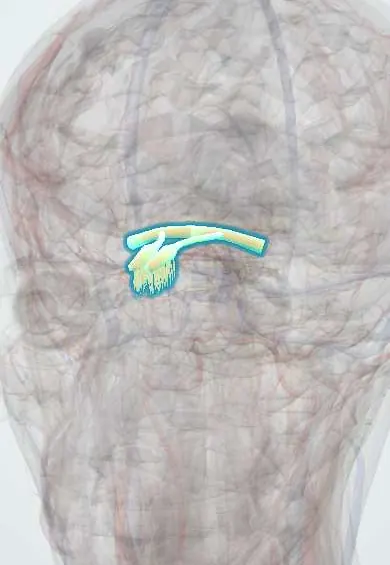
The olfactory nerve (cranial nerve I) carries smell from the roof of the nose to the brain; it is often damaged by head injury or viral infections.
Official name: Olfactory nerve
Opens in the Durgical app, no sign-up needed.
What it is
Fine nerve threads from the roof of the nose through the cribriform plate to the olfactory bulb.
What it does
Smell; often lost after head injury or viral infections.
Key facts
- Roots
- Olfactory epithelium -> olfactory bulb (no brainstem nucleus); passes the cribriform plate
- Moves
- None
- Feeling from
- Smell
Relations
- Course
- From the olfactory epithelium (roof of the nasal cavity, upper nasal septum and superior concha), about 20 bundles cross the cribriform plate of the ethmoid bone to the olfactory bulb, which continues back as the olfactory tract
- Above
- The bulb and tract lie in the olfactory sulcus under the frontal lobe, beside the gyrus rectus
- Below
- Roof of the nasal cavity, separated from the anterior cranial fossa only by the thin cribriform plate
How to find it
It cannot be felt. The olfactory mucosa lines the roof of the nasal cavity, the upper septum and the superior concha (olfactory cleft); its fibres rise through the cribriform plate, so endoscopic sinus surgery treats this area with care.
Examination
- Each nostril is tested separately, eyes closed, with a familiar non-irritating smell (coffee, soap); irritants such as ammonia stimulate the trigeminal nerve rather than smell
- Standardised smell identification tests (scratch-and-sniff odours) give a score that separates reduced from absent smell
On imaging
Coronal MRI of the anterior skull base shows the olfactory bulbs and sulci, which are small or absent in Kallmann syndrome; thin-slice CT shows cribriform plate fractures and the site of a CSF leak.
Clinical notes
- Post-viral loss of smell (common colds, COVID-19) may recover over months; distorted smells (parosmia) often appear during recovery
- Olfactory groove meningioma: slow, often unnoticed anosmia; it may cause optic atrophy on one side and papilloedema on the other (Foster Kennedy syndrome)
- Kallmann syndrome: anosmia with hypogonadotropic hypogonadism (delayed puberty)
- Skull base surgery and endoscopic sinus surgery near the cribriform plate risk a CSF leak and loss of smell
Anatomical variants
- The depth of the olfactory fossa varies (Keros types 1 to 3); when it is deep, the thin lateral lamella of the cribriform plate is tall and easier to breach in ethmoid surgery, with a risk of CSF leak
Development
Comes from the olfactory placode; the GnRH-producing neurons migrate along the olfactory nerve into the forebrain, which is why their failure in Kallmann syndrome comes with anosmia.
Related conditions
Test yourself
Think of the answer, then tap the question to see it.
Through which bone plate do the filaments of the olfactory nerve (I) pass, and what does a head injury there cause?
The cribriform plate of the ethmoid; shearing of the filaments gives anosmia, sometimes with CSF leaking from the nose.
How does the smell pathway of the olfactory nerve differ from the other senses on its way to the cortex?
It reaches the cortex (piriform cortex, amygdala, entorhinal area) without first relaying in the thalamus.
How is the olfactory nerve tested at the bedside, and why is ammonia avoided?
Each nostril separately, eyes closed, with a familiar non-irritating smell; irritants like ammonia stimulate the trigeminal nerve, not smell.
Which syndrome combines anosmia with hypogonadotropic hypogonadism?
Kallmann syndrome: loss of smell with delayed puberty from hypogonadotropic hypogonadism.
Educational information, not medical advice. For any symptom, see a health professional.
Its names
- Official Latin (TA2)
- nervus olfactorius TA2 6181
- Official Spanish (DeCS)
- Nervio Olfatorio DeCS D009832
- English (TA2)
- Olfactory nerve
- Also called
- cranial nerve I · nervi olfactorii · fila olfactoria · olfactory nerves · olfactory fibre bundles · olfactory fiber bundles
Related
Sources: Terminologia Anatomica (TA2); DeCS; Neuroanatomy, Cranial Nerve 1 (Olfactory); Anatomy of the Human Body (20th ed.): Composition and Central Connections of the Spinal Nerves (Lea & Febiger (Gray's Anatomy, 1918), 1918) · adapted, Public domain.
Spotted a mistake?We are always improving for the community. Tell us what is wrong and our team will review it.Report a mistake
Representative model, for educational purposes only.