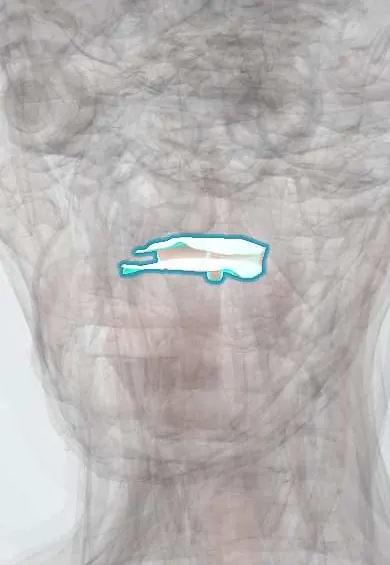
Digestive system · Head and neck
Soft palate !
The soft palate is the muscular back part of the roof of the mouth, ending in the uvula; it rises to close off the nose when swallowing and speaking.
Opens in the Durgical app, no sign-up needed.
What it is
The muscular back part of the roof of the mouth, ending in the uvula.
What it does
Rises to close off the nose when swallowing and speaking.
Key facts
- Where
- Back of the roof of the mouth, ending in the uvula
- Blood supply
- Lesser palatine, ascending palatine arteries
- Nerve
- Motor X (tensor veli palatini: V3); sensory V2
- Function
- Closes the nasopharynx when swallowing and speaking; uvula deviates away from a vagus lesion
Relations
- In front
- Hard palate: the palatine aponeurosis attaches to the back edge of the palatine bone
- Above
- Nasopharynx, with the openings of the auditory tubes and the adenoids
- Below
- Oral cavity and the dorsum of the tongue
- Lateral
- Palatoglossal and palatopharyngeal arches running down to the tongue and the pharyngeal wall, with the palatine tonsil between them
How to find it
With the mouth open and the tongue held down, saying 'aah' lifts the soft palate; it should rise evenly with the uvula in the midline.
Examination
- Saying 'aah': in a one-sided vagus nerve lesion the palatal arch droops on the weak side and does not rise
- Gag reflex, tested on each side: an absent response on one side suggests a lesion of the glossopharyngeal or vagus nerve
On imaging
On a lateral neck radiograph and sagittal MRI it is the soft-tissue band hanging back from the hard palate. Videofluoroscopy or nasendoscopy watch it rise against the back wall of the pharynx; a gap during speech or swallowing (velopharyngeal insufficiency) lets air or contrast into the nasopharynx. Contrast CT shows a peritonsillar abscess pushing into it, and MRI stages tumours here.
Clinical notes
- Cleft palate: feeding problems with milk coming out of the nose, hypernasal speech and middle ear effusions; repaired in infancy by a cleft team
- Submucous cleft: bifid uvula, a notch at the back of the hard palate and a thin bluish midline; recognising it matters before adenoidectomy, which can unmask nasal speech
- Velopharyngeal insufficiency after cleft repair or adenoidectomy causes hypernasal speech and nasal air escape
Anatomical variants
- A bifid uvula on its own is a common and usually harmless finding; it matters when it comes with the other signs of a submucous cleft
Development
The palatal shelves grow toward the midline and fuse from front to back with the primary palate and the nasal septum; the uvula fuses last, so a bifid uvula is the mildest form of cleft.
Related conditions
- Peritonsillar abscess
- Obstructive sleep apnoea
- Cleft lip and palate
- Trisomy 18 (Edwards) and trisomy 13 (Patau)
Test yourself
Think of the answer, then tap the question to see it.
What is the motor nerve supply of the soft palate, and which muscle is the exception?
The vagus nerve (X) via the pharyngeal plexus; the tensor veli palatini is supplied by the mandibular nerve (V3).
What are the afferent and efferent limbs of the gag reflex?
Afferent: glossopharyngeal nerve (IX) from the back of the tongue or pharynx; efferent: vagus nerve (X), which raises the soft palate and squeezes the pharynx.
Which way does the uvula deviate in a one-sided vagus nerve lesion?
Away from the lesion: the palatal arch droops on the weak side and does not rise on saying «aah».
Why are middle ear effusions common in cleft palate?
The tensor veli palatini, which opens the auditory tube when swallowing, works poorly in cleft palate.
What are the signs of a submucous cleft palate, and why do they matter before adenoidectomy?
Bifid uvula, a notch at the back of the hard palate and a thin bluish midline; adenoidectomy can unmask hypernasal speech.
Educational information, not medical advice. For any symptom, see a health professional.
Its names
- Official Latin (TA2)
- palatum molle TA2 2780
- Official Spanish (DeCS)
- Paladar Blando DeCS D010160
- English (TA2)
- Soft palate
- Also called
- velum
Related
Sources: Terminologia Anatomica (TA2); DeCS; Anatomy, Head and Neck, Palate; Anatomy, Head and Neck, Tensor Veli Palatini Muscle.
Spotted a mistake?We are always improving for the community. Tell us what is wrong and our team will review it.Report a mistake
Representative model, for educational purposes only.