Conditions · Metabolism: amino acids and the urea cycle
Alkaptonuria !
In alkaptonuria homogentisic acid builds up: urine darkens in air and, over the years, cartilage and joints become stained and worn.
Updated 2026-11-01
Structures involved
Tap one to see what it is and open it in 3D.
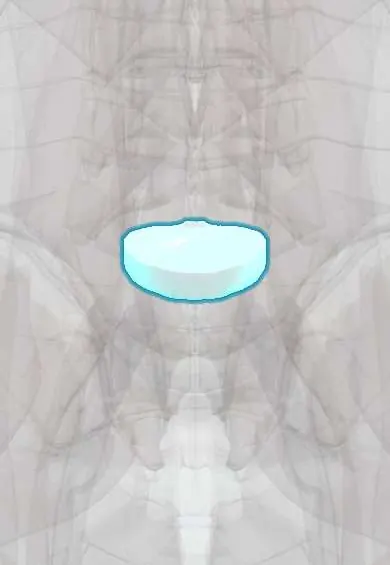
- L4–L5 disc
- Femoral cartilage
- L3–L4 disc
- L5–S1 disc
- Tibial cartilage
- Aortic right coronary cusp
- Aortic left coronary cusp
- Aortic non-coronary cusp
In biochemistry
- Phenylalanine and tyrosine metabolism: Step 4 · Homogentisate 1,2-dioxygenase (homogentisate oxidase, HGD)
- Tyrosine
Why it happens
What it is
An inherited disease from lack of homogentisate 1,2-dioxygenase. Homogentisic acid builds up, appears in urine and deposits in connective tissue (ochronosis).
Who gets it
Rare: between 1 in 250,000 and 1 in a million people in the United States. It is more common in parts of Slovakia and in the Dominican Republic.
Causes
- Variants in both alleles of the HGD gene (autosomal recessive)
Risk factors
- Carrier parents
- Consanguinity
Pathophysiology
In tyrosine breakdown, homogentisate is not opened. It builds up and oxidises to a melanin-like pigment that binds collagen. Stained cartilage becomes stiff and breaks up: arthropathy of the spine and large joints, valve calcification and stones.
Symptoms and signs
- Urine that darkens in air or nappies stained black
- Grey-blue pigment in the sclera and ear cartilage (from about age 30)
- Low back pain and spinal stiffness
- Early osteoarthritis of knees, hips and shoulders
Diagnosis
- Clinical
- Dark urine in childhood or early arthropathy with ochronotic pigment.
- Tests
- High urinary homogentisic acid; HGD gene testing.
- Imaging
- Spine X-ray: calcified, narrowed discs; echocardiography to assess the aortic valve.
Treatment
- Medical
- Nitisinone, which blocks an earlier step of the pathway and greatly lowers homogentisic acid
- Rehabilitation
- Physiotherapy and joint pain control
- Surgical
- Joint or aortic valve replacement when damage is advanced
- Lifestyle
- Lower protein intake (tyrosine and phenylalanine), especially when nitisinone is used
Complications
- Ochronotic arthropathy of spine and large joints
- Aortic stenosis
- Kidney and prostate stones
- Tendon ruptures
Prognosis
Life expectancy is usually normal, but arthropathy greatly limits mobility from middle age.
Test yourself
Think of the answer, then tap the question to see it.
Which enzyme is missing in alkaptonuria?
Homogentisate 1,2-dioxygenase, which opens the ring of homogentisate in tyrosine breakdown.
What is ochronosis?
Deposition of a dark pigment derived from homogentisic acid in cartilage, tendons, sclera and valves.
Which drug lowers homogentisic acid?
Nitisinone, which inhibits 4-hydroxyphenylpyruvate dioxygenase, an earlier step of the pathway.
Related conditions
- Tyrosinaemia type I (hepatorenal)
- Aortic Valve Stenosis
- Knee Osteoarthritis
- Kidney stones (urolithiasis)
Educational information, not medical advice. For any symptom, see a health professional.
Sources: Alkaptonuria: MedlinePlus Genetics (MedlinePlus, US National Library of Medicine, 2026); HGD gene: MedlinePlus Genetics (MedlinePlus, US National Library of Medicine, 2026); Tyrosine catabolism (Reactome, 2026).
Spotted a mistake?We are always improving for the community. Tell us what is wrong and our team will review it.Report a mistake
Representative model, for educational purposes only.