Conditions · Gastroenterology and hepatology
Ascites and spontaneous bacterial peritonitis !
Ascites is fluid in the abdomen, usually from cirrhosis. Spontaneous bacterial peritonitis is its infection without a perforation, and can be fatal.
Updated 2026-11-01
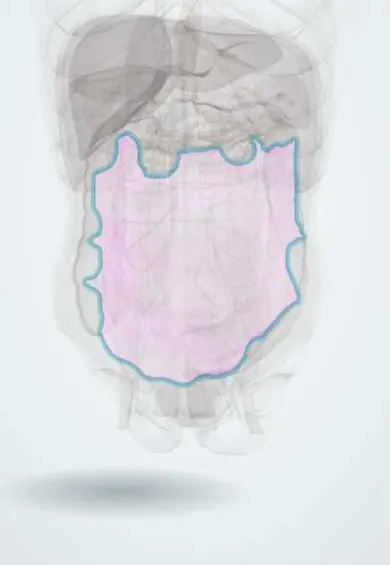
Structures involved
Tap one to see what it is and open it in 3D.
In the clinical exam
Why it happens
- Edema and effusions: the four mechanisms
- Splanchnic and portal circulation
- The renin–angiotensin–aldosterone system
- Starling forces at the capillary
- Serous membranes: pleura and peritoneum
What it is
Ascites is the accumulation of fluid in the peritoneal cavity, most often from portal hypertension in cirrhosis. Spontaneous bacterial peritonitis (SBP) is infection of that fluid with no surgically treatable intra-abdominal source, unlike secondary (surgical) peritonitis.
Who gets it
Ascites is the most common decompensating event in cirrhosis, and SBP occurs in a notable proportion of hospitalised patients with cirrhotic ascites. In Colombia and Latin America the underlying liver disease is mainly alcohol-related, metabolic or viral; tuberculous peritonitis remains an important alternative cause of ascites in the region.
Causes
- Cirrhosis with portal hypertension (most ascites)
- Other causes of ascites: heart failure, peritoneal carcinomatosis, tuberculous peritonitis, nephrotic syndrome, pancreatitis
- SBP organisms: mostly enteric gram-negative bacilli (Escherichia coli, Klebsiella), sometimes streptococci; usually a single organism
Risk factors
- Advanced cirrhosis (Child-Pugh C)
- Low ascitic fluid protein
- Previous episode of SBP
- Upper GI bleeding in a person with cirrhosis
- Proton pump inhibitor use (association reported)
Pathophysiology
Portal hypertension and splanchnic vasodilation reduce effective arterial volume, activating the renin-angiotensin-aldosterone and sympathetic systems, so the kidneys retain sodium and water that leaks into the peritoneum. In SBP, gut bacteria cross a leaky intestinal wall (bacterial translocation) and seed ascitic fluid, which has poor opsonic activity when its protein is low. The inflammatory response can precipitate kidney failure (hepatorenal syndrome).
Classification
- Ascites grade 1 (only on ultrasound), grade 2 (moderate distension), grade 3 (tense)
- Uncomplicated, refractory or complicated ascites
- Culture-positive SBP versus culture-negative neutrocytic ascites; bacterascites
- Secondary bacterial peritonitis (perforation or abscess), which needs surgery
Symptoms and signs
- Increasing abdominal girth, weight gain and shifting dullness
- Fever or low-grade temperature
- Diffuse abdominal pain or tenderness, often mild
- New or worsening confusion (hepatic encephalopathy)
- Reduced urine output
- Often no symptoms at all: SBP may be found only on routine paracentesis
Diagnosis
- Clinical
- Diagnostic paracentesis in every patient with cirrhosis and ascites who is admitted, or who has fever, pain, encephalopathy, kidney injury or GI bleeding. Abdominal examination for distension and shifting dullness.
- Tests
- Ascitic neutrophil (PMN) count of 250 cells/mm³ or more establishes SBP; culture in blood-culture bottles at the bedside. Serum-ascites albumin gradient (SAAG) of 1.1 g/dL or more indicates portal hypertension. Ascitic protein, glucose and LDH help detect secondary peritonitis; blood cultures and creatinine.
- Imaging
- Ultrasound confirms small-volume ascites and guides paracentesis; Doppler studies portal and hepatic veins. CT is used when secondary peritonitis or malignancy is suspected.
Differential diagnosis
- Secondary (surgical) bacterial peritonitis from perforation or abscess
- Tuberculous peritonitis
- Peritoneal carcinomatosis
- Heart failure or Budd-Chiari syndrome as the cause of ascites
- Pancreatic ascites
Goal of treatment
For ascites: negative sodium balance and symptom relief. For SBP: rapid empirical antibiotics, prevention of kidney failure and prevention of recurrence.
Treatment
- Lifestyle
- Moderate dietary sodium restriction and abstinence from alcohol; fluid restriction only for marked hyponatraemia.
- Medical
- Ascites: aldosterone antagonists (spironolactone) alone or with a loop diuretic (furosemide), with monitoring of weight, sodium, potassium and creatinine. NSAIDs and ACE inhibitors are avoided.
- Procedure
- Large-volume paracentesis with intravenous albumin for tense or refractory ascites; TIPS in selected patients.
- Acute
- SBP: empirical third-generation cephalosporin (adjusted to local resistance and to hospital-acquired infection), plus intravenous albumin to reduce the risk of kidney failure.
- Medical
- Antibiotic prophylaxis (for example a fluoroquinolone or trimethoprim-sulfamethoxazole) after a first episode of SBP and in selected high-risk patients, including during upper GI bleeding.
- Follow-up
- Nursing care: daily weight, abdominal girth, intake and output, mental status, vital signs and site checks after paracentesis.
- Surgical
- Referral for liver transplantation evaluation after SBP or refractory ascites.
Complications
- Hepatorenal syndrome and acute kidney injury
- Septic shock
- Hepatic encephalopathy
- Hyponatraemia
- Umbilical hernia and hepatic hydrothorax
- Recurrence of SBP
Prognosis
The onset of ascites signals decompensated cirrhosis and shortens survival. In-hospital mortality from SBP remains substantial despite antibiotics, and survivors have a high recurrence rate, so liver transplantation is considered.
Prevention
- Long-term antibiotic prophylaxis after a first SBP episode
- Short-term prophylaxis during upper GI bleeding in cirrhosis
- Avoiding unnecessary proton pump inhibitors
Test yourself
Think of the answer, then tap the question to see it.
What ascitic fluid finding establishes spontaneous bacterial peritonitis?
A neutrophil (PMN) count of 250 cells/mm³ or more, even before culture results.
What does a serum-ascites albumin gradient of 1.1 g/dL or more indicate?
Portal hypertension as the cause of ascites (cirrhosis, heart failure, Budd-Chiari).
Why is intravenous albumin given with antibiotics in SBP?
It lowers the risk of kidney failure (hepatorenal syndrome) and death.
Which organisms most often cause SBP?
Enteric gram-negative bacilli such as Escherichia coli and Klebsiella, usually a single organism.
Which diuretic is the backbone of treatment for cirrhotic ascites?
An aldosterone antagonist (spironolactone), often combined with a loop diuretic, with sodium restriction.
Related conditions
- Cirrhosis
- Portal hypertension
- Peritonitis
- Hepatic encephalopathy
- Acute kidney injury
- Sepsis and septic shock
- Heart failure
- Tuberculosis
Educational information, not medical advice. For any symptom, see a health professional.
Sources: Peritonitis - spontaneous bacterial: MedlinePlus Medical Encyclopedia (MedlinePlus (U.S. National Library of Medicine), 2026); Ascites: MedlinePlus Medical Encyclopedia (MedlinePlus (U.S. National Library of Medicine), 2024).
Spotted a mistake?We are always improving for the community. Tell us what is wrong and our team will review it.Report a mistake
Representative model, for educational purposes only.