Scoliosis !
Scoliosis is a sideways curve of the spine with twisting of the vertebrae; the most common form starts in adolescence without a known cause.
Updated 2026-10-29
Structures involved
Tap one to see what it is and open it in 3D.
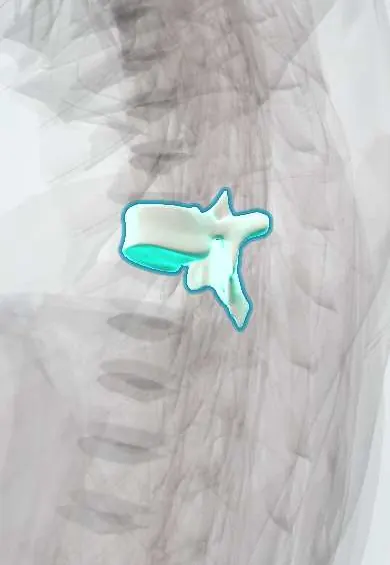
- T7 vertebra
- T8 vertebra
- T9 vertebra
- Ribs (back part)
- L1 vertebra
- L2 vertebra
- Endplates
- Rib-to-spine ligaments
- Multifidus
In embryology
- Paraxial mesoderm and somites: sclerotome, myotome, dermatome
- Vertebrae: resegmentation of the sclerotomes
- Hemivertebra, congenital scoliosis and Klippel–Feil
- Spinal cord: alar and basal plates and the ascent of the cord
- Chiari malformations
In the clinical exam
- Spine examination: the Adams forward-bend test and Schober test
- Inspection of gait and posture (orthopedic)
Why it happens
What it is
Three-dimensional deformity of the spine with a side curve of 10 degrees or more measured by the Cobb angle on X-ray, together with vertebral rotation. The most common form is adolescent idiopathic scoliosis.
Who gets it
Adolescent idiopathic scoliosis appears from about 10 years of age until skeletal maturity. Small curves are similar in both sexes, but curves that progress and need treatment are much more frequent in girls. School screening practices vary between countries.
Causes
- Idiopathic (most cases): infantile, juvenile or adolescent; probably multifactorial with a genetic component
- Congenital: vertebral malformations such as hemivertebrae or unsegmented bars
- Neuromuscular: cerebral palsy, muscular dystrophy, spinal muscular atrophy, myelomeningocele
- Syndromic: Marfan syndrome, neurofibromatosis, connective tissue disorders
- Degenerative (de novo) scoliosis in older adults
Risk factors
- Female sex (for progression)
- Family history
- Rapid growth: before or around the pubertal growth spurt
- Skeletal immaturity (low Risser grade, before menarche)
- Larger curve at diagnosis
Pathophysiology
The spine curves sideways and the vertebrae rotate toward the convexity, pulling the ribs with them and forming a rib hump. Asymmetric loading of the growth plates during growth makes vertebrae wedge and the curve progress. Large thoracic curves reduce chest volume and can restrict lung function.
Classification
- By cause: idiopathic, congenital, neuromuscular, syndromic, degenerative
- By age at onset (idiopathic): infantile (under 3 years), juvenile (3–10), adolescent (10 years to maturity)
- By curve location: thoracic, thoracolumbar, lumbar, double major
- Most common adolescent pattern: right thoracic curve; a left thoracic curve is atypical and prompts a search for an underlying cause
Symptoms and signs
- Shoulder or scapular asymmetry
- Uneven waist or a pelvis that looks tilted
- Rib hump seen on bending forward
- Trunk shifted to one side
- Usually painless in adolescents; back pain is more common in adults with degenerative curves
Diagnosis
- Clinical
- The Adams forward-bend test shows the rib or lumbar hump; a scoliometer measures trunk rotation. Exam includes leg lengths, skin, joints and a full neurological exam.
- Tests
- No routine laboratory tests; genetic or other studies only if a syndrome is suspected.
- Imaging
- Standing full-spine posteroanterior and lateral X-rays measure the Cobb angle and skeletal maturity (Risser sign). MRI for atypical curves, early onset, pain or neurological signs, to look for a syrinx, tethered cord or tumour.
Differential diagnosis
- Postural (functional) scoliosis from a leg length difference
- Antalgic scoliosis from pain (disc herniation, osteoid osteoma)
- Congenital vertebral malformation
- Neuromuscular disease
- Intraspinal anomaly (syrinx, tethered cord, tumour)
- Scheuermann kyphosis
Goal of treatment
Stop curve progression during growth, preserve trunk balance and lung function, and correct the deformity surgically when the curve is large.
Treatment
- Follow-up
- Observation with periodic X-rays for small curves, especially near skeletal maturity.
- Conservative
- Bracing for moderate curves in a skeletally immature patient; it aims to stop progression, not to correct the curve. Thresholds vary between guidelines.
- Rehabilitation
- Scoliosis-specific exercises and physical therapy as support; evidence for stopping progression on their own is limited.
- Surgical
- Posterior spinal fusion with instrumentation for large or progressive curves; growth-friendly techniques in young children. Thresholds vary, and most are around large curves of about 45–50 degrees.
Complications
- Curve progression and trunk deformity
- Restrictive lung disease with large thoracic curves
- Back pain in adulthood
- Psychosocial effects and body image
- Surgical complications: neurological injury, infection, pseudarthrosis
Prognosis
Most small curves do not progress. Risk of progression depends on curve size and remaining growth. After skeletal maturity, large curves can keep progressing slowly through adult life.
Test yourself
Think of the answer, then tap the question to see it.
What is the minimum Cobb angle used to define scoliosis?
10 degrees on a standing X-ray, together with vertebral rotation.
What does the Adams forward-bend test detect?
The rib or lumbar hump caused by vertebral rotation; it is the classic screening sign of scoliosis.
What is the most common curve pattern in adolescent idiopathic scoliosis?
A right thoracic curve. A left thoracic curve is atypical and calls for MRI to look for an underlying cause.
What is the aim of bracing in adolescent idiopathic scoliosis?
To stop or slow progression of a moderate curve while the patient is still growing; it does not correct the curve.
Which factors predict progression of adolescent idiopathic scoliosis?
Larger curve size and more remaining growth: young age, low Risser grade, before menarche, and female sex.
Related conditions
Educational information, not medical advice. For any symptom, see a health professional.
Sources: Adolescent Idiopathic Scoliosis (StatPearls (NCBI Bookshelf), 2023).
Spotted a mistake?We are always improving for the community. Tell us what is wrong and our team will review it.Report a mistake
Representative model, for educational purposes only.