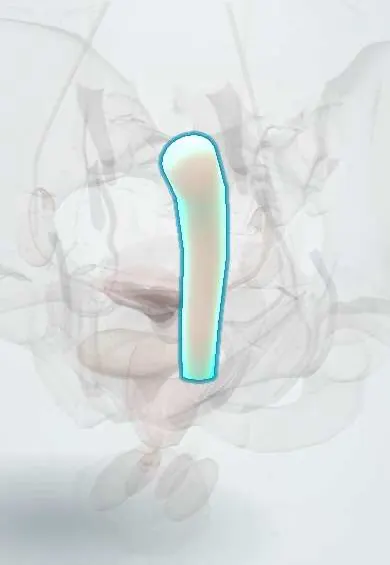
Haemorrhoids !
Haemorrhoids are swollen blood-vessel cushions of the anal canal; internal ones bleed painlessly, external ones hurt when a clot forms.
Updated 2026-10-29
Structures involved
Tap one to see what it is and open it in 3D.
- Rectum
- External anal sphincter
- Puborectalis
- Internal pudendal vein
- Internal iliac veins
- Internal pudendal artery
In histology
In embryology
In the clinical exam
In physiology
What it is
Enlarged, symptomatic vascular cushions of the anal canal. Internal haemorrhoids arise above the dentate line and typically bleed or prolapse painlessly; external haemorrhoids lie below it and hurt when they thrombose.
Who gets it
One of the most common anorectal complaints in adults, peaking in middle age; many people never consult. Pregnancy and the postpartum period are common triggers.
Causes
- Straining at stool and prolonged sitting on the toilet
- Chronic constipation or diarrhoea
- Raised intra-abdominal pressure (pregnancy, obesity, heavy lifting)
- Weakening of the supporting tissue of the anal cushions with age
Risk factors
- Low-fibre diet and low fluid intake
- Constipation and straining
- Pregnancy and childbirth
- Obesity
- Ageing
- Sedentary lifestyle
- Anticoagulant or antiplatelet drugs (bleeding)
Pathophysiology
Normal anal cushions (vessels, smooth muscle, connective tissue) help seal the anus. Repeated straining and hard stool engorge them and stretch their supporting tissue, so they slide down and may prolapse. Internal haemorrhoids are covered by mucosa with visceral innervation, so they rarely hurt; external haemorrhoids are covered by sensitive anoderm and become painful when a clot forms.
Classification
- Internal (above the dentate line), graded I–IV (Goligher): I bleeds without prolapse; II prolapses and reduces on its own; III needs manual reduction; IV cannot be reduced
- External (below the dentate line), including acute thrombosed external haemorrhoid
- Mixed (internal and external)
- Skin tags: residual folds after a thrombosed external haemorrhoid
Symptoms and signs
- Painless bright red bleeding on the paper, coating the stool or dripping into the toilet after defecation
- A lump that comes out with bowel movements and goes back on its own or by hand
- Anal itching, mucus discharge and a feeling of incomplete emptying
- Thrombosed external haemorrhoid: sudden, very painful, tense bluish lump at the anal edge
- Pain is not typical of internal haemorrhoids unless they are prolapsed and strangulated
Diagnosis
- Clinical
- History and inspection of the anus at rest and on straining, digital rectal examination and anoscopy to see internal haemorrhoids and grade them.
- Tests
- Blood count if bleeding is frequent or anaemia is suspected; faecal immunochemical testing in some screening settings.
- Imaging
- Colonoscopy or flexible sigmoidoscopy when there are red flags, in older patients or when bleeding does not fit haemorrhoids, to exclude colorectal cancer and inflammatory bowel disease.
Differential diagnosis
- Anal fissure (sharp pain on defecation, tear in the posterior midline)
- Colorectal cancer or anal cancer
- Rectal prolapse
- Perianal abscess
- Anal warts or skin tags
- Inflammatory bowel disease
Goal of treatment
Control bleeding, prolapse and pain by softening stool and reducing straining, adding office procedures or surgery when conservative care fails.
Treatment
- Lifestyle
- High-fibre diet or fibre supplements, adequate fluids, not straining and not sitting long on the toilet; this is the basis of every treatment.
- Medical
- Short courses of topical preparations (local anaesthetics, low-potency corticosteroids) for symptom relief; oral phlebotonics (flavonoids) are used in some countries, with modest evidence.
- Procedure
- Office treatment of grade I–III internal haemorrhoids: rubber band ligation (most used), sclerotherapy or infrared coagulation.
- Surgical
- Excisional haemorrhoidectomy for grade III–IV, mixed or recurrent haemorrhoids; stapled haemorrhoidopexy or Doppler-guided artery ligation are alternatives.
- Acute
- Thrombosed external haemorrhoid: excision of the clot under local anaesthesia when seen within about the first three days; after that, analgesia, sitz baths and stool softeners until it resolves.
Drugs for this condition
Complications
- Anaemia from chronic bleeding
- Thrombosis
- Strangulation and necrosis of prolapsed internal haemorrhoids
- Skin tags
- After procedures: pain, bleeding, urinary retention, anal stenosis or incontinence (rare)
Prognosis
Usually benign. Most improve with diet and bowel habit changes; band ligation controls many internal haemorrhoids, and surgery has the lowest recurrence but more pain.
Prevention
- Fibre-rich diet and good hydration
- Avoiding straining and long toilet sitting
- Regular physical activity
- Prompt treatment of constipation, including in pregnancy
Test yourself
Think of the answer, then tap the question to see it.
Why are internal haemorrhoids usually painless?
They arise above the dentate line, where the mucosa has visceral (autonomic) innervation, unlike the somatically innervated anoderm below.
How is a grade III internal haemorrhoid defined?
It prolapses on straining and must be pushed back by hand.
What is the most common office treatment for grade I–III internal haemorrhoids?
Rubber band ligation.
When is excision considered for a thrombosed external haemorrhoid?
When the patient is seen early, within about the first three days of pain; later it is managed conservatively.
Which findings with rectal bleeding call for colonoscopy rather than assuming haemorrhoids?
Older age, change in bowel habit, weight loss, anaemia, dark or mixed blood, or a family history of colorectal cancer.
Related conditions
Educational information, not medical advice. For any symptom, see a health professional.
Sources: Internal Hemorrhoid (StatPearls (NCBI Bookshelf), 2023); External Hemorrhoid (StatPearls (NCBI Bookshelf), 2023).
Spotted a mistake?We are always improving for the community. Tell us what is wrong and our team will review it.Report a mistake
Representative model, for educational purposes only.