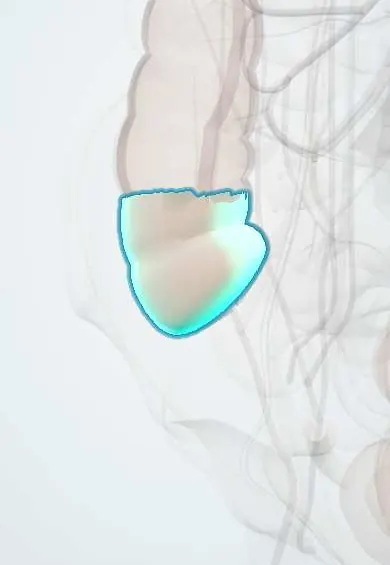
Colorectal cancer !
Colorectal cancer is a malignant tumour of the colon or rectum that usually grows from a polyp; screening can prevent it or find it early.
Updated 2026-10-30
Structures involved
Tap one to see what it is and open it in 3D.
- Cecum
- Ascending colon
- Sigmoid colon
- Rectum
- Transverse colon
- Descending colon
- Mesenteric lymph nodes
- Inferior mesenteric artery
- Colic arteries
- Liver
In biochemistry
- Tumour markers: principles of use
- Carcinoembryonic antigen (CEA)
- Dietary fibre
- Polyamines (putrescine, spermidine, spermine)
- Receptor tyrosine kinases
- DNA repair
- Epigenetics: DNA and histone methylation
- DNA polymerases
- dTMP (thymidine monophosphate)
- Drugs acting on nucleotide metabolism
- Thymidylate synthase
- Oncogenes and tumour suppressor genes
Microorganisms that cause it
In histology
- The GI tract wall: mucosa, submucosa, muscularis, serosa; enteric plexuses
- Large intestine, appendix and anal canal
In the clinical exam
- Abdominal palpation: light and deep, guarding and masses
- Digital rectal examination
- Bowel obstruction syndrome
- Upper and lower gastrointestinal bleeding
Why it happens
- Tumour suppressor genes: RB, TP53, APC, BRCA and the two-hit hypothesis
- Genomic instability: mismatch repair, BRCA and xeroderma pigmentosum
- Diet, cancer and systemic disease
- The hallmarks of cancer
- Multistep carcinogenesis: the adenoma–carcinoma sequence
- From specimen to report: fixation, margins and the pathology report
Show 14 more
- Grading and staging: what TNM means
- Benign vs malignant tumours: the comparison table
- Molecular pathology: PCR, FISH, sequencing and liquid biopsy
- Tumour angiogenesis
- Local effects of tumours and cancer cachexia
- Invasion and metastasis: the metastatic cascade, step by step
- How tumours evade the immune system
- Tumour markers: serum and tissue, and what each one is for
- Oncogenes: RAS, MYC, HER2, BCR-ABL and the table to know
- Cancer epidemiology: age, environment, predisposing conditions (and Colombia)
- Immunohistochemistry: the principle and the markers to know
- Pathways of spread and the usual metastatic sites
- Hereditary cancer syndromes: the table to know
- Precancerous conditions: when chronic inflammation, metaplasia or hyperplasia raise the risk
What it is
A malignant tumour of the colon or rectum, almost always an adenocarcinoma arising from a polyp, which can be prevented or found early by screening.
Who gets it
One of the most common cancers and causes of cancer death worldwide. Incidence is rising in Latin America with ageing and changes in diet and lifestyle, and cases under 50 are increasing. Global Burden of Disease estimates show its age-adjusted mortality in Latin America rose by 20.56% from 1990 to 2019, with wide differences between countries.
Causes
- Adenoma-carcinoma sequence (chromosomal instability: APC, KRAS, TP53)
- Serrated pathway from sessile serrated lesions
- Microsatellite instability, including Lynch syndrome (mismatch repair genes)
- Familial adenomatous polyposis and other polyposis syndromes
Risk factors
- Age
- Personal or family history of colorectal cancer or advanced adenomas
- Lynch syndrome, familial adenomatous polyposis
- Long-standing ulcerative colitis or Crohn colitis
- Red and processed meat, low fibre intake, obesity, physical inactivity
- Smoking, alcohol and type 2 diabetes
Pathophysiology
Most cancers develop over years as accumulated genetic changes turn a benign adenoma or serrated lesion into an invasive carcinoma. The tumour grows through the bowel wall and spreads to regional lymph nodes and, through the portal venous system, to the liver; rectal cancers can also spread to the lungs.
Classification
- TNM staging (stages 0-IV)
- Location: right colon, left colon, rectum
- Molecular: microsatellite instability (MSI-high / dMMR) vs microsatellite stable; RAS and BRAF status
Symptoms and signs
- May be silent: found by screening
- Right colon: iron deficiency anaemia, fatigue, weight loss, a mass in the right lower abdomen; bleeding often occult
- Left colon: change in bowel habit, narrowing of stools, colicky pain, obstruction, visible blood in stool
- Rectum: bright red bleeding, tenesmus and a feeling of incomplete emptying
- Late: weight loss, liver enlargement, ascites
Diagnosis
- Clinical
- History, family history and red flags; abdominal and digital rectal examination.
- Tests
- Colonoscopy with biopsy is the key test and examines the whole colon for synchronous lesions. Blood count and iron studies, liver tests, baseline CEA (for follow-up, not for diagnosis or screening). Mismatch repair or MSI testing of the tumour.
- Imaging
- CT of the chest, abdomen and pelvis for staging. Pelvic MRI (and sometimes endorectal ultrasound) for rectal cancer. CT colonography when colonoscopy is incomplete.
Differential diagnosis
- Haemorrhoids and anal fissure
- Diverticular disease
- Inflammatory bowel disease
- Infectious or ischaemic colitis
- Irritable bowel syndrome
- Angiodysplasia
Goal of treatment
Cure localised disease through complete resection with clear margins and lymph node removal, reduce recurrence with additional therapy, and prolong survival with good quality of life in advanced disease.
Treatment
- Procedure
- Endoscopic removal (polypectomy) of adenomas and selected very early cancers during colonoscopy.
- Surgical
- Colon cancer: surgical resection (right, left or sigmoid colectomy), open or laparoscopic, with its mesentery and an adequate number of lymph nodes.
- Surgical
- Rectal cancer: total mesorectal excision (anterior resection or abdominoperineal resection); locally advanced tumours receive neoadjuvant chemoradiotherapy or total neoadjuvant therapy first.
- Medical
- Adjuvant chemotherapy for node-positive (stage III) and selected high-risk stage II colon cancer; in metastatic disease, chemotherapy with anti-EGFR or anti-VEGF antibodies according to RAS status, and immune checkpoint inhibitors for MSI-high tumours.
- Surgical
- Resection or ablation of limited liver or lung metastases; stents or stomas for obstruction.
- Follow-up
- Follow-up with history, CEA, CT and colonoscopy at intervals set by the guideline.
Drugs for this condition
Complications
- Large bowel obstruction
- Perforation and peritonitis
- Bleeding and anaemia
- Liver and lung metastases
- After surgery: anastomotic leak, stoma problems, bowel and sexual or urinary dysfunction after rectal surgery
- Streptococcus gallolyticus (bovis) bacteraemia or endocarditis may reveal an occult tumour
Prognosis
Prognosis depends mainly on stage: early tumours are usually curable, while survival falls with node involvement and distant metastases. Resectable liver metastases can still be cured in some patients.
Prevention
- Screening of average-risk adults with stool tests (FIT or guaiac faecal occult blood) or colonoscopy, starting at an age that varies between guidelines (commonly 45 or 50)
- Earlier and more frequent colonoscopy for family history, Lynch syndrome, polyposis or long-standing IBD
- Diet rich in fibre with less red and processed meat, physical activity, healthy weight, not smoking and limiting alcohol
Test yourself
Think of the answer, then tap the question to see it.
How does right-sided colon cancer typically present compared with left-sided?
Right-sided: iron deficiency anaemia, fatigue and a mass. Left-sided: change in bowel habit, narrow stools, visible bleeding and obstruction.
What is the role of CEA in colorectal cancer?
A baseline value is used for prognosis and follow-up to detect recurrence; it is not a screening or diagnostic test.
Which inherited syndrome causes colorectal cancer through mismatch repair defects?
Lynch syndrome (hereditary non-polyposis colorectal cancer).
Which organ is the most common site of colorectal cancer metastases and why?
The liver, because venous drainage of the colon and upper rectum goes through the portal system.
Which bacteraemia should prompt a colonoscopy to look for colorectal cancer?
Streptococcus gallolyticus (formerly S. bovis) bacteraemia or endocarditis.
Related conditions
- Diverticular disease and diverticulitis
- Small bowel obstruction
- Large bowel obstruction
- Ulcerative colitis
- Crohn disease
- Haemorrhoids
- Irritable bowel syndrome
- Sigmoid volvulus
Educational information, not medical advice. For any symptom, see a health professional.
Sources: Colorectal Cancer Screening (StatPearls (NCBI Bookshelf), 2024); Colorectal cancer disparities in Latin America: Mortality trends 1990-2019 and a paradox association with human development (PloS one, 2023) · adapted, CC BY 4.0.
Spotted a mistake?We are always improving for the community. Tell us what is wrong and our team will review it.Report a mistake
Representative model, for educational purposes only.