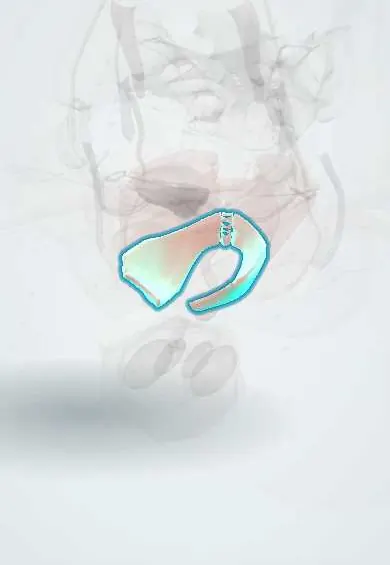
Puborectalis !
The puborectalis is a U-shaped sling of the pelvic floor around the rectum; it bends the rectum forward to hold stool in and relaxes to let it out.
Opens in the Durgical app, no sign-up needed.
What it is
A U-shaped sling from the pubic bone around the back of the rectum.
What it does
Pulls the rectum forward to make a bend that keeps stool in; it relaxes to let the bowel empty. It can be torn off the bone in a difficult birth (levator avulsion).
Key facts
- Origin
- Back of the body of the pubis, either side of the symphysis
- Insertion
- Loops behind the anorectal junction to the opposite side (U-shaped sling)
- Action
- Pulls the anorectal junction forward (anorectal angle about 90°); faecal continence; relaxes for defecation
- Nerve
- Nerve to levator ani (S3–S4) and pudendal nerve (S2–S4) branches
- Blood supply
- Inferior rectal and internal pudendal arteries
Relations
- In front
- Back of the pubis either side of the pubic symphysis; between its two limbs run the urethra and, in women, the vagina
- Behind
- Loops behind the anorectal junction, where it is felt as a ridge on rectal examination
- Above
- Pubococcygeus, lying above and lateral to it
- Below
- Deep part of the external anal sphincter, with which it blends
- Lateral
- Obturator internus fascia and the anterior part of the ischioanal fossa
How to find it
On digital rectal examination it is felt as a firm sling on the back wall at the top of the anal canal. When the person squeezes, the finger is pulled forward towards the pubis; when the person bears down, the sling should relax and descend.
Examination
- Rectal examination with squeeze and push: the sling should relax on straining; paradoxical tightening suggests dyssynergic defecation (anismus)
- Palpation of its pubic attachment on vaginal examination: a gap or missing muscle beside the pubis suggests levator avulsion
On imaging
3D/4D transperineal ultrasound shows the levator hiatus in the axial plane and the muscle's attachment to the pubis (avulsion, an overstretched or «ballooning» hiatus). Dynamic MR or X-ray defecography measures the anorectal angle at rest, on squeezing and on straining.
Common problems
- Stretching or tearing in vaginal birth.
- Pelvic organ prolapse.
- Urinary or faecal incontinence.
- Overactive, painful pelvic floor (pain with sex, pelvic pain).
How it is diagnosed
Pelvic examination, sometimes ultrasound or MRI of the pelvic floor.
Treatment
- Pelvic floor muscle training (Kegel exercises) with a physiotherapist.
- A pessary (a removable support placed in the vagina).
- Surgery for prolapse that bothers the person.
Clinical notes
- Levator avulsion after vaginal birth, most often with forceps and in the first birth, is linked to later pelvic organ prolapse
- In dyssynergic defecation the sling fails to relax, the angle stays closed and emptying is obstructed; biofeedback training is one approach described
- Obstetric anal sphincter injury and puborectalis damage often occur together, adding to the risk of faecal incontinence
Anatomical variants
- Some texts count it as part of the external anal sphincter complex rather than the levator ani; it tends to thin with age
Development
In anorectal malformations (imperforate anus) the level at which the rectal pouch ends relative to this sling guides the repair and the outlook for continence; in the posterior sagittal repair the rectum is brought down inside the sling and the sphincter muscles.
Related conditions
Test yourself
Think of the answer, then tap the question to see it.
What angle does the puborectalis create, and how does it change with contraction and relaxation?
The anorectal angle: it sharpens when the puborectalis contracts and opens when it relaxes to let stool pass.
Which structures form the anorectal ring, and why does it matter in fistula surgery?
Puborectalis, deep external anal sphincter and upper internal anal sphincter; cutting this ring causes incontinence.
On rectal examination with squeeze and push, what finding suggests dyssynergic defecation?
Paradoxical tightening of the puborectalis on straining instead of relaxation and descent.
How does the puborectalis differ from the rest of the levator ani in its attachments?
It loops behind the anorectal junction as a sling from the pubis; its fibres do not reach the coccyx.
Educational information, not medical advice. For any symptom, see a health professional.
Its names
- Official Latin (TA2)
- musculus puboanalis TA2 2406
- Official Spanish (DeCS)
- Músculo puboanal DeCS D017773
- English (TA2)
- Puborectalis
- Also called
- puborectalis muscle
Related
Sources: Terminologia Anatomica (TA2); DeCS; Anatomy, Abdomen and Pelvis: Levator Ani Muscle; Anatomy, Abdomen and Pelvis: Pelvic Floor.
Spotted a mistake?We are always improving for the community. Tell us what is wrong and our team will review it.Report a mistake
Representative model, for educational purposes only.