Inguinal hernia !
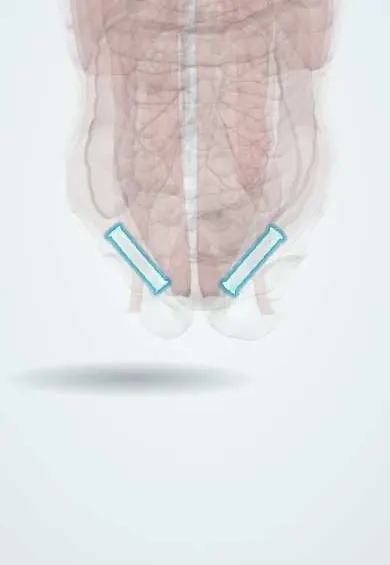
An inguinal hernia is a bulge in the groin where fat or bowel pushes through a weak spot in the lower abdominal wall, above the inguinal ligament.
Updated 2026-10-29
Structures involved
Tap one to see what it is and open it in 3D.
- Inguinal canal
- Inguinal ligament
- Transversalis fascia
- Spermatic cord
- Epigastric vessels
- External oblique
- Internal oblique
- Transversus abdominis
- Iliohypogastric and ilioinguinal nerves
- Genitofemoral nerve
In embryology
- Gonads and the descent of the testis
- Cryptorchidism
- Processus vaginalis: hydrocele and indirect inguinal hernia
In the clinical exam
- Examination of the groin and abdominal wall for hernias
- Male genital exam: transillumination, cremasteric reflex, Prehn sign
- Bowel obstruction syndrome
What it is
Protrusion of abdominal contents, such as fat or bowel, through the inguinal canal or its posterior wall above the inguinal ligament, felt as a groin bulge.
Who gets it
The most common abdominal wall hernia. It occurs in both sexes but is much more common in men; indirect hernias are the commonest type in men, women and children. Groin hernia repair is among the most frequent general surgery operations worldwide.
Causes
- Indirect: a patent processus vaginalis lets contents pass through the deep inguinal ring, along the canal
- Direct: acquired weakness of the transversalis fascia in the posterior wall (Hesselbach triangle)
- Raised intra-abdominal pressure acting on a weak area
Risk factors
- Male sex and older age
- Family history
- Prematurity and low birth weight (indirect hernia in infants)
- Chronic cough, constipation, straining to pass urine (prostatic enlargement)
- Heavy lifting, previous hernia on the other side
- Connective tissue disorders, smoking, previous lower abdominal surgery
Pathophysiology
An indirect hernia enters the deep ring, a gap in the transversalis fascia lateral to the inferior epigastric vessels, and follows the spermatic cord (or round ligament), sometimes into the scrotum or labium. A direct hernia bulges through the Hesselbach triangle, medial to the vessels. A narrow neck can trap contents (incarceration) and cut off their blood supply (strangulation).
Classification
- Indirect (lateral to the inferior epigastric vessels, through the deep ring)
- Direct (medial to the vessels, through Hesselbach triangle)
- Pantaloon (combined direct and indirect)
- Reducible, incarcerated (irreducible) or strangulated
- Femoral hernia is a separate groin hernia, below the inguinal ligament
- Formal systems exist (e.g., European Hernia Society, Nyhus)
Symptoms and signs
- Groin bulge that grows when standing, coughing or straining and goes back when lying down
- Dragging discomfort or aching in the groin, worse at the end of the day
- Swelling extending into the scrotum (indirect hernia in men)
- May be painless and found on examination
Diagnosis
- Clinical
- Examination standing and lying, with a cough impulse; position relative to the pubic tubercle (inguinal: above and medial; femoral: below and lateral). Distinguishing direct from indirect by examination is unreliable and is usually confirmed at surgery.
- Tests
- Not needed for an uncomplicated hernia. In suspected strangulation: blood count, lactate, electrolytes and kidney function.
- Imaging
- Usually none. Ultrasound for an unclear or occult hernia; MRI or CT if still in doubt. CT in suspected obstruction or strangulation.
Differential diagnosis
- Femoral hernia
- Hydrocele, spermatocele or varicocele
- Inguinal lymphadenopathy
- Lipoma of the cord or groin
- Undescended or retractile testis
- Femoral artery aneurysm, saphena varix or psoas abscess
Goal of treatment
Relieve symptoms and prevent incarceration and strangulation with a durable, low-recurrence repair, while limiting chronic postoperative pain.
Treatment
- Follow-up
- Watchful waiting is a reasonable option for men with minimal or no symptoms, with advice about warning signs; many later need surgery.
- Surgical
- Open mesh repair (e.g., Lichtenstein tension-free technique) reinforces the posterior wall; it can be done under local, regional or general anaesthesia.
- Surgical
- Laparoscopic preperitoneal mesh repair (TAPP or TEP), useful for bilateral or recurrent hernias and in women, because it also covers the femoral canal.
- Acute
- An incarcerated, painful hernia needs emergency assessment; gentle reduction may be tried only when strangulation is not suspected, followed by early repair.
- Surgical
- Emergency surgery for strangulation, with bowel resection if non-viable. In children, herniotomy (ligation of the sac) without mesh.
Complications
- Incarceration and strangulation with bowel obstruction or necrosis
- Chronic postoperative groin pain from the ilioinguinal, iliohypogastric or genital branch of the genitofemoral nerve
- Recurrence
- Seroma, haematoma, wound or mesh infection
- Ischaemic orchitis or testicular atrophy, vas deferens injury
- Urinary retention after surgery
Prognosis
Elective repair has good results and a low recurrence rate. Emergency repair of a strangulated hernia carries clearly higher morbidity and mortality, especially in older patients.
Prevention
- Treating chronic cough, constipation and urinary obstruction
- Timely repair of symptomatic hernias and of femoral hernias
Test yourself
Think of the answer, then tap the question to see it.
Which landmark separates an indirect from a direct inguinal hernia?
The inferior epigastric vessels: indirect hernias are lateral (through the deep ring), direct hernias are medial (through Hesselbach triangle).
What are the boundaries of the Hesselbach triangle?
Inferior epigastric vessels laterally, the lateral border of the rectus abdominis medially and the inguinal ligament inferiorly.
Which is the most common type of groin hernia in women?
The indirect inguinal hernia; femoral hernias are more common in women than in men but are still less frequent than inguinal hernias.
Why is a femoral hernia repaired promptly?
Its narrow, rigid neck gives it a high risk of incarceration and strangulation.
Which nerves are at risk of injury causing chronic pain after inguinal hernia repair?
The ilioinguinal, iliohypogastric and the genital branch of the genitofemoral nerve.
Related conditions
- Small bowel obstruction
- Femoral hernia
- Hydrocele
- Umbilical hernia
- Intussusception (children)
- Varicocele
- Cryptorchidism (undescended testis)
- Hypospadias
Educational information, not medical advice. For any symptom, see a health professional.
Sources: Open Inguinal Hernia Repair (StatPearls (NCBI Bookshelf), 2026).
Spotted a mistake?We are always improving for the community. Tell us what is wrong and our team will review it.Report a mistake
Representative model, for educational purposes only.