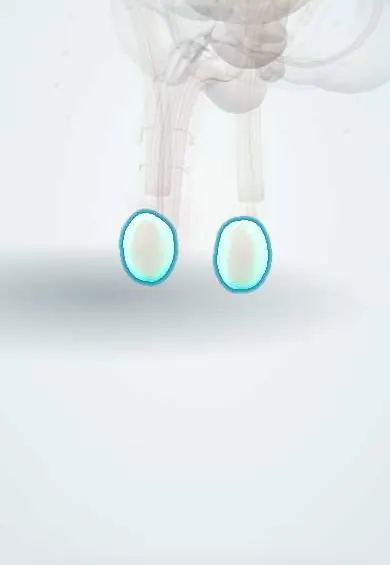
Cryptorchidism (undescended testis) !
Cryptorchidism (undescended testis) is a testis that has not come down into the scrotum; it is the most common birth defect of the male genitals.
Updated 2026-10-29
Structures involved
Tap one to see what it is and open it in 3D.
In histology
In embryology
- Poland sequence and prune belly syndrome
- Androgens, diethylstilbestrol and other hormones
- Gonads and the descent of the testis
- Hypospadias and epispadias
- Cryptorchidism
In physiology
Why it happens
What it is
A testis that is not in the bottom of the scrotum and cannot be brought there, because it stopped along its normal path of descent or lies in an ectopic position. It is the most common congenital anomaly of the male genitalia.
Who gets it
It is found in a small percentage of full-term newborn boys and is much more common in preterm infants. Many testes descend on their own in the first months of life; after about six months, spontaneous descent is unlikely.
Causes
- Failure of the transabdominal phase of descent (gubernaculum, INSL3 hormone)
- Failure of the inguinoscrotal phase, which depends on androgens
- Ectopic testis: outside the normal path (perineal, femoral, pubic)
- Hormonal or genetic disorders and some syndromes
- Acquired (ascending) testis that was in the scrotum and later retracts upwards
Risk factors
- Prematurity and low birth weight
- Family history
- Hypospadias or other genital anomalies
- Endocrine disorders (hypogonadotropic hypogonadism, androgen insensitivity)
- Maternal exposures in pregnancy (for example smoking), with weaker evidence
Pathophysiology
A testis outside the scrotum sits at a higher temperature, which damages germ cells over time and impairs later sperm production. The undescended testis is also more prone to cancer, and the associated patent processus vaginalis predisposes to hernia and torsion.
Classification
- Palpable (inguinal or suprascrotal) or non-palpable (intra-abdominal, absent or atrophic)
- Unilateral or bilateral
- True undescended, ectopic, retractile (a normal variant) or ascending
Symptoms and signs
- Empty or underdeveloped scrotum on one or both sides
- Testis felt in the groin, or not felt at all
- Possible inguinal bulge from an associated hernia
- Usually painless; sudden pain suggests torsion
Diagnosis
- Clinical
- Examination in a warm room, relaxed and in several positions; the testis is milked down from the groin. A retractile testis can be brought to the scrotum and stays there; an undescended testis cannot.
- Tests
- Bilateral non-palpable testes or associated hypospadias call for karyotype and hormonal evaluation (for example 17-hydroxyprogesterone, gonadotropins, anti-Müllerian hormone).
- Imaging
- Ultrasound is not routinely recommended before referral because it rarely changes management. Diagnostic laparoscopy locates a non-palpable testis.
Differential diagnosis
- Retractile testis
- Absent testis (anorchia or vanishing testis)
- Ectopic testis
- Disorder of sex development
- Inguinal hernia or hydrocele of the cord
Goal of treatment
Place the testis in the scrotum early to protect fertility, make cancer easier to detect, and prevent torsion and hernia.
Treatment
- Follow-up
- Observation for spontaneous descent in the first months, with referral to paediatric surgery or urology if the testis has not descended by about six months.
- Surgical
- Orchiopexy, ideally in the first year to eighteen months of life (guideline timing varies). Inguinal or scrotal approach for palpable testes; laparoscopic orchiopexy, sometimes staged, for intra-abdominal testes.
- Surgical
- Orchiectomy for an atrophic or non-viable testis, or in some post-pubertal cases.
- Medical
- Hormonal therapy is not routinely recommended by major guidelines because success rates are low.
Complications
- Reduced fertility, especially when bilateral
- Higher risk of testicular cancer
- Testicular torsion
- Inguinal hernia
- Testicular atrophy, including after surgery
- Psychological impact of an empty scrotum
Prognosis
Early orchiopexy usually places the testis successfully and improves fertility prospects; outcomes are better for unilateral and palpable testes. The cancer risk is reduced but not eliminated, so self-examination is encouraged later in life.
Test yourself
Think of the answer, then tap the question to see it.
How is a retractile testis distinguished from an undescended testis?
A retractile testis can be brought down into the scrotum and stays there; an undescended testis cannot.
By what age is orchiopexy generally recommended?
In the first year to eighteen months of life; guideline timing varies slightly.
Which finding in a newborn calls for urgent evaluation for a disorder of sex development?
Bilateral non-palpable testes, especially with hypospadias, to rule out congenital adrenal hyperplasia.
Is ultrasound routinely recommended before referral for an undescended testis?
No. It rarely changes management; laparoscopy is used to find a non-palpable testis.
Which two long-term risks are increased in cryptorchidism?
Infertility and testicular cancer.
Related conditions
Educational information, not medical advice. For any symptom, see a health professional.
Sources: Cryptorchidism (StatPearls (NCBI Bookshelf), 2024).
Spotted a mistake?We are always improving for the community. Tell us what is wrong and our team will review it.Report a mistake
Representative model, for educational purposes only.