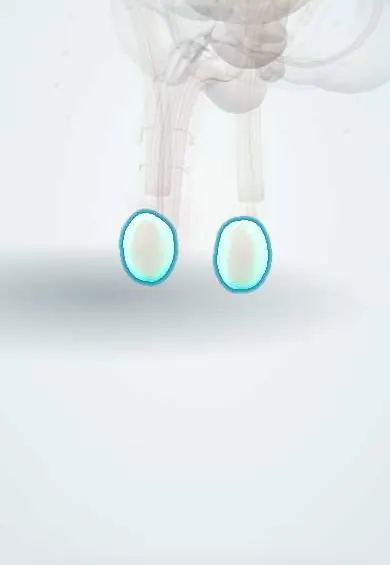
Testes !
The testes (testicles) are the two oval glands in the scrotum that make sperm and testosterone; they hang outside the body because sperm need a cooler place.
Official name: Testis
Opens in the Durgical app, no sign-up needed.
What it is
Two oval glands, about 4-5 cm long, in the scrotum, each in a tough coat (tunica albuginea) inside a serous sac (tunica vaginalis). They form high in the abdomen and descend into the scrotum before birth.
What it does
Make sperm and testosterone; sperm production needs a temperature about 2-3 °C below body temperature, which is why they hang outside the body.
Key facts
- Where
- In the scrotum (left usually lower), each in a tunica albuginea inside the tunica vaginalis; formed on the posterior abdominal wall and descended through the inguinal canal before birth
- Blood supply
- Testicular artery (aorta, about L2); cremasteric and deferential arteries; veins by the pampiniform plexus to the IVC (right) and left renal vein (left)
- Nerve
- Testicular plexus along the artery (sympathetic, T10); pain referred to the umbilical region; cremasteric reflex (genitofemoral, L1–L2) often absent in torsion
- Function
- Sperm (seminiferous tubules, Sertoli cells) and testosterone (Leydig cells); lymph to para-aortic nodes near the renal vessels, not to the groin
Relations
- Above
- Spermatic cord, attached at the upper pole, with the head of the epididymis and the appendix testis
- Behind
- Epididymis along the posterolateral border and the mediastinum testis, where vessels and ducts enter and leave
- Medial
- Scrotal septum, separating it from the other testis
- Superficial
- Tunica vaginalis, internal spermatic fascia, cremaster, external spermatic fascia, dartos and scrotal skin
How to find it
Examined standing and lying: each testis is held between thumb and fingers and compared for size and consistency (smooth, firm, rubbery), with the epididymis felt behind it. In infants, the examiner checks that both are in the scrotum, sweeping down along the inguinal canal.
Examination
- Cremasteric reflex: stroking the upper inner thigh lifts the testis on that side (L1–L2); usually absent in torsion
- Transillumination: light passes through a hydrocele but not through a solid tumour or blood
- Blue dot sign: a small blue-black spot at the upper pole seen through the skin suggests a twisted appendix testis rather than testicular torsion
On imaging
Scrotal ultrasound with colour Doppler comes first: torsion shows absent or reduced flow and a twisted cord ('whirlpool' sign); cancer shows a solid, usually dark (hypoechoic) mass inside the testis; microlithiasis appears as bright dots.
Common problems
- Undescended testis (cryptorchidism): checked at birth; corrected in early childhood.
- Testicular torsion: the testis twists on its cord; sudden severe pain, an emergency.
- Testicular cancer, most common in young men (about 15-35 years); usually a painless lump.
- Hydrocele (fluid around the testis).
How it is diagnosed
Examination and self-examination; scrotal ultrasound; tumour markers in the blood when cancer is suspected.
Treatment
- Emergency surgery to untwist and fix a torsion, ideally within about 6 hours.
- Surgery to bring down an undescended testis (orchidopexy).
- Removal of the testis through the groin (radical orchiectomy) for cancer, often followed by other treatment.
Clinical notes
- Hydrocele: fluid in the tunica vaginalis surrounds the testis, which can then be hard to feel; in infants a communicating hydrocele shares the open processus vaginalis of an indirect hernia
- Testicular cancer is mostly germ cell tumours (seminoma and non-seminoma) in young men; alpha-fetoprotein, beta-hCG and LDH are the tumour markers
Anatomical variants
- Appendix testis: a remnant of the paramesonephric duct at the upper pole; it can twist and mimic torsion
- Ectopic testis lies off the normal path of descent (perineum, thigh, above the pubis); an undescended testis stops along the path; a retractile testis can be brought down and stays
Development
Forms on the posterior abdominal wall near the kidneys, which is why its artery comes from the aorta and its lymph goes to para-aortic nodes. The gubernaculum guides it through the inguinal canal, usually into the scrotum in the last months of pregnancy, with the processus vaginalis in front.
Related conditions
- Fragile X syndrome
- Testicular torsion
- Epididymitis
- Hydrocele
- Testicular cancer
- Cryptorchidism (undescended testis)
- Male hypogonadism
- Androgen insensitivity syndrome
- Male infertility
- Klinefelter syndrome (47,XXY)
Test yourself
Think of the answer, then tap the question to see it.
What are the classic findings of testicular torsion?
Sudden severe pain, a high-riding testis lying horizontally and an absent cremasteric reflex; salvage is best within about 6 hours.
What anatomical variant predisposes to testicular torsion?
The bell-clapper deformity: the tunica vaginalis attaches too high, so the testis hangs free.
Why is suspected testicular cancer removed through the groin rather than the scrotum?
To avoid opening a second lymph pathway to the groin nodes; testicular lymph normally drains to para-aortic nodes.
What does the blue dot sign suggest?
A twisted appendix testis rather than torsion of the testis.
Which tumour markers are used in testicular germ cell tumours?
Alpha-fetoprotein, beta-hCG and LDH.
Educational information, not medical advice. For any symptom, see a health professional.
Its names
- Official Latin (TA2)
- testis
- Official Spanish (DeCS)
- Testículo
- English (TA2)
- Testis
- Also called
- testicle
Related
Sources: Anatomy, Abdomen and Pelvis: Testes.
Spotted a mistake?We are always improving for the community. Tell us what is wrong and our team will review it.Report a mistake
Representative model, for educational purposes only.