Conditions · Pediatrics and neonatology
Meckel diverticulum !
A small pouch left over from fetal development on the lower small bowel. Most cause no trouble, but some bleed painlessly or block the bowel.
Updated 2026-11-01
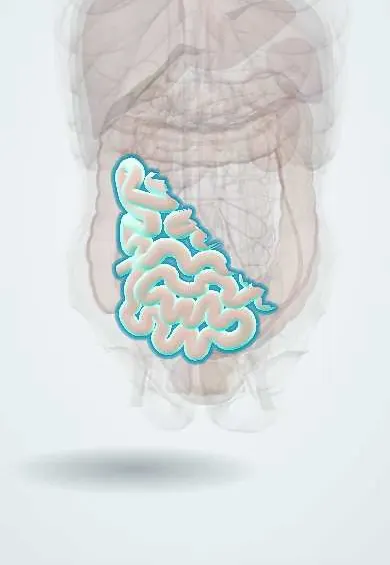
Structures involved
Tap one to see what it is and open it in 3D.
Why it happens
What it is
A true diverticulum of the antimesenteric border of the distal ileum, left when the vitelline (omphalomesenteric) duct fails to close. It may contain heterotopic gastric or pancreatic tissue, and it is the most common congenital anomaly of the gastrointestinal tract.
Who gets it
Present in about 2% of people, and only a small fraction ever have symptoms, most of them children under two years. The classic rule of twos summarises it. In Colombia and Latin America it is a recognised cause of painless rectal bleeding in young children and of intestinal obstruction in surgical practice.
Causes
- Incomplete obliteration of the vitelline duct, which connects the fetal midgut to the yolk sac
- Ectopic gastric mucosa secreting acid that ulcerates adjacent ileal mucosa
- Related vitelline remnants: fibrous band to the umbilicus, umbilical sinus or fistula
Risk factors
- Male sex (symptoms more frequent in boys)
- Young age, especially under 2 years
- Presence of heterotopic gastric mucosa
Pathophysiology
Acid secreted by ectopic gastric mucosa ulcerates the neighbouring ileum, causing painless, sometimes massive, bleeding. The diverticulum can act as a lead point for intussusception, twist around a band to the umbilicus (volvulus), or trap bowel causing obstruction. Obstruction of its neck leads to inflammation that mimics appendicitis.
Classification
- Rule of twos: about 2% of the population, about 2 feet (60 cm) from the ileocaecal valve, about 2 inches long, 2 types of ectopic tissue (gastric, pancreatic), symptoms often before 2 years
Symptoms and signs
- Painless rectal bleeding, often brick-red or maroon, in a young child
- Pallor and fatigue from anaemia
- Colicky abdominal pain, vomiting and distension (obstruction or intussusception)
- Periumbilical or right lower abdominal pain and fever (diverticulitis)
- Umbilical discharge from a persistent vitelline remnant
- Often no symptoms at all
Diagnosis
- Clinical
- Suspect in a young child with painless lower gastrointestinal bleeding, or in a child with obstruction and no previous surgery. Assess haemodynamic status first.
- Tests
- Blood count and iron studies for anaemia, blood group and crossmatch, coagulation; stool testing for blood.
- Imaging
- Technetium-99m pertechnetate scan (Meckel scan), which highlights ectopic gastric mucosa, is the key test for bleeding. Ultrasound for intussusception; CT for obstruction or inflammation. Diagnostic laparoscopy when tests are negative but suspicion is high.
Differential diagnosis
- Juvenile polyp
- Intussusception
- Anal fissure
- Acute appendicitis
- Infectious colitis or inflammatory bowel disease
Goal of treatment
Stabilise bleeding or obstruction and surgically remove the diverticulum with any ulcerated bowel in symptomatic patients.
Treatment
- Acute
- Resuscitation for bleeding or obstruction: intravenous access, fluids, transfusion when needed, nil by mouth and gastric decompression.
- Surgical
- Surgical diverticulectomy or segmental ileal resection with anastomosis, by laparoscopy or open surgery.
- Medical
- Treatment of iron deficiency anaemia after bleeding; acid-suppressing drugs may be used while awaiting surgery.
- Conservative
- Incidental asymptomatic diverticula found at surgery may be left or removed depending on features and age (an individual surgical decision).
Complications
- Massive lower gastrointestinal bleeding
- Intussusception and small bowel obstruction
- Volvulus around a vitelline band
- Diverticulitis and perforation with peritonitis
- Iron deficiency anaemia
Prognosis
After resection recovery is usually complete and recurrence does not occur. Delayed diagnosis of bleeding or obstruction raises morbidity.
Test yourself
Think of the answer, then tap the question to see it.
What is the classic presentation of a symptomatic Meckel diverticulum in a toddler?
Painless rectal bleeding.
Which embryological structure fails to close in Meckel diverticulum?
The vitelline (omphalomesenteric) duct.
What scan detects ectopic gastric mucosa in a Meckel diverticulum?
A technetium-99m pertechnetate scan.
Is a Meckel diverticulum a true or a false diverticulum?
A true diverticulum, containing all layers of the bowel wall.
On which border of the ileum does a Meckel diverticulum arise?
The antimesenteric border of the distal ileum.
Related conditions
- Intussusception (children)
- Lower gastrointestinal bleeding
- Acute appendicitis
- Small bowel obstruction
- Iron deficiency anaemia
- Peritonitis
Educational information, not medical advice. For any symptom, see a health professional.
Sources: Meckel diverticulum: MedlinePlus Medical Encyclopedia (MedlinePlus (U.S. National Library of Medicine), 2024).
Spotted a mistake?We are always improving for the community. Tell us what is wrong and our team will review it.Report a mistake
Representative model, for educational purposes only.