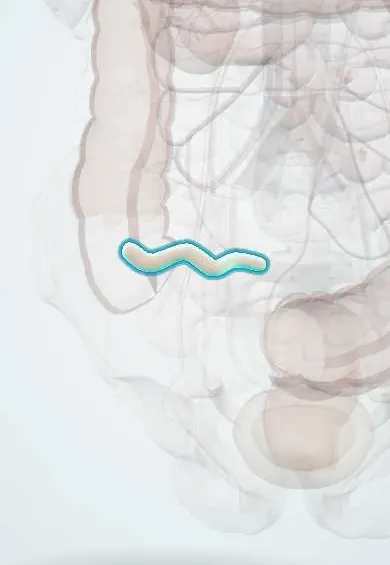
Acute appendicitis !
Acute appendicitis is inflammation of the appendix, usually after it gets blocked; the pain often starts near the navel and moves to the lower right belly.
Updated 2026-10-29
Structures involved
Tap one to see what it is and open it in 3D.
- Appendix
- Cecum
- Mesoappendix
- Appendicular artery
- Ileocolic artery
- Ileum
- Peritoneum
- Psoas major
- Greater omentum
In biochemistry
In immunology
In histology
In embryology
- Primitive gut: foregut, midgut and hindgut and their arteries
- Midgut: physiological herniation and rotation
- Meckel diverticulum and other vitelline duct remnants
In the clinical exam
- Abdominal regions and quadrants: what lies under each
- Abdominal palpation: light and deep, guarding and masses
- McBurney point
- Rebound tenderness (Blumberg sign)
- Rovsing, psoas and obturator signs
- Acute abdomen and peritoneal irritation
In physiology
Why it happens
- Outcomes of acute inflammation: resolution, abscess, scar or chronic inflammation
- Inflammation: the cardinal signs and its five steps
- Patterns of acute inflammation: serous, fibrinous, purulent, abscess, ulcer
- Leukocyte recruitment: rolling, adhesion, transmigration, chemotaxis
What it is
Acute inflammation of the vermiform appendix, usually after its lumen is blocked. It is the most common cause of emergency abdominal surgery worldwide.
Who gets it
Can occur at any age but peaks in adolescents and young adults. It is a frequent emergency in Colombian and Latin American hospitals; delayed consultation, common in rural areas, raises the rate of perforation.
Causes
- Obstruction of the lumen by a faecalith (appendicolith)
- Lymphoid hyperplasia, often after a viral or bacterial infection
- Less often: parasites, foreign bodies or tumours (for example carcinoid)
Risk factors
- Age between about 10 and 30 years
- Low-fibre diet (suggested, not proven)
- Family history of appendicitis
Pathophysiology
Blockage of the lumen lets mucus build up and pressure rise. Venous congestion, then arterial compromise, leads to ischaemia and bacterial invasion of the wall. Without treatment the wall becomes gangrenous and can perforate, causing a localised abscess or generalised peritonitis.
Classification
- Uncomplicated (simple, non-perforated)
- Complicated: gangrenous, perforated, with abscess, phlegmon or peritonitis
Symptoms and signs
- Vague periumbilical pain that migrates to the right lower quadrant (McBurney's point) within hours
- Loss of appetite (anorexia), nausea and vomiting after the pain starts
- Low-grade fever
- Tenderness and guarding at McBurney's point, rebound tenderness
- Rovsing sign: pain in the right lower quadrant when the left side is pressed
- Psoas sign (retrocaecal appendix) and obturator sign (pelvic appendix)
Diagnosis
- Clinical
- History and examination remain central. Scores such as the Alvarado score (MANTRELS) and the Appendicitis Inflammatory Response score help sort patients into low, intermediate and high risk.
- Tests
- Blood count (leucocytosis with left shift) and C-reactive protein. Urinalysis to look for urinary causes. Pregnancy test in every woman of reproductive age.
- Imaging
- Ultrasound first in children and pregnant women; CT with contrast is the most accurate test in adults. MRI without contrast is used in pregnancy when ultrasound is inconclusive.
Differential diagnosis
- Mesenteric lymphadenitis
- Ectopic pregnancy, ovarian torsion or pelvic inflammatory disease
- Right ureteric stone or pyelonephritis
- Acute gastroenteritis
- Meckel diverticulitis or terminal ileitis (Crohn disease)
- Right-sided diverticulitis
Goal of treatment
Remove the source of infection before perforation, control sepsis and allow a fast return to normal activity.
Treatment
- Acute
- Initial care: fasting, intravenous fluids, pain relief (analgesia does not hide the diagnosis) and antiemetics.
- Medical
- Broad-spectrum antibiotics covering gut Gram-negative and anaerobic bacteria, started before surgery.
- Surgical
- Appendectomy, usually laparoscopic, is the standard treatment; open surgery is an alternative.
- Conservative
- Antibiotics alone are an option in selected adults with uncomplicated appendicitis confirmed on CT and no appendicolith; recurrence is common and criteria vary.
- Follow-up
- A localised abscess may be drained percutaneously first, with interval decisions about appendectomy.
Complications
- Perforation and generalised peritonitis
- Periappendiceal abscess or phlegmon
- Sepsis
- Wound infection or intra-abdominal collection after surgery
- Adhesions and later bowel obstruction
- Pregnancy loss or preterm labour when appendicitis occurs in pregnancy
Prognosis
With early surgery, recovery is quick and mortality is very low. Perforation, delay, older age and pregnancy raise complications and death.
Prevention
- No proven prevention; early consultation for abdominal pain reduces perforation
Test yourself
Think of the answer, then tap the question to see it.
What is the classic sequence of symptoms in acute appendicitis?
Periumbilical pain first, then anorexia, nausea or vomiting, then pain that moves to the right lower quadrant at McBurney's point, with low-grade fever.
Where is McBurney's point?
One-third of the way along a line from the right anterior superior iliac spine to the umbilicus.
What does a positive psoas sign suggest?
A retrocaecal appendix irritating the psoas major: pain on extending the right hip.
Which imaging test is preferred first in children and pregnant women with suspected appendicitis?
Ultrasound, to avoid radiation; MRI is used in pregnancy if ultrasound is inconclusive. CT is the most accurate test in adults.
What is the Alvarado score used for?
To estimate the probability of appendicitis from symptoms, signs and white cell count, guiding observation, imaging or surgery.
Related conditions
- Small bowel obstruction
- Diverticular disease and diverticulitis
- Kidney stones (urolithiasis)
- Acute pyelonephritis
- Ectopic pregnancy
- Pelvic inflammatory disease
- Acute (viral) gastroenteritis
- Crohn disease
Educational information, not medical advice. For any symptom, see a health professional.
Sources: Appendicitis (StatPearls (NCBI Bookshelf), 2024).
Spotted a mistake?We are always improving for the community. Tell us what is wrong and our team will review it.Report a mistake
Representative model, for educational purposes only.