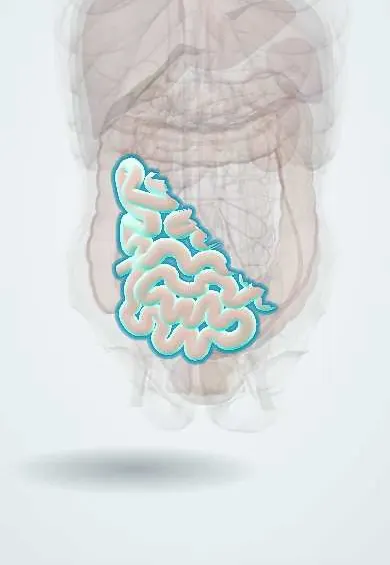
Ileum !
The ileum is the last part of the small intestine, ending at the colon in the lower right belly; it absorbs vitamin B12 and bile acids.
Opens in the Durgical app, no sign-up needed.
What it is
The last part of the small intestine, in the lower right abdomen, ending at the cecum.
What it does
Absorbs vitamin B12 and bile salts.
Key facts
- Where
- Distal three-fifths of small intestine to ileocecal junction; mostly right lower abdomen and pelvis
- Blood supply
- Ileal branches of SMA (many arcades, short vasa recta) and ileal branch of ileocolic artery
- Nerve
- Vagus (parasympathetic); sympathetic via superior mesenteric plexus (T8–T10)
- Function
- Absorbs vitamin B12 and bile salts (terminal ileum); Peyer's patches; Meckel diverticulum about 60 cm from ileocecal valve
Relations
- Course
- Coils in the lower abdomen and pelvis down to the ileocecal junction in the right iliac fossa, entering the medial side of the cecum
- In front
- Greater omentum and the anterior abdominal wall
- Behind
- Behind the parietal peritoneum: right psoas, right ureter and the iliac vessels at the pelvic brim
- Below
- Pelvic organs: bladder, and uterus and ovaries in women; loops often lie in the rectovesical or rectouterine pouch
- Lateral
- Cecum and ascending colon on the right
How to find it
At surgery it is traced back from the ileocecal junction; the ileocecal fold (bloodless fold of Treves) on the antimesenteric border near the cecum is a landmark. A Meckel diverticulum is looked for by running the distal ileum back from the cecum.
On imaging
In Crohn disease, CT or MR enterography shows thickening of the terminal ileum and the comb sign (engorged vasa recta); a barium follow-through may show the string sign of a narrowed segment. A technetium-99m pertechnetate scan (Meckel scan) detects ectopic gastric mucosa in a Meckel diverticulum.
Common problems
- Crohn disease often affects its last part.
How it is diagnosed
Examination, X-ray or CT, endoscopy, blood tests.
Treatment
- Depends on the cause: rest and fluids for many obstructions, medicines for Crohn disease, surgery for some.
Clinical notes
- Meckel diverticulum may present as painless rectal bleeding in a young child (acid from ectopic gastric mucosa ulcerates the nearby ileum), or mimic appendicitis, intussusception or obstruction
- Ileocolic intussusception in infants, often with enlarged Peyer patches as the lead point after a viral illness
- Gallstone ileus: a large stone that has passed through a cholecystoduodenal fistula impacts near the ileocecal valve, the narrowest part of the small bowel
- Ileal tuberculosis favors the ileocecal region and can mimic Crohn disease
Anatomical variants
- Meckel diverticulum, the commonest congenital anomaly of the gut; it may contain gastric or pancreatic tissue
Development
The vitelline (omphalomesenteric) duct joins the apex of the midgut loop, the future ileum, to the yolk sac; if it fails to close it can leave a Meckel diverticulum, a fibrous cord to the umbilicus or an umbilical fistula.
Memory aid
Meckel «rule of 2s», a classic teaching aid rather than exact data: about 2% of people, about 2 feet (60 cm) from the ileocecal valve, about 2 inches long, 2 kinds of ectopic tissue (gastric, pancreatic), often symptomatic before age 2.
Related conditions
- Small bowel obstruction
- Crohn disease
- Irritable bowel syndrome
- Acute (viral) gastroenteritis
- Acute mesenteric ischaemia
- Intussusception (children)
- Carcinoid syndrome
- Lactose intolerance
- Normal anion gap (hyperchloraemic) metabolic acidosis
- Megaloblastic anaemia (B12 or folate deficiency)
- Paralytic ileus and colonic pseudo-obstruction (Ogilvie)
- Small intestinal bacterial overgrowth (SIBO)
- Short bowel syndrome
- Tropical sprue
- Graft-versus-host disease
- Soil-transmitted helminthiasis (ascariasis, hookworm, trichuriasis)
- Typhoid (enteric) fever
- Bacterial infectious diarrhoea and dysentery
- Cholera
- Cryptosporidiosis and other intestinal coccidia (Cyclospora, Cystoisospora)
- Intestinal tapeworm infections (taeniasis, hymenolepiasis, diphyllobothriasis)
- Prematurity and its complications
- Necrotising enterocolitis
- Meckel diverticulum
- IgA vasculitis (Henoch–Schönlein purpura)
- Postoperative ileus
Test yourself
Think of the answer, then tap the question to see it.
What does the terminal ileum absorb?
Vitamin B12 and bile salts; disease or resection (as in Crohn disease) causes B12 deficiency, bile-acid diarrhea and more gallstones.
Where does a Meckel diverticulum arise?
From the antimesenteric border of the ileum, about 60 cm from the ileocecal valve; it may contain gastric or pancreatic tissue.
How does a Meckel diverticulum classically present in a young child?
Painless rectal bleeding: acid from ectopic gastric mucosa ulcerates the nearby ileum; a Meckel scan (technetium-99m pertechnetate) detects it.
Where does a gallstone impact in gallstone ileus?
Near the ileocecal valve, the narrowest part of the small bowel, after passing through a cholecystoduodenal fistula.
Educational information, not medical advice. For any symptom, see a health professional.
Its names
- Official Latin (TA2)
- ileum TA2 2959
- Official Spanish (DeCS)
- Íleon DeCS D007082
- English (TA2)
- Ileum
- Also called
- intestinum ileum · intestinum ilium
Related
Sources: Terminologia Anatomica (TA2); DeCS; Anatomy, Abdomen and Pelvis, Small Intestine.
Spotted a mistake?We are always improving for the community. Tell us what is wrong and our team will review it.Report a mistake
Representative model, for educational purposes only.