Conditions · Pediatrics and neonatology
Neuroblastoma !
Neuroblastoma is a childhood cancer of immature nerve cells, usually in the adrenal gland. It often shows as a belly mass in a young child.
Updated 2026-11-01
Structures involved
Tap one to see what it is and open it in 3D.
- Left adrenal gland
- Right adrenal gland
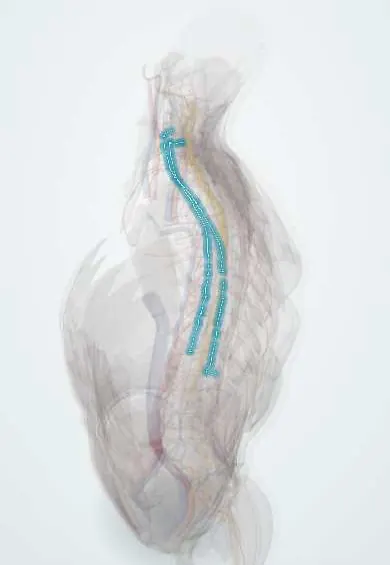
- Sympathetic trunk
- Celiac plexus
- Kidneys
- Para-aortic lymph nodes
- Liver
- Abdominal aorta
Why it happens
- Tumours of infancy and childhood
- Oncogenes: RAS, MYC, HER2, BCR-ABL and the table to know
- Translocations, amplifications and epigenetic changes in cancer
- Molecular pathology: PCR, FISH, sequencing and liquid biopsy
- Naming tumours: -oma, carcinoma, sarcoma, and the misleading names
- The adrenal medulla and catecholamines
What it is
An embryonal tumour arising from neural crest cells of the sympathetic nervous system, most often in the adrenal medulla and along the paravertebral sympathetic chain. It is the commonest extracranial solid tumour of childhood and behaves very variably, from spontaneous regression to aggressive metastatic disease.
Who gets it
About 90% of cases occur before age 5, with a median age at diagnosis of 1–2 years; it is the commonest cancer in infants. It accounts for 6–10% of childhood cancers in high-income countries. In Colombia and Latin America, many children present with advanced disease, which worsens outcomes.
Causes
- Malignant transformation of neural crest precursors of the sympathetic nervous system
- Mostly sporadic; about 1–2% familial (ALK or PHOX2B germline mutations)
- Tumour genetics (MYCN amplification, 11q and 1p loss) determine behaviour
Risk factors
- Young age (most cases under 5 years)
- Family history of neuroblastoma
- Germline ALK or PHOX2B mutations; association with Hirschsprung disease and congenital central hypoventilation
Pathophysiology
Tumour cells are small, round and blue, may form Homer Wright pseudorosettes, and produce catecholamines whose metabolites (VMA and HVA) appear in urine. Amplification of the MYCN oncogene marks aggressive disease. Tumours spread to lymph nodes, bone marrow, bone (including the orbits), liver and skin. Paraspinal tumours can grow through the intervertebral foramina and compress the spinal cord.
Classification
- INRG stages: L1 (localised, no image-defined risk factors), L2 (localised, with risk factors), M (distant metastases), MS (under 18 months with spread only to skin, liver or bone marrow)
- Risk groups: low, intermediate and high, based on stage, age, histology, MYCN status and ploidy
Symptoms and signs
- Firm, irregular abdominal mass that may cross the midline
- Bone pain, limp, fever, pallor and weight loss from metastases
- Periorbital bruising ('raccoon eyes') and proptosis from orbital metastases
- Bluish skin nodules ('blueberry muffin') and massive liver enlargement in infants with stage MS
- Horner syndrome from a cervical or upper thoracic tumour
- Opsoclonus-myoclonus-ataxia ('dancing eyes, dancing feet'); watery diarrhoea from VIP secretion; hypertension
Diagnosis
- Clinical
- Suspected in a young child with an abdominal or paraspinal mass, bone pain, periorbital ecchymoses or a paraneoplastic syndrome. Examination of the abdomen should be gentle and limited.
- Tests
- Urine catecholamine metabolites (VMA and HVA) are raised in most cases. Tumour biopsy for histology (International Neuroblastoma Pathology Classification), MYCN amplification and other genetic markers; bilateral bone-marrow aspirates and biopsies; LDH and ferritin.
- Imaging
- Ultrasound, then CT or MRI of the primary tumour (calcifications are common); MIBG scintigraphy to detect bone and soft-tissue metastases; MRI of the spine when cord compression is suspected.
Differential diagnosis
- Wilms tumour (arises in the kidney, rarely crosses the midline, calcification less common)
- Hepatoblastoma
- Rhabdomyosarcoma, Ewing sarcoma and lymphoma
- Acute leukaemia (bone pain, cytopenias)
- Child abuse (periorbital bruising)
Goal of treatment
Match treatment intensity to the risk group: observe or remove low-risk tumours, use surgery with moderate chemotherapy for intermediate risk, and use multimodal therapy for high-risk disease, while limiting long-term toxicity.
Treatment
- Follow-up
- Observation alone for selected infants with small adrenal masses or stage MS without symptoms, because many regress spontaneously.
- Surgical
- Resection of the primary tumour, alone for low risk or after chemotherapy for higher risk.
- Medical
- Multi-agent chemotherapy; for high risk add high-dose chemotherapy with autologous stem cell rescue, radiotherapy, a differentiating agent (isotretinoin) and anti-GD2 immunotherapy.
- Acute
- Urgent treatment of spinal cord compression with chemotherapy and, if needed, neurosurgical decompression.
Complications
- Spinal cord compression with paraplegia
- Metastatic disease to bone, bone marrow and liver
- Respiratory compromise from massive liver enlargement in infants
- Late effects of treatment: hearing loss, infertility, growth problems, second cancers
- Relapse in high-risk disease
Prognosis
Highly variable: low- and intermediate-risk disease has survival above 90%, and some infant tumours regress on their own. High-risk disease, usually with MYCN amplification or metastases after 18 months of age, has long-term survival of about 50% despite intensive therapy.
Test yourself
Think of the answer, then tap the question to see it.
From which cells does neuroblastoma arise, and where is the commonest primary site?
Neural crest cells of the sympathetic nervous system; the adrenal medulla is the commonest site.
Which urine tests support the diagnosis?
Raised catecholamine metabolites: vanillylmandelic acid (VMA) and homovanillic acid (HVA).
Which oncogene amplification marks a poor prognosis?
MYCN amplification.
What is the classic paraneoplastic syndrome of neuroblastoma?
Opsoclonus-myoclonus-ataxia ('dancing eyes, dancing feet').
How do neuroblastoma and Wilms tumour masses typically differ on examination?
Neuroblastoma is firm, irregular and may cross the midline; Wilms tumour is smooth, renal and usually does not cross it.
Related conditions
- Wilms tumour (nephroblastoma)
- Phaeochromocytoma
- Horner syndrome
- Malignant spinal cord compression
- Acute leukaemia (AML and ALL)
Educational information, not medical advice. For any symptom, see a health professional.
Sources: Neuroblastoma Treatment (PDQ®)–Patient Version (National Cancer Institute (NCI), 2026).
Spotted a mistake?We are always improving for the community. Tell us what is wrong and our team will review it.Report a mistake
Representative model, for educational purposes only.