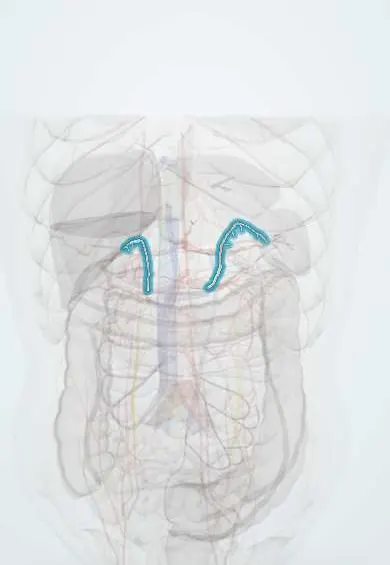
Phaeochromocytoma !
A pheochromocytoma is a rare tumour of the adrenal gland that releases adrenaline-like hormones, causing high blood pressure, headache and palpitations.
Updated 2026-10-29
Structures involved
Tap one to see what it is and open it in 3D.
- Right adrenal gland
- Left adrenal gland
- Adrenal arteries
- Inferior vena cava
- Left renal vein
- Abdominal aorta
- Sympathetic trunk
In biochemistry
- Catecholamine synthesis and breakdown: Step 5 · Catechol-O-methyltransferase (COMT)
- Tyrosine
- Tyrosine hydroxylase
- Molecules derived from amino acids
- Catecholamines: synthesis and breakdown
- Adrenaline
- Dopamine
- Norepinephrine (noradrenaline)
In histology
In embryology
- Neural crest cells and their derivatives
- Adrenal gland: cortex from mesoderm, medulla from neural crest
In physiology
Why it happens
- Hereditary cancer syndromes: the table to know
- Tumour angiogenesis
- Benign vs malignant tumours: the comparison table
What it is
Rare tumour of the chromaffin cells of the adrenal medulla that releases catecholamines (adrenaline and noradrenaline), causing episodic or sustained hypertension. Similar tumours outside the adrenal are called paragangliomas.
Who gets it
A rare cause of hypertension, usually diagnosed in middle age. A substantial share are hereditary, so genetic testing is offered to all patients, and many are now found on imaging done for another reason (adrenal incidentaloma).
Causes
- Sporadic tumours
- Germline mutations: multiple endocrine neoplasia type 2 (RET), von Hippel–Lindau disease, neurofibromatosis type 1, succinate dehydrogenase (SDH) genes
Risk factors
- Family history of phaeochromocytoma or paraganglioma
- Carriers of MEN2, VHL, NF1 or SDH mutations
- Adrenal incidentaloma (biochemical screening is recommended)
Pathophysiology
The tumour releases catecholamines continuously or in bursts, stimulating alpha and beta receptors: vasoconstriction, tachycardia, sweating and high glucose. Catecholamines are metabolised inside the tumour to metanephrines, which is why measuring metanephrines detects it reliably. Anaesthesia, tumour handling or beta blockade without alpha blockade can trigger a crisis.
Classification
- Adrenal (phaeochromocytoma) or extra-adrenal (paraganglioma)
- Sporadic or hereditary
- Biochemical phenotype: adrenergic, noradrenergic or dopaminergic
- All have metastatic potential; no histological feature reliably predicts it
Symptoms and signs
- Classic triad: episodic headache, sweating and palpitations
- Hypertension, sustained or paroxysmal, often resistant to treatment
- Pallor, tremor and anxiety during attacks
- Orthostatic hypotension
- High blood glucose and weight loss
- Some patients have few symptoms; many tumours are found incidentally
Diagnosis
- Clinical
- Suspected with paroxysmal episodes of the classic triad, resistant or early-onset hypertension, a paradoxical blood pressure rise with beta blockers or anaesthesia, an adrenal incidentaloma or a hereditary syndrome.
- Tests
- Plasma free metanephrines or 24-hour urinary fractionated metanephrines are the first test; a large rise is nearly diagnostic. Some drugs and physical stress cause false positives, so borderline results are repeated. Genetic testing is offered to all patients.
- Imaging
- CT or MRI of the abdomen and pelvis only after biochemical confirmation; functional imaging (MIBG scintigraphy or PET with specific tracers) for extra-adrenal, multiple or metastatic disease.
Differential diagnosis
- Essential hypertension
- Panic disorder and anxiety
- Hyperthyroidism
- Stimulant use (cocaine, amphetamines) or withdrawal of central antihypertensives
- Hypoglycaemia
- Other adrenal tumours (adenoma, carcinoma)
Goal of treatment
Control blood pressure and catecholamine effects, prepare the patient safely and remove the tumour completely, then follow up for recurrence.
Treatment
- Medical
- Preoperative alpha-adrenergic blockade, usually for 1–2 weeks, with a high-salt diet and fluids to restore blood volume.
- Medical
- Beta blockers are added only after adequate alpha blockade, to control tachycardia; given first, they can trigger a hypertensive crisis from unopposed alpha stimulation.
- Surgical
- Adrenalectomy, usually laparoscopic, by an experienced team with close anaesthetic monitoring; hypotension and hypoglycaemia are watched for after removal.
- Acute
- Hypertensive crisis: intravenous vasodilators or alpha blockers in intensive care.
- Medical
- Metastatic disease: radionuclide therapy, chemotherapy or targeted therapy in specialist centres.
- Follow-up
- Lifelong follow-up with metanephrines for recurrence, and screening of relatives in hereditary cases.
Drugs for this condition
Complications
- Hypertensive crisis, stroke and myocardial infarction
- Catecholamine-induced cardiomyopathy and arrhythmias
- Haemodynamic instability during surgery
- Hypotension and hypoglycaemia after resection
- Recurrence and metastatic disease
Prognosis
Complete removal of a localised tumour usually cures or improves the hypertension. Recurrence and metastasis can appear years later, so follow-up is lifelong.
Test yourself
Think of the answer, then tap the question to see it.
What is the classic triad of phaeochromocytoma?
Episodic headache, sweating and palpitations, usually with hypertension.
What is the best first biochemical test for phaeochromocytoma?
Plasma free metanephrines or 24-hour urinary fractionated metanephrines.
Why is alpha blockade started before beta blockade?
Beta blockade alone leaves alpha-mediated vasoconstriction unopposed and can cause a hypertensive crisis.
Which hereditary syndromes are associated with phaeochromocytoma?
MEN2 (RET), von Hippel–Lindau disease, neurofibromatosis type 1 and SDH gene mutations.
When is imaging done in suspected phaeochromocytoma?
After biochemical confirmation: CT or MRI of the abdomen and pelvis.
Related conditions
Educational information, not medical advice. For any symptom, see a health professional.
Sources: Pheochromocytoma (StatPearls (NCBI Bookshelf), 2024).
Spotted a mistake?We are always improving for the community. Tell us what is wrong and our team will review it.Report a mistake
Representative model, for educational purposes only.