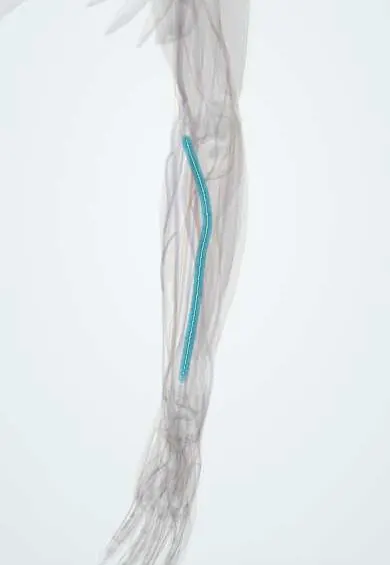
Anterior interosseous nerve !
The anterior interosseous nerve is a deep forearm branch of the median nerve; it moves the deep thumb and index flexors, as in making an 'OK' sign.
Opens in the Durgical app, no sign-up needed.
What it is
A deep branch of the median nerve on the interosseous membrane.
What it does
Powers the deep flexors of the thumb and index and the pronator quadratus (the 'OK' sign).
Key facts
- Roots
- C8–T1, from the median nerve below the elbow
- Moves
- FPL, FDP to index and middle, pronator quadratus
- Feeling from
- No skin (wrist joint only): pure motor 'OK sign' palsy
Relations
- Course
- Branches from the posterior side of the median nerve between the heads of pronator teres, descends on the interosseous membrane with the anterior interosseous artery and ends deep to pronator quadratus, sending fibres to the wrist joint
- In front
- Flexor digitorum superficialis and the median nerve, which continue in front of it
- Behind
- The interosseous membrane of the forearm
- Lateral
- Flexor pollicis longus
- Medial
- Flexor digitorum profundus
How to find it
Not palpable. It is identified in an anterior (Henry) approach to the forearm or in a dissection by following the median nerve between the heads of pronator teres; distally it lies on the interosseous membrane under pronator quadratus, where it is found for nerve transfers.
Examination
- OK sign: asked to make a round 'O' with the tips of thumb and index, a person with AIN palsy makes a flat pad-to-pad pinch with the thumb IP and index DIP joints straight; positive = weak FPL and index FDP
- Pronator quadratus test: resisted pronation with the elbow fully bent (pronator teres slack); weakness supports AIN involvement
- Tenodesis test: passive wrist extension normally flexes the thumb IP and finger DIP joints; this is kept in AIN palsy but lost in FPL or FDP tendon rupture
On imaging
Too small to see reliably, so imaging relies on its muscles. The classic MRI finding is denervation oedema, later fatty atrophy, in FPL, the radial half of FDP and pronator quadratus, the easiest to see. Ultrasound and MRI also look for a compressing band or mass near its origin below the elbow. Nerve conduction studies confirm the lesion.
Clinical notes
- Supracondylar humerus fracture in children: AIN palsy is typical of the extension type with posterolateral displacement; because sensation is normal, the OK sign is part of the routine check
- AIN syndrome (Kiloh–Nevin): palsy without trauma; many cases are a form of neuralgic amyotrophy (Parsonage–Turner) rather than compression
- Distal AIN to deep ulnar motor branch transfer, under pronator quadratus, can reinnervate the hand intrinsics after a high ulnar nerve injury
- Its terminal branch to the wrist can be divided, with the PIN branch, in partial wrist denervation
Anatomical variants
- A median-to-ulnar communicating branch in the forearm (Martin-Gruber anastomosis) is reported in about 10–15% of forearms, around half of them arising from the AIN
- An accessory head of flexor pollicis longus (Gantzer's muscle) lying beside the nerve may compress it
Related conditions
Test yourself
Think of the answer, then tap the question to see it.
What does anterior interosseous nerve palsy weaken, and why is it easily missed?
Thumb IP and index DIP flexion (and pronation); it is pure motor, so there is no sensory loss.
What is the OK sign in anterior interosseous nerve palsy?
Asked to make a round «O» with thumb and index tips, the patient makes a flat pad-to-pad pinch: weak FPL and index FDP.
Which fracture most often injures the anterior interosseous nerve?
The extension-type supracondylar humerus fracture in children, with posterolateral displacement.
How does the tenodesis test separate anterior interosseous nerve palsy from FPL or FDP tendon rupture?
Passive wrist extension still flexes the thumb IP and finger DIP joints in nerve palsy, but not when the tendon is ruptured.
Educational information, not medical advice. For any symptom, see a health professional.
Its names
- Official Latin (TA2)
- nervus interosseus anterior antebrachii TA2 6460
- Official Spanish (DeCS)
- Nervio interóseo anterior del antebrazo
- English (TA2)
- Anterior interosseous nerve
Related
Sources: Terminologia Anatomica (TA2); Anatomy, Shoulder and Upper Limb, Forearm Anterior Interosseous Nerve.
Spotted a mistake?We are always improving for the community. Tell us what is wrong and our team will review it.Report a mistake
Representative model, for educational purposes only.