FPL !
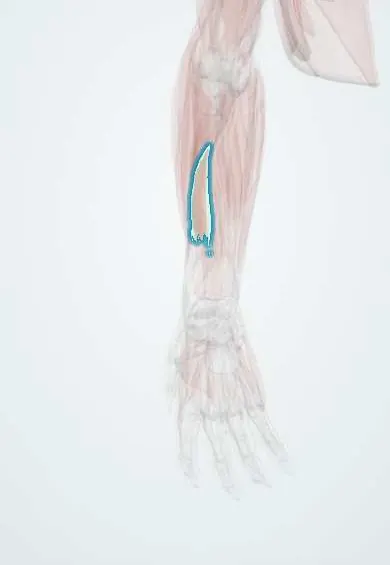
The flexor pollicis longus is a deep forearm muscle whose tendon reaches the thumb tip; it is the only muscle that bends the thumb's end joint.
Official name: Flexor pollicis longus
Opens in the Durgical app, no sign-up needed.
What it is
The deep forearm muscle that bends the thumb tip.
What it does
Bends the thumb, especially its end joint.
Key facts
- Origin
- Anterior radius and interosseous membrane
- Insertion
- Base of the distal phalanx of the thumb
- Action
- Flexes the interphalangeal joint of the thumb
- Nerve
- Anterior interosseous nerve (C8–T1)
- Blood supply
- Anterior interosseous artery
Relations
- Superficial
- Radial head of flexor digitorum superficialis (FDS) and flexor carpi radialis; the radial artery lies on it in the distal forearm
- Deep
- Front of the radius and the interosseous membrane; pronator quadratus at its lower end
- Medial
- Flexor digitorum profundus (FDP), with the anterior interosseous nerve and artery between them
- Course
- Its tendon crosses the carpal tunnel on the radial side, runs between the heads of the flexor pollicis brevis (FPB) and between the thumb sesamoids, and reaches the distal phalanx
How to find it
With the proximal phalanx of the thumb held still, bending the thumb tip shows the tendon working. The belly lies deep on the front of the radius and is met in the volar approach once flexor carpi radialis is retracted.
Examination
- FPL test: the thumb's proximal phalanx is held and the tip is bent; no flexion means tendon rupture, a cut or AIN palsy
- OK sign: the thumb IP joint stays straight when a round O is attempted with the index, pointing to anterior interosseous nerve palsy
On imaging
Ultrasound follows it from the radial side of the carpal tunnel, where it is the most radial flexor tendon, to the thumb's distal phalanx. Rupture shows as a gap with a retracted end. Classic causes: a palmar plate after distal radius fixation rubbing at the radius edge, or a scaphoid spur in rheumatoid arthritis. Radiographs show the plate or spur, not the tendon.
Clinical notes
- Rupture against a volar plate that sits too far distal on the radius (beyond the watershed line) after fracture fixation
- Attrition rupture over a scaphoid spur in rheumatoid arthritis (Mannerfelt lesion)
- AIN palsy can also come from neuralgic amyotrophy, which needs separating from a local compression
Anatomical variants
- Accessory head (Gantzer muscle) from the medial epicondyle or coronoid process, lying behind the median and anterior interosseous nerves; it is one cause of AIN compression
- A tendinous link between FPL and the index FDP (Linburg–Comstock variant) makes the index fingertip bend with the thumb
Related conditions
Test yourself
Think of the answer, then tap the question to see it.
What does loss of thumb tip flexion indicate, given the role of the FPL (flexor pollicis longus)?
The FPL is the only flexor of the thumb IP joint, so a cut or ruptured tendon or an anterior interosseous nerve palsy.
What is the OK sign, and what does it indicate?
When a round O is attempted with the index, the thumb IP joint stays straight; it points to anterior interosseous nerve palsy.
How can the FPL rupture after volar plating of a distal radius fracture?
Against a plate placed too far distal, beyond the watershed line.
Educational information, not medical advice. For any symptom, see a health professional.
Its names
- Official Latin (TA2)
- flexor longus pollicis TA2 2492
- Official Spanish (DeCS)
- Músculo flexor largo del pulgar
- English (TA2)
- Flexor pollicis longus
Related
Sources: Terminologia Anatomica (TA2); Anatomy, Shoulder and Upper Limb, Hand Flexor Pollicis Longus Muscle; Anatomy, Shoulder and Upper Limb, Hand Long Flexor Tendons and Sheaths.
Spotted a mistake?We are always improving for the community. Tell us what is wrong and our team will review it.Report a mistake
Representative model, for educational purposes only.