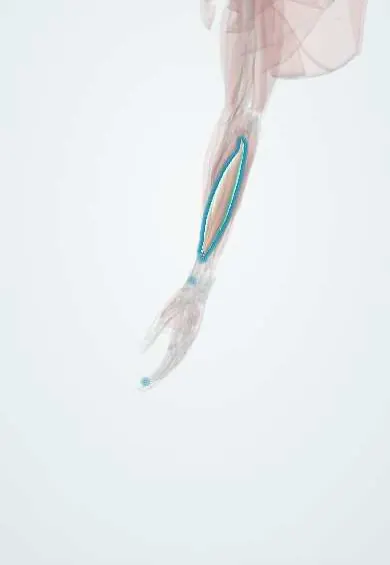
Volkmann ischaemic contracture !
Volkmann contracture is a permanent bending of the wrist and fingers after forearm muscles die from lack of blood, often after an elbow fracture.
Updated 2026-10-29
Structures involved
Tap one to see what it is and open it in 3D.
- FDP
- FPL
- Antebrachial fascia
- Brachial artery
- FDS
- Median nerve
- Ulnar nerve
- Anterior interosseous nerve
- Humerus
- Flexor carpi ulnaris
Why it happens
- Hypoxia, ischemia and reperfusion injury
- Fibrosis in organs: TGF-β and the myofibroblast
- Muscle injury, repair and satellite cells
- Skeletal muscle: sarcomere and contraction
What it is
Permanent flexion deformity of the wrist and fingers caused by death and scarring of forearm muscles after untreated or late-treated ischaemia, classically following a supracondylar humerus fracture or acute compartment syndrome of the forearm.
Who gets it
Now uncommon where compartment syndrome is recognised and treated early, but it still occurs after missed injuries, especially in children with elbow fractures and in adults after crush injuries.
Causes
- Acute compartment syndrome of the forearm that was not decompressed in time
- Supracondylar humerus fracture in children with brachial artery injury or swelling
- Forearm fractures, crush injuries, burns and tight casts or bandages
- Prolonged limb compression (for example during intoxication), reperfusion after vascular repair and intravenous infiltration
Risk factors
- Displaced supracondylar fracture in a child
- High-energy forearm trauma or crush injury
- Circumferential casts or dressings
- Delayed recognition of compartment syndrome, for example in sedated or non-verbal patients
Pathophysiology
Raised pressure inside a closed fascial compartment, or loss of arterial inflow, starves muscle and nerve of oxygen. After several hours the muscle dies; it is then replaced by fibrous scar that shortens. The deep flexors (flexor digitorum profundus and flexor pollicis longus) are the most vulnerable, and the median and ulnar nerves may be caught in the scar.
Classification
- Tsuge mild: localised, mainly the flexor digitorum profundus of two or three fingers, little or no nerve deficit
- Tsuge moderate: all deep flexors and some superficial flexors, with sensory and motor nerve deficits
- Tsuge severe: flexors and extensors involved, with marked nerve damage
Symptoms and signs
- Flexed wrist and fingers that cannot be fully straightened
- Fingers extend more when the wrist is flexed (Volkmann sign), showing shortening of the flexor muscles
- Wasted, firm forearm and weak grip
- Numbness and weakness in the median and ulnar nerve territories
- Clawing of the hand in severe cases
Diagnosis
- Clinical
- History of an injury followed by a fixed flexion deformity; the Volkmann sign; examination of each muscle and nerve to grade severity.
- Tests
- Nerve conduction studies and electromyography map nerve damage. In the acute phase, compartment pressure can be measured when examination is unreliable.
- Imaging
- MRI shows the extent of muscle necrosis and fibrosis; X-rays check old fractures and growth disturbance.
Differential diagnosis
- Dupuytren contracture
- Ulnar or combined nerve palsy (claw hand)
- Spastic contracture from cerebral palsy or stroke
- Post-traumatic joint contracture
- Arthrogryposis or congenital camptodactyly
Goal of treatment
In the acute phase, prevent the contracture by restoring blood flow and decompressing the compartment; once established, release the contracture, protect nerves and restore as much hand function as possible.
Treatment
- Acute
- Prevention: urgent fasciotomy for forearm compartment syndrome and restoration of arterial flow after a supracondylar fracture, removing tight casts and dressings.
- Rehabilitation
- Mild contracture: stretching, serial or dynamic splinting and hand therapy.
- Surgical
- Moderate contracture: excision of necrotic muscle, release of nerves and a flexor-pronator muscle slide or tendon lengthening.
- Surgical
- Severe contracture: tendon transfers, or a free functioning muscle transfer with nerve repair, after scar release.
Complications
- Permanent loss of grip and fine hand function
- Chronic nerve pain and sensory loss
- Limb-length and growth disturbance in children
- Recurrence of the deformity after release
Prognosis
Depends on severity and the time from injury. Mild cases can regain good function with therapy and limited surgery; severe cases keep major disability despite reconstruction. Prevention through early recognition of compartment syndrome is far more effective than treatment.
Prevention
- Repeated neurovascular checks after elbow and forearm fractures
- Avoiding tight casts and forced elbow flexion in swollen limbs
- Early fasciotomy for compartment syndrome
Test yourself
Think of the answer, then tap the question to see it.
Which fracture is classically associated with Volkmann ischaemic contracture?
A displaced supracondylar fracture of the humerus in a child, through brachial artery injury or forearm compartment syndrome.
Which forearm muscles are most vulnerable in Volkmann contracture?
The deep flexors: flexor digitorum profundus and flexor pollicis longus.
What is the Volkmann sign?
The fingers can be extended more when the wrist is flexed, showing shortening of the flexor muscles.
What is the most effective way to prevent Volkmann contracture?
Early recognition of compartment syndrome and urgent fasciotomy, with restoration of arterial flow after injury.
Which nerves are often involved in Volkmann contracture?
The median and ulnar nerves, which can be compressed or damaged by ischaemia and scar.
Related conditions
Educational information, not medical advice. For any symptom, see a health professional.
Sources: Volkmann Contracture (StatPearls (NCBI Bookshelf), 2023).
Spotted a mistake?We are always improving for the community. Tell us what is wrong and our team will review it.Report a mistake
Representative model, for educational purposes only.