Nervous system · Head and neck
Medulla oblongata !
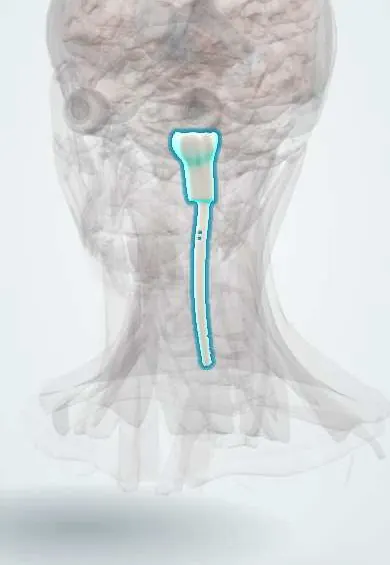
The medulla oblongata is the lowest part of the brainstem, joined to the spinal cord; it controls breathing, heart rate, blood pressure and swallowing.
Opens in the Durgical app, no sign-up needed.
What it is
The lowest part of the brainstem, continuous with the spinal cord.
What it does
Controls breathing, heart rate and blood pressure, swallowing and coughing.
Key facts
- Where
- Lowest brainstem, continuous with the cord at the foramen magnum
- Blood supply
- Vertebral, PICA, anterior spinal arteries
- Function
- Nuclei of IX-XII; breathing, heart rate, blood pressure; pyramids decussate
Relations
- In front
- Pyramids on either side of the anterior median fissure; the vertebral arteries, which join at its upper border to form the basilar artery; hypoglossal rootlets between pyramid and olive
- Lateral
- Olive (inferior olivary nucleus); the glossopharyngeal, vagus and accessory rootlets behind it; the inferior cerebellar peduncle
- Behind
- Lower floor of the fourth ventricle (hypoglossal and vagal trigones, area postrema) above; gracile and cuneate tubercles below; the cerebellar tonsils and the cisterna magna behind
- Above
- Pons, at the pontomedullary sulcus
- Below
- Spinal cord at the foramen magnum, just below the pyramidal decussation and at the first cervical rootlets; in front lie the dens of the axis and the anterior arch of the atlas, so a displaced dens or atlantoaxial instability can crush it
How to find it
It runs from the lower border of the pons to the foramen magnum, where it becomes the spinal cord at the first cervical rootlets. On its front the pyramids flank the midline fissure, with the olive lateral; hypoglossal rootlets emerge between them and glossopharyngeal, vagus and accessory rootlets behind the olive. The cerebellar tonsils lie just behind it at the foramen magnum.
Examination
- Gag and cough reflexes (glossopharyngeal and vagus nerves): absent in medullary failure and part of brain death testing
- Apnoea test: no breathing effort despite a rising carbon dioxide level shows loss of the medullary respiratory centre
- Palate and tongue: the uvula is pulled away from a vagus lesion; the tongue protrudes toward a hypoglossal lesion
On imaging
MRI is the study of choice; on CT, posterior fossa bone artefact hides it. Sagittal images show its shape and the cervicomedullary junction, for example tonsils below the foramen magnum in Chiari I malformation. In lateral medullary syndrome, axial DWI shows a small dorsolateral infarct, sometimes missed in the first day; CT or MR angiography checks the vertebral artery.
Clinical notes
- Tonsillar herniation through the foramen magnum compresses the medulla and stops breathing
- Bulbar palsy (lower motor neuron, e.g. motor neuron disease) wastes and fasciculates the tongue; pseudobulbar palsy (both corticobulbar tracts) gives a stiff, small tongue and emotional lability
- Suboccipital (cisternal) puncture reaches the cisterna magna behind the medulla through the posterior atlanto-occipital membrane; a needle passed too deep or too high can injure the medulla and the vertebral artery or PICA loops nearby
Development
Comes from the myelencephalon, the lower part of the hindbrain vesicle. Its upper half opens out as the lower floor of the fourth ventricle; its lower half stays closed around the central canal.
Memory aid
Wallenberg: 'Don't PICA horse (hoarseness) that can't eat (dysphagia)'.
Related conditions
- Respiratory acidosis
- Respiratory alkalosis
- Leigh syndrome
- Opioid overdose
- Salicylate (aspirin) toxicity
- Benzodiazepine overdose
- Rabies
- Botulism
- Amyotrophic lateral sclerosis
- Coma and brain death
- Brainstem stroke syndromes (Wallenberg and others)
- Sudden infant death syndrome (SIDS)
- Apnoea of prematurity
- Opioid use disorder, overdose and withdrawal
- Serotonin syndrome
- Sedative-hypnotic (benzodiazepine) use disorder and withdrawal
- Obesity hypoventilation syndrome
- Parkinson disease
- Multiple sclerosis
Test yourself
Think of the answer, then tap the question to see it.
What are the features of lateral medullary (Wallenberg) syndrome?
Pain and temperature loss on the same side of the face and opposite side of the body, Horner syndrome, hoarseness, dysphagia, vertigo and ataxia; vertebral artery or PICA.
What does medial medullary syndrome (anterior spinal artery) cause?
Opposite arm and leg weakness (pyramid), opposite loss of position and vibration sense (medial lemniscus), and the tongue deviating toward the lesion.
What is the area postrema of the medulla oblongata?
The vomiting centre in the lower floor of the fourth ventricle; it lies outside the blood–brain barrier and senses toxins in the blood.
What does tonsillar herniation do to the medulla oblongata?
The tonsils pass through the foramen magnum and compress the medulla, which stops breathing.
Educational information, not medical advice. For any symptom, see a health professional.
Its names
- Official Latin (TA2)
- medulla oblongata TA2 5983
- Official Spanish (DeCS)
- Bulbo Raquídeo DeCS D008526
- English (TA2)
- Medulla oblongata
- Also called
- medulla · myelencephalon · bulb
Related
Sources: Terminologia Anatomica (TA2); DeCS; Neuroanatomy, Medulla Oblongata; 13.1 The Embryologic Perspective (OpenStax (Rice University), 2022) · adapted, CC BY 4.0; 13.2 The Central Nervous System (OpenStax (Rice University), 2022) · adapted, CC BY 4.0; Tratado de anatomía humana (9.ª ed.), tomo II, Libro V, sección 2 (Encéfalo), capítulos I-V: bulbo, protuberancia, cerebelo, cuarto ventrículo, mesencéfalo.
Spotted a mistake?We are always improving for the community. Tell us what is wrong and our team will review it.Report a mistake
Representative model, for educational purposes only.