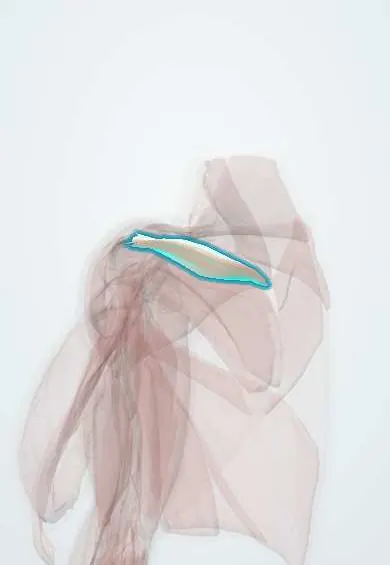
Supraspinatus !
The supraspinatus is a rotator cuff muscle above the spine of the shoulder blade; it starts lifting the arm to the side and keeps the ball centred.
Opens in the Durgical app, no sign-up needed.
What it is
The rotator cuff muscle above the spine of the shoulder blade; its tendon is the one that tears most often.
What it does
Starts lifting the arm to the side and keeps the ball centred.
Key facts
- Origin
- Supraspinous fossa
- Insertion
- Superior facet of the greater tubercle
- Action
- Starts abduction (first ~15°); stabilises the humeral head
- Nerve
- Suprascapular nerve (C5–C6)
- Blood supply
- Suprascapular artery
Relations
- Above
- Trapezius over the belly; laterally the acromion, coracoacromial ligament and AC joint, with the subacromial bursa between
- Deep
- Supraspinous fossa and the suprascapular nerve and artery; laterally the shoulder capsule, with which the tendon blends
- In front
- The rotator interval and, beyond it, the subscapularis
- Behind
- Infraspinatus, whose tendon merges with it near the greater tubercle
How to find it
The belly is felt through the trapezius in the fossa above the spine of the scapula as abduction starts. The tendon comes out from under the acromion and can be palpated just in front of its anterolateral corner with the arm extended and turned in (hand behind the back).
Examination
- Jobe (empty-can) test: arm at 90° in the plane of the scapula, thumb down, resisting downward pressure; weakness suggests a supraspinatus tear or suprascapular nerve lesion, pain alone is less specific
- Full-can test: the same with the thumb up; similar accuracy and less painful
- Drop-arm sign: the arm cannot be lowered slowly from 90° and falls; suggests a large tear
- Neer and Hawkins–Kennedy signs: pain when the greater tubercle is driven under the arch suggests subacromial pain from bursa or tendon
On imaging
Ultrasound with the hand behind the back shows the tendon out from under the acromion. On MRI a full-thickness tear is a fluid-bright gap; on oblique sagittal images muscle that falls below a line from the coracoid to the scapular spine (tangent sign) and fatty change predict a poor repair.
Common problems
- Rotator cuff tear, partial or full, from wear with age or from a fall; the most common cause of shoulder weakness.
- Tendinopathy and impingement: pain lifting the arm and at night.
- Calcific tendinitis: calcium deposits that cause sudden severe pain.
How it is diagnosed
Weakness and pain on cuff tests (for example the empty-can test). Ultrasound or MRI shows the tear size and muscle quality.
Treatment
- Physical therapy, pain medicines and sometimes injections, especially for partial and age-related tears.
- Arthroscopic rotator cuff repair with suture anchors for many full-thickness tears, especially recent ones in active people.
- Reverse shoulder replacement for large, irreparable tears with arthritis.
Clinical notes
- Suprascapular nerve compression at the notch (ligament, ganglion) or traction in overhead athletes mimics a cuff tear on strength testing
- Massive cuff tears let the head ride up toward the acromion and can lead to cuff tear arthropathy
- A zone of the tendon just proximal to its insertion is often described as poorly vascularised and is where degenerative tears usually begin (some texts question the vascular explanation)
Anatomical variants
- An aponeurotic expansion of the tendon reaching toward the intertubercular groove is common on MRI (about half on the cited page)
Development
Its muscle cells come from the C5–C6 somite levels and migrate into the upper limb bud, which shows up at the end of the fourth week. Upper trunk birth palsy (Erb) weakens it along with infraspinatus and deltoid, so the arm hangs adducted and turned in.
Memory aid
Suprascapular notch: 'Army over the bridge, Navy under' (artery over the ligament, nerve under).
Related conditions
Test yourself
Think of the answer, then tap the question to see it.
What are the attachments, nerve and main action of the supraspinatus?
From the supraspinous fossa to the superior facet of the greater tubercle; suprascapular nerve (C5–C6); starts abduction (first ~15°).
Under which arch does the supraspinatus tendon pass, explaining impingement?
The coracoacromial arch (acromion, coracoacromial ligament, AC joint), separated from it only by the subacromial bursa.
How is the Jobe (empty-can) test performed, and what does weakness suggest?
Arm at 90° in the scapular plane, thumb down, resisting downward pressure; weakness suggests a supraspinatus tear or a suprascapular nerve lesion.
A suprascapular nerve lesion weakens the supraspinatus and infraspinatus. Where is it?
At the suprascapular notch; a lesion at the spinoglenoid notch weakens only the infraspinatus.
Educational information, not medical advice. For any symptom, see a health professional.
Its names
- Official Latin (TA2)
- musculus supraspinatus TA2 2457
- Official Spanish (DeCS)
- Músculo supraespinoso
- English (TA2)
- Supraspinatus
Related
Sources: Terminologia Anatomica (TA2); Anatomy, Shoulder and Upper Limb, Arm Supraspinatus Muscle; Anatomy, Rotator Cuff; 8.5 Development of the Appendicular Skeleton (OpenStax (Rice University), 2022) · adapted, CC BY 4.0.
Spotted a mistake?We are always improving for the community. Tell us what is wrong and our team will review it.Report a mistake
Representative model, for educational purposes only.