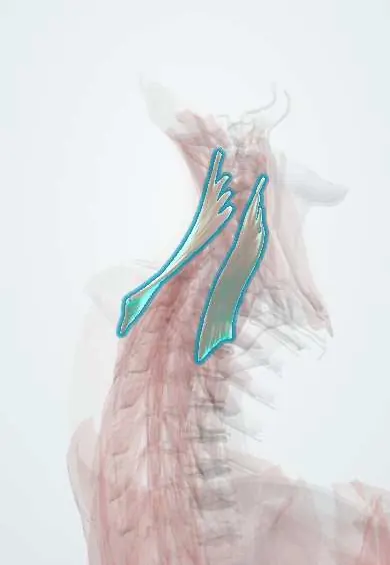
Levator scapulae !
The levator scapulae runs from the upper neck vertebrae to the shoulder blade; it lifts the shoulder blade and is a common site of neck pain.
Opens in the Durgical app, no sign-up needed.
What it is
A muscle from the upper four neck vertebrae to the top corner of the shoulder blade.
What it does
Lifts the shoulder blade and bends the neck to the same side; a common place for 'knots' and neck pain.
Key facts
- Origin
- Posterior tubercles of transverse processes of C1–C4
- Insertion
- Medial border of scapula from superior angle to root of the spine
- Action
- Elevates scapula and rotates glenoid inferiorly; lateral flexion of the neck
- Nerve
- Dorsal scapular nerve (C5) and cervical nerves (C3–C4)
- Blood supply
- Dorsal scapular and transverse cervical arteries
Relations
- Superficial
- Sternocleidomastoid above and trapezius below; in the posterior triangle only fascia, skin and the accessory nerve cover it
- In front
- Middle and posterior scalenes; the dorsal scapular nerve comes out through the middle scalene near its front edge
- Behind
- Splenius capitis and splenius cervicis
- Below
- Superior angle of the scapula, continued below by rhomboid minor
How to find it
With the shoulder shrugged and the neck bent to the same side, it is felt in the posterior triangle behind the posterior edge of sternocleidomastoid; its attachment at the superior angle of the scapula is felt through trapezius.
On imaging
On axial MRI or CT it runs from the upper cervical transverse processes to the superior angle of the scapula, in the floor of the posterior triangle behind sternocleidomastoid. Ultrasound shows it at the superior angle, a common pain site where injections are guided. After accessory nerve injury, MRI or CT shows trapezius atrophy while levator scapulae, with its own nerves, is spared.
Clinical notes
- In lymph node biopsy in the posterior triangle the accessory nerve, lying on the fascia over it, is the structure at risk
- Eden–Lange transfer: moving its insertion and the rhomboids laterally on the scapula can restore shoulder function after a permanent accessory nerve palsy
Anatomical variants
- Origin and insertion vary: the number of slips from the cervical transverse processes and how far its insertion runs on the scapula differ between people
Development
Forms in the lower neck and migrates down to the scapula, taking its nerves with it; this is why it is supplied by cervical nerves (C3–C4 and the dorsal scapular nerve, C5) though it acts on the shoulder blade.
Related conditions
Test yourself
Think of the answer, then tap the question to see it.
What are the attachments of the levator scapulae?
From the posterior tubercles of the C1–C4 transverse processes to the medial border of the scapula, superior angle to spine root.
What nerve supplies the levator scapulae?
The dorsal scapular nerve (C5), with cervical nerves C3–C4.
How does the levator scapulae differ from the upper trapezius in scapular rotation?
Both shrug the shoulder, but the levator scapulae rotates the glenoid down while the trapezius rotates it up.
Educational information, not medical advice. For any symptom, see a health professional.
Its names
- Official Latin (TA2)
- levator scapulae TA2 2234
- Official Spanish (DeCS)
- Músculo elevador de la escápula DeCS D064171
- English (TA2)
- Levator scapulae
- Also called
- levator scapulae muscle
Related
Sources: Terminologia Anatomica (TA2); DeCS; Anatomy, Head and Neck, Levator Scapulae Muscles; Anatomy of the Human Body (20th ed.): Development of the Muscles (Lea & Febiger (Gray's Anatomy, 1918), 1918) · adapted, Public domain.
Spotted a mistake?We are always improving for the community. Tell us what is wrong and our team will review it.Report a mistake
Representative model, for educational purposes only.