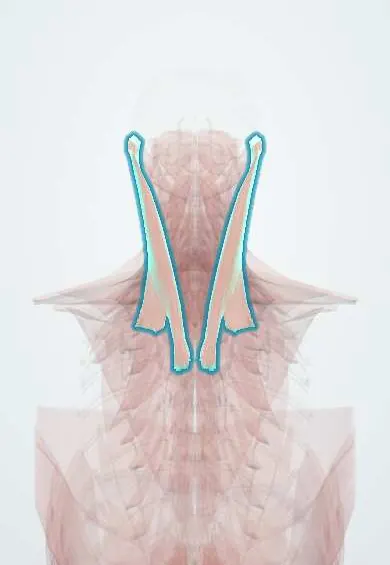
Torticollis !
Torticollis is a twisted neck: the head tilts to one side while the chin turns to the other; in babies it is often a tight neck muscle.
Updated 2026-10-29
Structures involved
Tap one to see what it is and open it in 3D.
- Sternocleidomastoid
- Atlas–axis joints
- Atlas (C1)
- Axis (C2)
- Trapezius
- Levator scapulae
- Splenius
- Scalenes
- Transverse ligament of the atlas
- Base of the skull
In embryology
- Paraxial mesoderm and somites: sclerotome, myotome, dermatome
- Muscles: somites, epaxial and hypaxial
- Developmental dysplasia of the hip
- Hemivertebra, congenital scoliosis and Klippel–Feil
What it is
Abnormal twisted posture of the head and neck: the head tilts to one side while the chin turns to the other. It can be congenital, usually from a tight sternocleidomastoid muscle, or acquired.
Who gets it
Congenital muscular torticollis is one of the most common musculoskeletal conditions of newborns. Acute acquired torticollis (wry neck) is very common in children and adults.
Causes
- Congenital muscular torticollis: fibrosis and shortening of the sternocleidomastoid
- Acute wry neck from muscle spasm or a minor facet joint problem
- Atlantoaxial rotatory subluxation, including Grisel syndrome after throat or ear infection or surgery
- Infection: retropharyngeal abscess, cervical lymphadenitis
- Drug-induced acute dystonia (antipsychotics, some antiemetics) and cervical dystonia
- Trauma, eye problems (fourth nerve palsy), vertebral anomalies and posterior fossa tumours
Risk factors
- Breech position, difficult delivery or first pregnancy (congenital form)
- Recent upper respiratory or throat infection (Grisel syndrome)
- Recent use of dopamine-blocking drugs
- Down syndrome and other conditions with ligament laxity (atlantoaxial instability)
Pathophysiology
In the congenital form, the sternocleidomastoid becomes fibrotic and short, perhaps from crowding in the womb or birth trauma. The tight muscle tilts the head toward its side and turns the chin away. In acquired forms, muscle spasm, rotatory displacement of C1 on C2, inflammation or abnormal brain signals hold the head in the same posture.
Classification
- Congenital: muscular (sternocleidomastoid), postural, or bony (vertebral anomalies)
- Acquired: traumatic, infectious or inflammatory, neurological (dystonia, tumour), ocular
- Cervical dystonia (spasmodic torticollis) in adults
Symptoms and signs
- Head tilted toward one side with the chin turned to the other
- Limited neck rotation and side bending
- In infants: a firm lump in the sternocleidomastoid in the first weeks and flattening of the skull (plagiocephaly)
- In acute wry neck: sudden painful neck stiffness, often on waking
- In cervical dystonia: involuntary twisting, tremor and pain
Diagnosis
- Clinical
- Age, onset, drug history and exam of the neck muscles, range of motion, eyes and neurology. In infants, check the hips for dysplasia.
- Tests
- Blood count and inflammatory markers when infection is suspected.
- Imaging
- Ultrasound of the sternocleidomastoid in infants; neck X-rays for vertebral anomalies; dynamic CT for atlantoaxial rotatory subluxation; CT or MRI for abscess, tumour or trauma.
Differential diagnosis
- Atlantoaxial rotatory subluxation
- Retropharyngeal abscess
- Posterior fossa tumour
- Ocular torticollis (fourth nerve palsy)
- Cervical spine fracture or congenital vertebral anomaly
- Benign paroxysmal torticollis of infancy
Goal of treatment
Find and treat the cause, restore full neck movement and head position, and prevent skull and facial asymmetry in infants.
Treatment
- Rehabilitation
- Infants: early stretching of the sternocleidomastoid and positioning by physiotherapists and caregivers; most improve within months.
- Conservative
- Acute wry neck: heat, gentle movement and reassurance; treatment of the cause in infection or rotatory subluxation (sometimes traction and a collar).
- Medical
- Analgesics and muscle relaxants for acute wry neck; anticholinergic or antihistamine drugs for drug-induced dystonia; botulinum toxin injections for cervical dystonia.
- Surgical
- Surgical release or lengthening of the sternocleidomastoid for congenital torticollis that persists despite therapy; fusion for chronic irreducible atlantoaxial subluxation.
Complications
- Plagiocephaly and facial asymmetry in infants
- Permanent limitation of neck movement
- Neurological injury from untreated subluxation or infection
Prognosis
Congenital muscular torticollis treated early with stretching has an excellent outcome, and few need surgery. Acute wry neck resolves within days to a couple of weeks. Outcome of other forms depends on the cause.
Test yourself
Think of the answer, then tap the question to see it.
In congenital muscular torticollis, which way do the head and chin point?
The head tilts toward the affected sternocleidomastoid and the chin turns to the opposite side.
Which hip condition should be screened for in an infant with congenital muscular torticollis?
Developmental dysplasia of the hip, which is associated with it.
What is the first-line treatment for congenital muscular torticollis?
Early stretching and positioning with physiotherapy; surgery is reserved for persistent cases.
What is Grisel syndrome?
Non-traumatic atlantoaxial rotatory subluxation after a throat or ear infection or surgery, causing torticollis.
Which drug classes can cause acute dystonic torticollis?
Dopamine-blocking drugs such as antipsychotics and some antiemetics; it responds to anticholinergic or antihistamine drugs.
Related conditions
Educational information, not medical advice. For any symptom, see a health professional.
Sources: Congenital Torticollis (StatPearls (NCBI Bookshelf), 2024).
Spotted a mistake?We are always improving for the community. Tell us what is wrong and our team will review it.Report a mistake
Representative model, for educational purposes only.