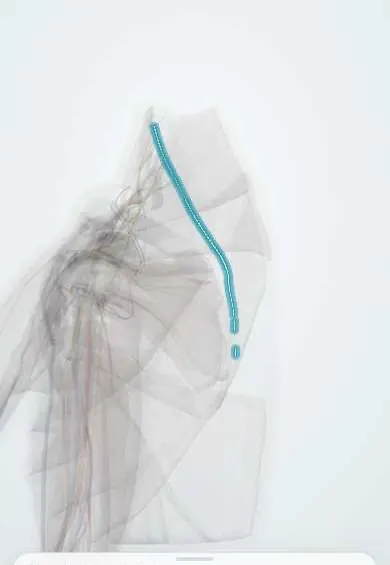
Dorsal scapular nerve !
The dorsal scapular nerve runs along the inner edge of the shoulder blade; it moves the rhomboids and the levator scapulae.
Opens in the Durgical app, no sign-up needed.
What it is
A nerve from the C5 root that runs down along the inner edge of the shoulder blade.
What it does
Powers the rhomboids and levator scapulae.
Key facts
- Roots
- C5 root
- Moves
- Rhomboids, levator scapulae
- Feeling from
- None
Relations
- Course
- From the back of the C5 root it pierces the middle scalene, runs down and back deep to levator scapulae and descends along the medial border of the scapula, deep to rhomboid minor and rhomboid major, supplying them
- Superficial
- Levator scapulae, rhomboid minor and rhomboid major, and over them the trapezius
- Deep
- Serratus posterior superior and the posterior chest wall
- Lateral
- The medial border of the scapula, a short distance away
How to find it
Not palpable. It runs a short distance medial to the medial border of the scapula, with the dorsal scapular artery, deep to the rhomboids; in entrapment there may be tenderness there or over the middle scalene.
Examination
- Rhomboid test: hand on the hip, the person pushes the elbow backward against resistance while the rhomboids are felt along the medial border; weakness, or a scapula that drifts outward and wings mildly, indicates rhomboid palsy
- EMG of the rhomboids helps place a lesion at the C5 root rather than at the upper trunk
On imaging
Not seen on routine imaging. Ultrasound can follow it through or beside the middle scalene and then deep to levator scapulae, running with the dorsal scapular artery along the medial border of the scapula. Denervation of the rhomboids or levator scapulae shows on MRI as oedema, then fatty atrophy; electromyography confirms, and cervical spine MRI excludes a C5 root lesion.
Clinical notes
- Weak rhomboids and serratus anterior in an upper plexus injury suggest damage at root level, possibly an avulsion; sparing suggests a lesion at the upper trunk or below
- Entrapment in an enlarged middle scalene (overhead work, athletes) causes interscapular pain and mild winging
- C5 radiculopathy weakens the rhomboids together with the deltoid, supraspinatus and biceps
Anatomical variants
- It may receive fibres from C4 (prefixed pattern) and may share its origin with the C5 part of the long thoracic nerve
Development
The rhomboids belong with trapezius and latissimus dorsi among the superficial muscles that migrate over the deep back muscles; they keep a ventral-ramus supply (C5, sometimes C4) through this nerve, unlike the deep back muscles, which dorsal rami supply.
Related conditions
Test yourself
Think of the answer, then tap the question to see it.
From where does the dorsal scapular nerve arise, and why does that matter in plexus injuries?
From the C5 root itself, before the trunks form; weak rhomboids suggest a root-level injury, possibly an avulsion.
Which muscles does the dorsal scapular nerve supply?
The rhomboids and levator scapulae.
Which muscle does the dorsal scapular nerve pierce, and what does entrapment there cause?
The middle scalene; entrapment causes aching along the medial border of the scapula and mild winging.
Educational information, not medical advice. For any symptom, see a health professional.
Its names
- Official Latin (TA2)
- nervus dorsalis scapulae TA2 6409
- Official Spanish (DeCS)
- Nervio dorsal de la escápula
- English (TA2)
- Dorsal scapular nerve
Related
Sources: Terminologia Anatomica (TA2); Anatomy, Shoulder and Upper Limb, Dorsal Scapular Nerve; Anatomy of the Human Body (20th ed.): Development of the Muscles (Lea & Febiger (Gray's Anatomy, 1918), 1918) · adapted, Public domain.
Spotted a mistake?We are always improving for the community. Tell us what is wrong and our team will review it.Report a mistake
Representative model, for educational purposes only.