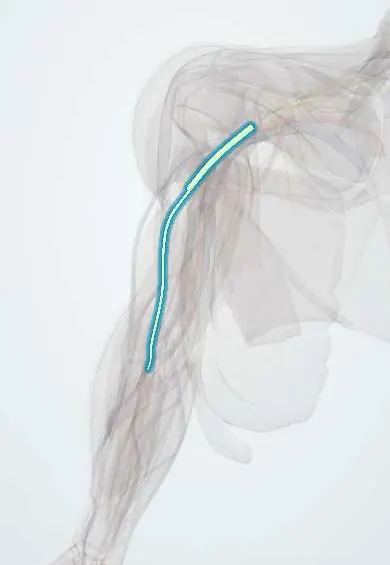
Musculocutaneous nerve !
The musculocutaneous nerve runs through the front of the upper arm; it moves the elbow benders and gives feeling to the outer forearm.
Opens in the Durgical app, no sign-up needed.
What it is
The nerve that pierces coracobrachialis and runs between the biceps and brachialis.
What it does
Powers the elbow benders at the front of the arm; ends as feeling on the outer forearm.
Key facts
- Roots
- C5–C7, lateral cord
- Moves
- Coracobrachialis, biceps, brachialis
- Feeling from
- Lateral forearm (lateral antebrachial cutaneous nerve)
Relations
- Course
- From the lateral cord at the lower border of pectoralis minor it runs laterally, pierces coracobrachialis, descends between biceps and brachialis, supplying all three, and appears lateral to the biceps tendon above the elbow as the lateral antebrachial cutaneous nerve
- In front
- Biceps brachii
- Behind
- Brachialis
- Medial
- The axillary artery and the median nerve, before it enters coracobrachialis
How to find it
Not palpable. On ultrasound in the axilla it appears as a bright flattened oval inside coracobrachialis or between it and biceps, apart from the other nerves around the axillary artery. In anterior shoulder approaches it is found entering the deep surface of the conjoint tendon (coracobrachialis and short head of biceps).
Examination
- Resisted elbow flexion with the forearm fully supinated (biceps, brachialis) compared with flexion in mid-pronation (brachioradialis): weakness only in supination points to the musculocutaneous nerve
- Biceps reflex (C5–C6) reduced or absent
- Pinprick along the lateral forearm
On imaging
Rarely imaged for its own sake. On axillary ultrasound it leaves the plexus, pierces coracobrachialis and runs between biceps and brachialis, a landmark in axillary blocks, where it must be blocked separately. After injury, MRI shows denervation oedema in biceps and brachialis. Its end branch, the lateral cutaneous nerve of the forearm, lies beside the biceps tendon at the elbow.
Common problems
- Rarely injured alone; can be stretched in shoulder trauma or surgery near the coracoid.
- Injury weakens elbow bending and numbs the outer forearm.
How it is diagnosed
Biceps strength, biceps reflex and feeling on the outer forearm; EMG.
Treatment
- Observation and physical therapy for stretch injuries.
- Nerve repair or transfer for injuries that do not recover.
Clinical notes
- Retraction of the conjoint tendon or coracoid transfer (Latarjet) for shoulder instability can stretch it
- Isolated palsy is described after heavy weight training or carrying loads on the shoulder, from compression inside coracobrachialis
- After upper trunk injury, fascicles of the ulnar or median nerve can be transferred to its biceps and brachialis branches (Oberlin-type transfer) to restore elbow flexion
Anatomical variants
- It may be absent, the median nerve then supplying the anterior arm muscles and the lateral forearm skin
- Communicating branches between the musculocutaneous and median nerves in the arm are common, and it sometimes passes beside coracobrachialis instead of through it
Development
It takes anterior-division fibres (C5–C7) from the lateral cord into the ventral (flexor) mass of the arm; its frequent connections with the median nerve reflect that both draw on the lateral cord.
Memory aid
'BBC': Biceps, Brachialis, Coracobrachialis.
Related conditions
Test yourself
Think of the answer, then tap the question to see it.
Which muscle does the musculocutaneous nerve pierce, and where?
Coracobrachialis, a few centimetres below the coracoid process.
Which muscles does the musculocutaneous nerve supply, and what is its skin territory?
Coracobrachialis, biceps and brachialis; the lateral forearm, via the lateral antebrachial cutaneous nerve.
Why is the musculocutaneous nerve often missed by an axillary block?
It leaves the sheath high, inside coracobrachialis, so it is blocked separately.
After an isolated musculocutaneous nerve lesion, why is elbow flexion in mid-pronation preserved?
Brachioradialis, supplied by the radial nerve, still flexes the elbow; flexion with the forearm supinated is weak.
Educational information, not medical advice. For any symptom, see a health professional.
Its names
- Official Latin (TA2)
- nervus musculocutaneus TA2 6421
- Official Spanish (DeCS)
- Nervio musculocutáneo
- English (TA2)
- Musculocutaneous nerve
Related
Sources: Terminologia Anatomica (TA2); Anatomy, Shoulder and Upper Limb, Musculocutaneous Nerve; Anatomy, Shoulder and Upper Limb, Forearm Nerves; Anatomy of the Human Body (20th ed.): The Branchial Region (Lea & Febiger (Gray's Anatomy, 1918), 1918) · adapted, Public domain.
Spotted a mistake?We are always improving for the community. Tell us what is wrong and our team will review it.Report a mistake
Representative model, for educational purposes only.