Joints and ligaments · Lower limb
Sacroiliac ligaments !
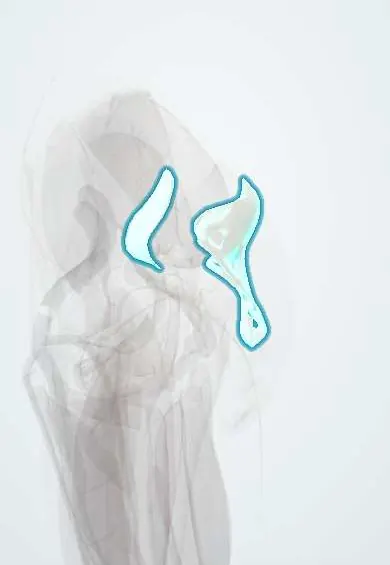
The sacroiliac ligaments are very strong bands joining the sacrum to the hip bones; they allow only tiny movements.
Official name: Anterior, interosseous and posterior sacroiliac ligaments
Opens in the Durgical app, no sign-up needed.
What it is
Very strong ligaments in front of, behind and between the sacrum and the hip bones, holding the sacroiliac (SI) joints together.
What it does
Lock the pelvis into a strong ring that passes the body's weight from the spine to the legs. They allow only a few degrees of movement.
Key facts
- Attaches
- Anterior, interosseous and posterior sacroiliac ligaments: sacrum to ilium; interosseous between the tuberosities
- Function
- Bind sacrum to ilia; interosseous is strongest; transfer trunk weight to pelvis with tiny movement
- Tight in
- Sacral nutation; long posterior sacroiliac ligament in counternutation
Relations
- In front
- Iliacus and psoas; the lumbosacral trunk and the L5 nerve root cross in front of the joint, beside the internal iliac vessels
- Behind
- Multifidus and erector spinae, the thoracolumbar fascia and the origin of gluteus maximus
- Below
- Sacrotuberous and sacrospinous ligaments, which continue the support below
How to find it
The posterior superior iliac spine, under the skin dimple level with the second sacral spine, sits over the middle of the joint, and the posterior ligaments lie deep to it. The long posterior ligament can be pressed as a firm cord just below the spine; the interosseous and anterior ligaments are out of reach.
Examination
- FABER (Patrick) test: pain in the back of the pelvis points to the sacroiliac joint; pain in the groin points to the hip
- Gaenslen test: one hip held flexed while the other leg hangs into extension off the table; pain at the sacroiliac joint is positive
- Distraction and compression tests: pressure apart on both ASIS (supine) or down on the iliac crest (side-lying) reproducing sacroiliac pain
- Thigh thrust: hip flexed to 90° and pushed back along the femur; buttock pain on that side is positive
On imaging
AP pelvis X-ray shows widening in pelvic ring injuries and erosions, sclerosis or fusion in sacroiliitis. CT is best for fractures and joint widening. MRI (fat-suppressed sequences) shows the bone-marrow oedema of active sacroiliitis.
Common problems
- SI joint pain: low back and buttock pain, sometimes into the thigh, from strain, a fall, uneven leg loading or arthritis.
- Loosening during pregnancy, from hormones that relax the ligaments.
- Inflammation of the joint (sacroiliitis), for example in some types of arthritis.
- Tears with pelvic fractures from high-energy injuries.
How it is diagnosed
Physical exam with pain provocation tests; X-rays, CT or MRI; a numbing injection into the joint can confirm the source of pain.
Treatment
- Physical therapy, a pelvic belt and anti-inflammatory medicine.
- Injections into the joint, or treatment of the small nerves that carry pain from it.
- SI joint fusion surgery for selected long-lasting cases; surgical fixation for unstable fractures.
Clinical notes
- Pelvic ring injuries are graded by which sacroiliac ligaments are torn: anterior only (APC II) or anterior and posterior (APC III, unstable)
- Iliosacral screws are placed close to the L5 root and the lumbosacral trunk in front of the joint
- Sacroiliitis is an early sign of axial spondyloarthritis
Anatomical variants
- Accessory sacroiliac joints between the ilium and the sacrum, behind the main joint; reported frequency varies widely, and they are more common in older people
Related conditions
Test yourself
Think of the answer, then tap the question to see it.
In an open-book pelvic injury, which sacroiliac ligament fails first?
The thin anterior sacroiliac ligament; the posterior ligaments may hold (APC II), and if they also tear the injury is unstable (APC III).
Which is the strongest of the sacroiliac ligaments?
The interosseous sacroiliac ligament, between the tuberosities of the sacrum and ilium.
Which sacroiliac ligament is felt just below the posterior superior iliac spine and is often tender in pregnancy?
The long posterior sacroiliac ligament, often tender in pregnancy-related pelvic girdle pain.
How should sacroiliac pain provocation tests be interpreted?
As a cluster: several positive tests (such as FABER, Gaenslen, distraction, compression, thigh thrust) make the joint a likelier source than any single test.
Educational information, not medical advice. For any symptom, see a health professional.
Its names
- Official Latin (TA2)
- ligamentum sacroiliacum anterius; ligamentum sacroiliacum interosseum; ligamentum sacroiliacum posterius TA2 1862
- Official Spanish (DeCS)
- Ligamentos sacroilíacos DeCS D012446
- English (TA2)
- Anterior, interosseous and posterior sacroiliac ligaments
- Also called
- ligamenta sacroiliaca anteriora · ligamenta sacroilica ventralia
Related
Sources: Terminologia Anatomica (TA2); DeCS; Anatomy, Abdomen and Pelvis, Sacroiliac Joint; Anatomy of the Human Body (20th ed.): Surface Markings of the Lower Extremity (Lea & Febiger (Gray's Anatomy, 1918), 1918) · adapted, Public domain; Anatomía humana (4.ª ed.), tomo 1, cap. 64: Cintura pelviana.
Spotted a mistake?We are always improving for the community. Tell us what is wrong and our team will review it.Report a mistake
Representative model, for educational purposes only.