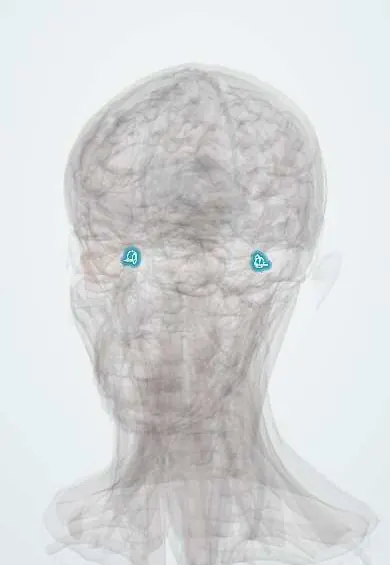
Semicircular canals !
The semicircular canals are three fluid-filled loops in the inner ear at right angles to each other; they sense head rotation for balance.
Opens in the Durgical app, no sign-up needed.
What it is
Three fluid-filled loops at right angles to each other.
What it does
Sense head rotation; loose crystals in them cause positional vertigo (BPPV).
Key facts
- Where
- Three canals at right angles (anterior, posterior, lateral)
- Blood supply
- Labyrinthine artery
- Nerve
- Vestibular part of VIII
- Function
- Sense head rotation (posterior canal = most common BPPV)
Relations
- Contents
- Membranous semicircular ducts with endolymph, floating in perilymph inside the bony canals
- In front
- Vestibule, into whose utricle the canals open by five openings (the anterior and posterior share a common limb)
- Lateral
- The lateral canal bulges into the medial wall of the aditus and mastoid antrum, a landmark in mastoid surgery
- Above
- The anterior canal raises the arcuate eminence on the petrous ridge, under the floor of the middle cranial fossa
How to find it
The anterior canal lies roughly at right angles to the long axis of the petrous bone, the posterior canal roughly parallel to it, and the lateral canal about 30° from the horizontal when the head is upright, which is why the head is tilted forward for caloric testing.
Examination
- Dix–Hallpike: the head is turned 45° and the person is laid back quickly with the head hanging slightly over the end of the couch; latency, torsional upbeating nystagmus and fatigue indicate posterior canal BPPV
- Supine roll test: horizontal nystagmus on turning the head to each side indicates lateral canal BPPV
- Head impulse test: a corrective saccade after a quick head turn toward one side shows a weak vestibular input on that side (vestibular neuritis); a normal result in acute vertigo raises concern for stroke
- Caloric test: water or air in the ear canal makes endolymph flow in the lateral canal; cold gives nystagmus beating away, warm toward the tested side
- Fistula test: pressure in the ear canal producing vertigo and nystagmus suggests erosion of the lateral canal by cholesteatoma
On imaging
BPPV is diagnosed clinically. CT of the temporal bone shows a dehiscent anterior canal or a canal eroded by cholesteatoma; MRI is used when central causes or a vestibular schwannoma are suspected.
Common problems
- Benign paroxysmal positional vertigo (BPPV): loose crystals cause brief spinning when turning in bed or looking up.
- Vestibular neuritis and Ménière disease also cause vertigo.
How it is diagnosed
Positional tests (Dix-Hallpike) that trigger the vertigo and the typical eye movements.
Treatment
- Repositioning manoeuvres (such as Epley) that move the crystals out of the canal.
- Balance exercises (vestibular rehabilitation).
Clinical notes
- BPPV is treated with canalith repositioning manoeuvres that roll the particles back into the utricle (Epley or Semont for the posterior canal, barbecue roll for the lateral)
- Vestibular neuritis: hours to days of constant vertigo with nystagmus and no hearing loss; with hearing loss it is called labyrinthitis
- Ménière disease: episodes of vertigo lasting minutes to hours with fluctuating hearing loss, tinnitus and fullness
- In mastoidectomy the lateral canal marks the level of the facial nerve, which runs just below it
Development
The canals bud from the utricular part of the otic vesicle; the bony canals are fully formed and adult-sized at birth.
Memory aid
Caloric nystagmus: «COWS», Cold Opposite, Warm Same (direction of the fast phase).
Related conditions
Test yourself
Think of the answer, then tap the question to see it.
What does the ampulla of each semicircular duct contain, and how does it sense head rotation?
A crista whose gelatinous cupula is bent by endolymph flow when the head rotates.
Which semicircular canal is most often affected in BPPV, and what does the Dix–Hallpike test show?
The posterior canal: after a short delay, brief upbeating torsional nystagmus that fatigues.
In caloric testing, which way does the fast phase of nystagmus beat with cold and with warm water?
Cold: away from the tested ear; warm: toward it («COWS», Cold Opposite, Warm Same). The water makes endolymph flow in the lateral canal.
What does a corrective saccade on the head impulse test mean in acute vertigo?
A weak vestibular input on the side of the head turn, as in vestibular neuritis; a normal result in acute vertigo raises concern for stroke.
What causes vertigo with loud sounds or pressure in superior canal dehiscence?
Missing bone over the anterior semicircular canal; affected people may also hear their own body sounds.
Educational information, not medical advice. For any symptom, see a health professional.
Its names
- Official Latin (TA2)
- canales semicirculares TA2 6954
- Official Spanish (DeCS)
- Canales Semicirculares DeCS D012665
- English (TA2)
- Semicircular canals
Related
Sources: Terminologia Anatomica (TA2); DeCS; Inner Ear Anatomy and Cochlear Physiology; Benign Paroxysmal Positional Vertigo.
Spotted a mistake?We are always improving for the community. Tell us what is wrong and our team will review it.Report a mistake
Representative model, for educational purposes only.