Conditions · Pediatrics and neonatology
Bronchopulmonary dysplasia !
A chronic lung disease of babies born very early who needed oxygen or a ventilator. The lungs grow abnormally and stay stiff and scarred.
Updated 2026-11-01
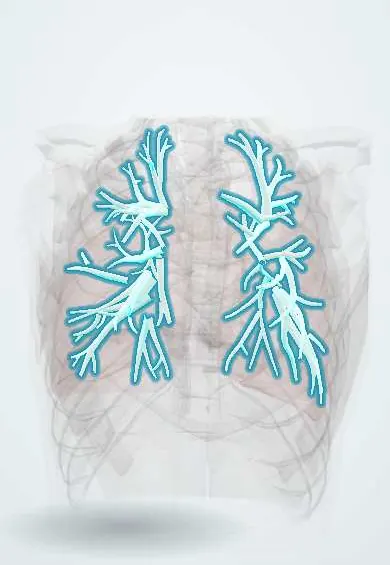
Structures involved
Tap one to see what it is and open it in 3D.
Why it happens
- Oxidative stress and free-radical injury
- Prematurity and fetal growth restriction
- Neonatal respiratory distress syndrome: surfactant and hyaline membranes
- Diffusion across the respiratory membrane and DLCO
- The alveolus: type I and II pneumocytes, surfactant, the blood–air barrier
What it is
Chronic lung disease of infancy in which very preterm babies, usually after oxygen therapy or mechanical ventilation, develop arrested alveolar and vascular growth. It is defined by a continued need for oxygen or breathing support at 36 weeks postmenstrual age.
Who gets it
The most common chronic complication of extreme prematurity; its frequency rises sharply as gestational age and birth weight fall. In Colombia and Latin America it has become more visible as more very preterm babies survive in neonatal intensive care units.
Causes
- Lung injury in an immature lung, in the canalicular or saccular stage of development
- Oxygen toxicity (free radicals) and ventilator injury (volutrauma, barotrauma)
- Inflammation from prenatal or postnatal infection
Risk factors
- Birth before 28–30 weeks and very low birth weight
- Neonatal respiratory distress syndrome needing prolonged ventilation
- Chorioamnionitis and postnatal sepsis
- Hemodynamically significant patent ductus arteriosus
- Fetal growth restriction and male sex
- Excess fluids in the first days
Pathophysiology
The "new" BPD is mainly arrested development: fewer, larger, simplified alveoli and a reduced, dysmorphic capillary bed rather than the heavy fibrosis of the original form. Gas exchange area falls, airways are hyper-reactive, and the abnormal vascular bed can lead to pulmonary hypertension and right heart strain.
Classification
- Mild: needs no supplemental oxygen at 36 weeks after having needed it for at least 28 days
- Moderate: needs less than 30% oxygen at 36 weeks
- Severe: needs 30% oxygen or more, or positive-pressure support, at 36 weeks
Symptoms and signs
- Persistent oxygen requirement beyond the first weeks
- Tachypnea, retractions and nasal flaring
- Wheezing and crackles
- Episodes of desaturation with feeding or handling
- Poor weight gain because of high breathing effort
Diagnosis
- Clinical
- Diagnosed in a preterm infant by the level of oxygen or respiratory support needed at 36 weeks postmenstrual age.
- Tests
- Pulse oximetry and blood gases (hypoxemia, chronic CO2 retention with compensation); echocardiography to screen for pulmonary hypertension.
- Imaging
- Chest X-ray shows hazy or streaky opacities, hyperinflation and, in severe cases, cystic areas; chest CT in selected cases.
Differential diagnosis
- Persistent respiratory distress syndrome
- Neonatal pneumonia
- Congenital heart disease with pulmonary overcirculation
- Recurrent aspiration or tracheoesophageal fistula
- Congenital lung malformations
Goal of treatment
Prevent further lung injury, support lung growth and nutrition, keep oxygen saturation in a safe target range, and detect pulmonary hypertension early.
Treatment
- Acute
- Lung-protective respiratory support: early non-invasive ventilation, gentle ventilation when needed, and titrated oxygen; surfactant for respiratory distress syndrome.
- Medical
- Caffeine helps shorten ventilation; diuretics, inhaled bronchodilators and, in selected infants, systemic corticosteroids are used, weighing neurodevelopmental risks.
- Medical
- Immunoprophylaxis against RSV with monoclonal antibodies and routine vaccines, since viral infections can be severe.
- Follow-up
- Pulse oximetry, growth and nutrition tracking, screening echocardiograms for pulmonary hypertension, and follow-up of neurodevelopment.
- Lifestyle
- High-calorie nutrition with fluid limits, and a smoke-free home; some infants go home on oxygen.
Complications
- Pulmonary hypertension and cor pulmonale
- Recurrent wheezing and hospital admissions for viral infections
- Growth failure
- Neurodevelopmental delay
- Reduced lung function into adulthood
Prognosis
Most infants improve as new lung grows during the first years, but wheezing and lower lung function often persist. BPD with pulmonary hypertension carries a markedly higher mortality.
Prevention
- Antenatal corticosteroids when preterm birth is expected
- Non-invasive ventilation and careful oxygen targets
- Early caffeine in very preterm infants
Test yourself
Think of the answer, then tap the question to see it.
At what age is bronchopulmonary dysplasia defined by oxygen or support needs?
At 36 weeks postmenstrual age in a preterm infant.
What is the main histological feature of the "new" BPD?
Arrested alveolar development: fewer, larger, simplified alveoli with a reduced capillary bed.
Which serious cardiovascular complication is screened for in BPD?
Pulmonary hypertension, with echocardiography, as it can cause right heart failure.
Which two mechanisms of injury drive BPD?
Oxygen toxicity and ventilator-induced lung injury in an immature lung, with inflammation from infection.
Related conditions
- Prematurity and its complications
- Neonatal respiratory distress syndrome (hyaline membrane disease)
- Persistent pulmonary hypertension of the newborn
- Apnoea of prematurity
- Retinopathy of prematurity
- Patent ductus arteriosus
- Bronchiolitis (RSV)
- Asthma
Educational information, not medical advice. For any symptom, see a health professional.
Sources: Bronchopulmonary dysplasia (MedlinePlus Medical Encyclopedia (U.S. National Library of Medicine), 2025).
Spotted a mistake?We are always improving for the community. Tell us what is wrong and our team will review it.Report a mistake
Representative model, for educational purposes only.