Conditions · Pediatrics and neonatology
Persistent pulmonary hypertension of the newborn !
At birth the lung arteries fail to relax, so blood bypasses the lungs through fetal channels and the baby stays blue despite oxygen.
Updated 2026-11-01
Structures involved
Tap one to see what it is and open it in 3D.
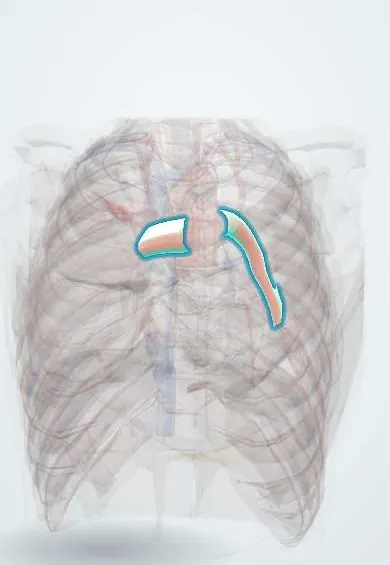
- Pulmonary arteries
- Ligamentum arteriosum
- Pulmonary trunk
- Right ventricle
- Right atrium
- Interatrial septum
- Aortic arch
Why it happens
- Fetal circulation and the transition at birth
- The pulmonary circulation and hypoxic vasoconstriction
- Nitric oxide (NO)
What it is
Failure of the normal fall in pulmonary vascular resistance after birth. Pulmonary pressure stays at or above systemic pressure, and blood shunts right to left through the ductus arteriosus and foramen ovale, causing severe hypoxemia, usually in term or near-term newborns.
Who gets it
Uncommon but serious, affecting mostly term and late-preterm infants, and is a major reason for neonatal intensive care admission. In Colombia, meconium aspiration and births at high altitude are relevant contexts.
Causes
- Maladaptation: parenchymal disease such as meconium aspiration, respiratory distress syndrome, pneumonia or sepsis
- Maldevelopment: idiopathic, with remodeled pulmonary arteries and a clear chest X-ray
- Underdevelopment: pulmonary hypoplasia, as in congenital diaphragmatic hernia or oligohydramnios
- Obstruction: polycythemia with high blood viscosity
Risk factors
- Meconium-stained amniotic fluid and perinatal asphyxia
- Maternal use of SSRIs or NSAIDs late in pregnancy
- Cesarean birth without labor, post-term birth
- Maternal diabetes and obesity
- Congenital diaphragmatic hernia
Pathophysiology
Normally lung expansion, rising oxygen and nitric oxide relax the pulmonary arteries at birth. In PPHN they stay constricted or remodeled, so right ventricular pressure stays high and deoxygenated blood crosses the open ductus arteriosus into the descending aorta and the foramen ovale into the left atrium. Hypoxemia and acidosis cause further vasoconstriction, a vicious cycle.
Symptoms and signs
- Cyanosis within hours of birth that responds poorly to oxygen
- Tachypnea and respiratory distress
- Labile hypoxemia with large swings in saturation on handling
- Differential cyanosis: higher saturation in the right hand than in the feet
- Loud single second heart sound or tricuspid regurgitation murmur
Diagnosis
- Clinical
- Suspected in a term newborn with hypoxemia out of proportion to lung disease; pre-ductal (right hand) and post-ductal (foot) pulse oximetry differ by more than about 5–10%.
- Tests
- Arterial blood gases and oxygenation index, blood count and cultures for sepsis, glucose and calcium.
- Imaging
- Echocardiography is the key test: it shows right-to-left or bidirectional shunting at the ductus or foramen ovale, tricuspid regurgitation and septal flattening, and excludes cyanotic congenital heart disease. Chest X-ray shows the underlying lung disease or clear, dark lungs in idiopathic PPHN.
Differential diagnosis
- Cyanotic congenital heart disease (transposition of the great arteries, total anomalous pulmonary venous return)
- Severe respiratory distress syndrome or pneumonia
- Sepsis
- Transient tachypnea of the newborn
- Pneumothorax
Goal of treatment
Lower pulmonary vascular resistance, keep systemic pressure up and oxygen delivery adequate, and treat the underlying cause.
Treatment
- Acute
- Supportive care: normothermia, correction of glucose, calcium and acidosis, minimal handling, sedation, and antibiotics when sepsis is possible.
- Acute
- Optimal lung recruitment with conventional or high-frequency ventilation, surfactant when there is parenchymal disease, and oxygen titrated to avoid both hypoxemia and hyperoxia.
- Medical
- Inhaled nitric oxide, a selective pulmonary vasodilator, is the first-line specific therapy; it is weaned slowly to avoid rebound.
- Medical
- Inotropes and vasopressors to keep systemic pressure above pulmonary pressure; phosphodiesterase inhibitors in refractory cases.
- Procedure
- Extracorporeal membrane oxygenation (ECMO) for refractory hypoxemia despite maximal therapy.
Complications
- Hypoxic-ischemic brain injury
- Sensorineural hearing loss
- Chronic lung disease
- Neurodevelopmental delay
- Death
Prognosis
Most infants survive with modern care, but mortality remains significant in severe or hypoplastic forms, and survivors need hearing and neurodevelopmental follow-up.
Test yourself
Think of the answer, then tap the question to see it.
Through which two fetal channels does blood shunt in PPHN?
The ductus arteriosus and the foramen ovale, right to left.
What bedside finding suggests ductal shunting in PPHN?
A pre-ductal (right hand) saturation more than about 5–10% higher than post-ductal (foot) saturation.
What is the key diagnostic test for PPHN?
Echocardiography, which also rules out cyanotic congenital heart disease.
What is the first-line selective pulmonary vasodilator?
Inhaled nitric oxide.
What is a common parenchymal cause of PPHN in term newborns?
Meconium aspiration syndrome (others: pneumonia, sepsis, respiratory distress syndrome).
Related conditions
- Meconium aspiration syndrome
- Congenital diaphragmatic hernia
- Neonatal sepsis
- Neonatal respiratory distress syndrome (hyaline membrane disease)
- Transient tachypnea of the newborn
- Patent ductus arteriosus
- Transposition of the great arteries
- Pulmonary hypertension and cor pulmonale
- Bronchopulmonary dysplasia
Educational information, not medical advice. For any symptom, see a health professional.
Sources: Persistent pulmonary hypertension of the newborn (Maternal Health, Neonatology and Perinatology, 2015).
Spotted a mistake?We are always improving for the community. Tell us what is wrong and our team will review it.Report a mistake
Representative model, for educational purposes only.