
Carotid sinus hypersensitivity and carotid sinus syndrome
In some older people, pressure on the neck where the pulse is felt makes the heart pause or blood pressure fall, causing faints or falls.
What it is
An exaggerated carotid baroreceptor reflex, mainly in older adults. Carotid sinus hypersensitivity is an abnormal response to carotid sinus massage (a pause of more than 3 seconds, a systolic fall of more than 50 mmHg, or both); carotid sinus syndrome is that response plus spontaneous syncope reproduced by massage.
Who gets it
Almost confined to older people (mean age about 75 in syncope series) and more common in men. A hypersensitive response is rare before 40 and common after 80, and carotid sinus syndrome explains a meaningful share of unexplained syncope and some unexplained falls in older adults. The cardioinhibitory component dominates in most patients.
Causes
- Age-related baroreflex dysfunction (baroreceptor or brainstem changes); the exact cause is unknown
- Mechanical triggers: turning or extending the neck, tight collars or ties
- Neck lesions that compress or irritate the sinus: tumours, previous neck surgery or radiotherapy
- Most patients have no local trigger
Risk factors
- Older age
- Male sex
- Drugs that slow the heart or lower blood pressure (worsen episodes)
Pathophysiology
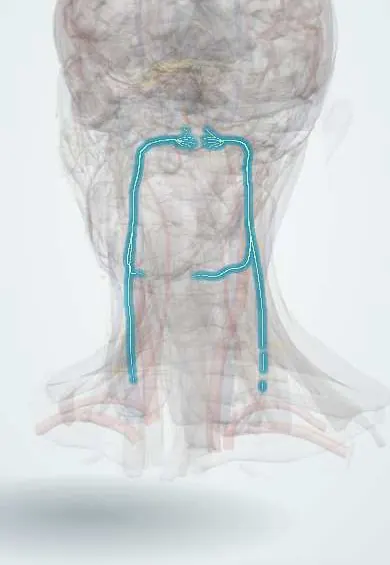
Stretch of the carotid sinus is signalled through the glossopharyngeal nerve to the medulla. In carotid sinus hypersensitivity the reflex reply is exaggerated. The cardioinhibitory arm acts through the vagus nerve, causing sinus arrest or AV block and asystole. The vasodepressor arm is sympathetic withdrawal, causing vasodilatation and a fall in blood pressure without much change in rate. Either one can drop cerebral perfusion enough for syncope; brief episodes may be remembered only as a fall because of amnesia for the event.
Classification
- Carotid sinus hypersensitivity: abnormal response to massage without spontaneous symptoms
- Carotid sinus syndrome: syncope with symptoms reproduced by massage
- Cardioinhibitory: asystole of more than 3 seconds (the most common type)
- Vasodepressor: systolic fall of more than 50 mmHg without significant asystole
- Mixed: both responses
Symptoms and signs
- Sudden syncope or near-syncope with little or no warning
- Episodes triggered by turning the head, looking up, shaving or a tight collar (often no trigger is recalled)
- Unexplained falls, sometimes with amnesia for losing consciousness
- Injuries from falls
- Rapid recovery once lying down
Diagnosis
- Clinical
- Consider it in an older adult with unexplained syncope or falls, especially if linked to neck movement or collars. Start with the standard syncope work-up (history, examination, lying and standing blood pressure, ECG). Carotid sinus massage is done by a trained clinician with continuous ECG and beat-to-beat blood pressure monitoring, supine and then upright, about 10 seconds on each side in turn, never both at once.
- Tests
- Positive massage: asystole of more than 3 seconds and/or a systolic fall of more than 50 mmHg; reproduction of the patient's symptoms makes it carotid sinus syndrome. Massage is avoided with a carotid bruit or a stroke, transient ischaemic attack or myocardial infarction in the last 3 months; rare complications are neurological events and transient atrial fibrillation. Prolonged ECG monitoring or an implantable loop recorder can catch spontaneous pauses.
- Imaging
- Carotid duplex ultrasound when a bruit or cerebrovascular disease raises concern before massage. Echocardiography only when structural heart disease is suspected.
Differential diagnosis
- Orthostatic hypotension
- Vasovagal (reflex) syncope
- Sick sinus syndrome or AV block
- Ventricular arrhythmia or aortic stenosis
- Transient ischaemic attack or seizure
- Mechanical falls without loss of consciousness
An older adult who faints or falls: which reflex or rhythm?
| Feature | Carotid sinus syndrome | Orthostatic hypotension | Sick sinus syndrome |
|---|---|---|---|
| Trigger | Neck turning, tight collar, often none | Standing up, after meals, hot weather | None; may occur at rest or after a fast rhythm ends |
| Key test | Carotid sinus massage under monitoring | Lying and standing blood pressure | ECG monitoring showing pauses or bradycardia |
| Mechanism | Exaggerated baroreflex: vagal pause and/or vasodilatation | Failure of the reflex that tightens vessels on standing | Diseased sinus node |
| Pacemaker helps? | Cardioinhibitory type only | No | Yes, for symptomatic bradycardia |
Goal of treatment
Prevent syncope and injurious falls by removing triggers and drugs that worsen the reflex, and pace the heart when the cardioinhibitory arm causes symptomatic pauses.
Treatment
- Procedure
- Permanent pacing, preferably dual-chamber, for recurrent syncope from cardioinhibitory or mixed carotid sinus syndrome; single-chamber ventricular pacing if the patient is in permanent atrial fibrillation. Some recurrence persists because of the vasodepressor component.
- Conservative
- Avoid triggers (tight collars, sudden neck turning), and review and reduce drugs that lower blood pressure or slow the heart.
- Medical
- Vasodepressor type: more fluid and salt when safe; selected patients may receive drugs that raise blood pressure under specialist care, limited by supine hypertension. Results are often unsatisfactory.
- Rehabilitation
- Falls prevention: home safety review, strength and balance training, and planning for injury risk.
Complications
- Fractures and head injury from falls
- Recurrent syncope despite pacing (vasodepressor component)
- Loss of confidence and independence
Common traps
- A positive carotid massage explains the faint: hypersensitivity is common in older people without syncope; the diagnosis is carotid sinus syndrome only when massage reproduces the patient's symptoms
- A pacemaker cures it: pacing stops the asystole but not the vasodepressor fall in blood pressure, so the type must be defined first
- Massage both carotids together for a stronger test: they are massaged one at a time with full monitoring, never together, and not with a bruit or recent stroke or infarction
- No loss of consciousness was reported, so it was just a trip: older adults often have amnesia for brief syncope, so unexplained falls can be carotid sinus syndrome
Prognosis
Not life-threatening in itself, but falls cause serious injury. Pacing greatly reduces syncope in cardioinhibitory disease, though some patients still have episodes. Vasodepressor forms are harder to control.
Prevention
- Avoid tight collars and sudden neck movements in people with known hypersensitivity
- Review blood pressure-lowering and rate-slowing drugs in older adults with falls
- Falls prevention programmes for older adults
Test yourself
Think of the answer, then tap the question to see it.
An 80-year-old man faints while turning his head to reverse his car. Which reflex is suspected, and how is it tested?
Carotid sinus syndrome. Carotid sinus massage, one side at a time, supine and upright, with continuous ECG and beat-to-beat blood pressure monitoring.
What responses to carotid sinus massage define the cardioinhibitory and vasodepressor types?
Cardioinhibitory: asystole of more than 3 seconds. Vasodepressor: systolic fall of more than 50 mmHg without significant asystole. Mixed: both.
Why does a pacemaker not prevent every faint in carotid sinus syndrome?
It treats only the vagal pause. A vasodepressor component, from sympathetic withdrawal and vasodilatation, still lowers blood pressure.
When should carotid sinus massage be avoided?
With a carotid bruit, or after a stroke, transient ischaemic attack or myocardial infarction in the previous 3 months.
Which nerves carry the two limbs of the carotid sinus reflex?
The glossopharyngeal nerve carries the afferent signal to the medulla; the vagus slows the heart, and sympathetic withdrawal causes vasodilatation.
Connections
Educational information, not medical advice. For any symptom, see a health professional.
Sources: Carotid sinus syndrome: Progress in understanding and management (Global Cardiology Science & Practice, 2014).
Spotted a mistake?We are always improving for the community. Tell us what is wrong and our team will review it.Report a mistake
Representative model, for educational purposes only.