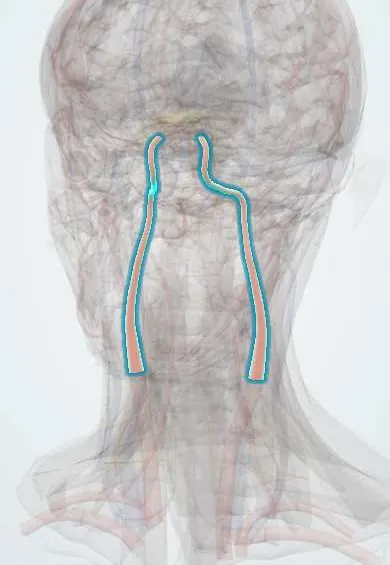
Carotid artery stenosis !
Carotid artery stenosis is narrowing of the main neck artery to the brain by fatty plaque; pieces can break off and cause a stroke.
Updated 2026-10-29
Structures involved
Tap one to see what it is and open it in 3D.
- Carotid bifurcation
- Internal carotid artery
- Common carotid artery
- External carotid artery
- Middle cerebral artery
- Ophthalmic artery
- Carotid sheath
- Hypoglossal nerve (XII)
- Vagus nerve
In physiology
Why it happens
What it is
Narrowing of the carotid artery, almost always from atherosclerotic plaque at the bifurcation and origin of the internal carotid artery. It causes a large share of ischaemic strokes, mainly by embolism from the plaque.
Who gets it
Increases with age and with cardiovascular risk factors. Ischaemic stroke is a major cause of death and disability in Colombia and Latin America, and carotid disease is one of its treatable causes.
Causes
- Atherosclerosis (most cases)
- Less often: fibromuscular dysplasia, radiation-induced arteritis, dissection, vasculitis
Risk factors
- Older age and male sex
- Smoking
- Arterial hypertension
- Diabetes
- Dyslipidaemia
- Coronary or peripheral artery disease
- Previous neck radiotherapy
Pathophysiology
Turbulent flow at the carotid bifurcation favours plaque build-up. An unstable plaque can ulcerate and release emboli of thrombus or cholesterol into the middle cerebral or ophthalmic arteries. Very tight stenosis or occlusion can also reduce flow when collateral circulation through the circle of Willis is poor.
Classification
- Asymptomatic or symptomatic (ipsilateral stroke, TIA or amaurosis fugax in recent months)
- Degree of stenosis by NASCET method: mild, moderate, severe, near-occlusion, occlusion
Symptoms and signs
- Often no symptoms; a carotid bruit may be heard
- Transient monocular vision loss (amaurosis fugax)
- Transient or permanent weakness or numbness of the face, arm or leg on the opposite side
- Aphasia when the dominant hemisphere is affected
- Cholesterol emboli in retinal arterioles (Hollenhorst plaques)
Diagnosis
- Clinical
- Suspected after a TIA, stroke or amaurosis fugax in the carotid territory. A neck bruit is unreliable and its absence does not exclude stenosis. Population screening of asymptomatic people is not recommended by most guidelines.
- Tests
- Lipid profile, glucose or HbA1c and ECG for atrial fibrillation as part of the stroke risk work-up.
- Imaging
- Carotid duplex ultrasound is the first test. CT angiography or MR angiography confirm the degree of stenosis and plan treatment; brain CT or MRI looks for infarcts.
Differential diagnosis
- Cardioembolic stroke (atrial fibrillation)
- Carotid or vertebral dissection
- Small-vessel (lacunar) disease
- Migraine aura
- Seizure with postictal weakness
- Hypoglycaemia
Goal of treatment
Prevent stroke by stabilising the plaque and reducing risk factors, and remove or open severe symptomatic stenosis early when the benefit outweighs the procedural risk.
Treatment
- Medical
- Best medical therapy for everyone: antiplatelet agents, high-intensity statins, blood pressure and glucose control.
- Lifestyle
- Stopping smoking, regular physical activity, healthy diet and weight control.
- Surgical
- Carotid endarterectomy for symptomatic moderate-to-severe stenosis, ideally within about two weeks of symptoms; selected asymptomatic severe stenosis. Thresholds vary between guidelines.
- Procedure
- Carotid artery stenting as an alternative in selected patients, for example with high surgical risk, restenosis or a radiation-treated neck.
- Follow-up
- Periodic duplex ultrasound to follow progression or restenosis after treatment.
Complications
- Ischaemic stroke
- Transient ischaemic attacks
- Retinal artery occlusion
- Procedural stroke, myocardial infarction
- Cranial nerve injury (hypoglossal, vagus) and neck haematoma after endarterectomy
Prognosis
The risk of stroke is highest in the weeks after a first symptom, which is why early treatment matters. Asymptomatic stenosis carries a lower annual risk that has fallen with modern medical therapy.
Prevention
- Control of hypertension, diabetes and lipids
- Not smoking
- Prompt evaluation of any TIA or amaurosis fugax
Test yourself
Think of the answer, then tap the question to see it.
Where does carotid atherosclerotic plaque most often form?
At the carotid bifurcation and the origin of the internal carotid artery.
What is amaurosis fugax and what does it suggest?
Transient monocular vision loss from emboli to the ophthalmic or retinal artery, suggesting ipsilateral carotid disease.
What is the first imaging test for suspected carotid stenosis?
Carotid duplex ultrasound.
When does endarterectomy give the greatest benefit in symptomatic stenosis?
In moderate-to-severe stenosis, performed early, ideally within about two weeks of the event.
Which cranial nerve injury causes tongue deviation after carotid endarterectomy?
Hypoglossal nerve (XII) injury: the tongue deviates towards the injured side.
Related conditions
- Ischaemic stroke
- Atherosclerosis and dyslipidaemia
- Arterial hypertension
- Type 2 diabetes mellitus
- Peripheral artery disease
- Transient ischaemic attack
- Migraine
Educational information, not medical advice. For any symptom, see a health professional.
Sources: Carotid Artery Stenosis (StatPearls (NCBI Bookshelf), 2026).
Spotted a mistake?We are always improving for the community. Tell us what is wrong and our team will review it.Report a mistake
Representative model, for educational purposes only.