Transient ischaemic attack !
A transient ischaemic attack (TIA) is a brief stroke-like episode that goes away fully; it is a warning sign of a high, near-term stroke risk.
Updated 2026-10-29
Structures involved
Tap one to see what it is and open it in 3D.
- Internal carotid artery
- Middle cerebral artery
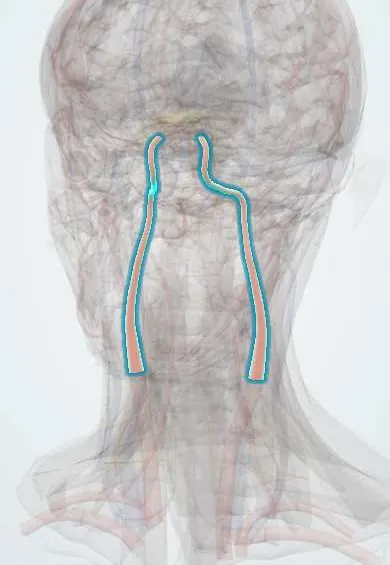
- Vertebral artery
- Basilar artery
- Carotid bifurcation
- Common carotid artery
- Circle of Willis
- Ophthalmic artery
- Central retinal artery
- Posterior cerebral artery
In the clinical exam
Why it happens
- Systemic (arterial) thromboembolism
- Reversible vs irreversible cell injury: the point of no return
- Cerebral blood flow, brain metabolism and intracranial pressure
What it is
A brief episode of focal neurological dysfunction caused by ischaemia of the brain, spinal cord or retina, without infarction on imaging. It is a warning sign: the short-term risk of stroke is high, so it is managed as an emergency.
Who gets it
Risk rises with age and with the same vascular risk factors as stroke. Hypertension, diabetes and atrial fibrillation are common in Colombia, and rapid access to imaging varies between regions.
Causes
- Atherosclerosis of the carotid or vertebrobasilar arteries (artery-to-artery embolism or low flow)
- Cardioembolism, mainly from atrial fibrillation
- Small-vessel (lacunar) disease
- Less common: arterial dissection, vasculitis, hypercoagulable states
Risk factors
- Older age
- Arterial hypertension
- Diabetes
- Dyslipidaemia
- Smoking
- Atrial fibrillation and other cardiac sources of emboli
- Previous stroke or TIA
Pathophysiology
A clot or reduced flow briefly starves a vascular territory of oxygen. Blood flow returns before tissue dies, so symptoms resolve, usually within minutes. The modern definition is tissue-based: if imaging shows infarction, the event is a stroke, whatever its duration.
Symptoms and signs
- Sudden weakness or numbness of the face, arm or leg on one side
- Speech or language disturbance (dysarthria, aphasia)
- Transient monocular blindness (amaurosis fugax)
- Homonymous visual field loss
- Vertigo with diplopia, ataxia or dysarthria (posterior circulation)
- Complete resolution, usually within an hour
Diagnosis
- Clinical
- Based on the history, often from witnesses, as the examination is usually normal. The ABCD2 score (age, blood pressure, clinical features, duration, diabetes) has been used to estimate early risk, though current guidance favours urgent assessment for everyone.
- Tests
- ECG and prolonged rhythm monitoring for atrial fibrillation; blood glucose (hypoglycaemia mimics TIA), full blood count, lipids and HbA1c. Echocardiography when a cardiac source is suspected.
- Imaging
- Urgent brain imaging, MRI with diffusion-weighted sequences preferred, to look for infarction. Carotid Doppler ultrasound, CT angiography or MR angiography to assess the neck and intracranial arteries.
Differential diagnosis
- Hypoglycaemia
- Focal seizure with post-ictal (Todd) paresis
- Migraine with aura
- Syncope
- Peripheral vertigo
- Functional neurological disorder
Goal of treatment
Find the cause fast and start secondary prevention at once to prevent a stroke in the following days and weeks.
Treatment
- Acute
- Same-day specialist assessment, ideally in a rapid-access TIA clinic or stroke unit; ongoing symptoms are managed as acute stroke.
- Medical
- Antiplatelet therapy, with short-term dual antiplatelet therapy for selected high-risk minor events; anticoagulation instead when atrial fibrillation is the cause.
- Medical
- High-intensity statin, blood pressure control and good glucose control.
- Surgical
- Carotid endarterectomy (or stenting in selected cases) for symptomatic significant carotid stenosis, ideally within two weeks.
- Lifestyle
- Stopping smoking, regular exercise, healthy diet, limited alcohol and weight control.
Drugs for this condition
Complications
- Ischaemic stroke, most often in the first days
- Recurrent TIA
- Myocardial infarction and other vascular events
- Bleeding from antithrombotic treatment
Prognosis
Stroke risk is concentrated in the first 48 hours to 7 days. Rapid assessment and prompt secondary prevention substantially lower that risk.
Prevention
- Control of blood pressure, lipids and diabetes
- Not smoking
- Detection and anticoagulation of atrial fibrillation
- Regular physical activity
Test yourself
Think of the answer, then tap the question to see it.
What separates a TIA from an ischaemic stroke in the current tissue-based definition?
Absence of acute infarction on imaging; if MRI shows infarction it is a stroke, whatever the symptom duration.
What is amaurosis fugax and which artery does it point to?
Sudden painless transient monocular vision loss; it suggests emboli from the ipsilateral internal carotid artery.
When is the risk of stroke after a TIA highest?
In the first 48 hours to 7 days, which is why assessment and secondary prevention are urgent.
Which bedside test must always be done to exclude a common TIA mimic?
Capillary blood glucose, to exclude hypoglycaemia.
Which antithrombotic strategy replaces antiplatelets when TIA is due to atrial fibrillation?
Oral anticoagulation.
Related conditions
- Ischaemic stroke
- Atrial fibrillation
- Arterial hypertension
- Atherosclerosis and dyslipidaemia
- Type 2 diabetes mellitus
- Carotid artery stenosis
- Giant cell arteritis
- Migraine
Educational information, not medical advice. For any symptom, see a health professional.
Sources: Transient Ischemic Attack (StatPearls (NCBI Bookshelf), 2026).
Spotted a mistake?We are always improving for the community. Tell us what is wrong and our team will review it.Report a mistake
Representative model, for educational purposes only.