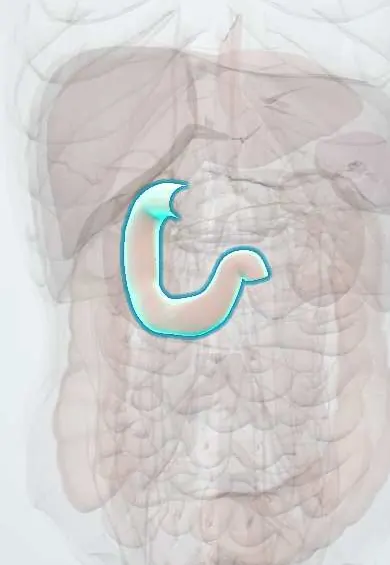
Coeliac disease !
Coeliac disease is an immune reaction to gluten (in wheat, barley and rye) that damages the lining of the small intestine and impairs absorption of food.
Updated 2026-10-29
Structures involved
Tap one to see what it is and open it in 3D.
In biochemistry
In immunology
- Mucosa-associated lymphoid tissue (tonsils, Peyer patches)
- Autoantibodies: the table to know
- HLA associations with disease
- MHC/HLA class I and II
In histology
- Cilia, microvilli and stereocilia
- Small intestine: villi, crypts, enterocytes, Paneth cells; duodenum vs jejunum vs ileum
- Enteroendocrine cells and GALT
In physiology
- Carbohydrate digestion and absorption
- Fat digestion and absorption
- Protein digestion and absorption
- Absorption of iron, calcium and vitamin B12
- Patterns of malabsorption
Why it happens
What it is
Immune-mediated disease of the small intestine triggered by gluten (from wheat, barley and rye) in genetically predisposed people, causing villous atrophy and malabsorption.
Who gets it
Affects children and adults worldwide. Once thought rare in Latin America, it is now recognised across the region and is probably underdiagnosed because many cases have few or atypical symptoms.
Causes
- Immune reaction to gluten peptides (gliadin) in genetically susceptible people
- HLA-DQ2 or HLA-DQ8 is needed (almost all patients carry one)
- Tissue transglutaminase modifies gliadin and is the target of autoantibodies
Risk factors
- First-degree relative with coeliac disease
- Type 1 diabetes and autoimmune thyroid disease
- Selective IgA deficiency
- Down, Turner and Williams syndromes
Pathophysiology
Gluten peptides cross the gut lining and are modified by tissue transglutaminase, which makes them bind strongly to HLA-DQ2 or DQ8 and activate T cells. The inflammation produces intraepithelial lymphocytes, crypt hyperplasia and villous atrophy, mostly in the duodenum and proximal jejunum, reducing absorption of iron, folate, calcium and fat.
Classification
- Classical (malabsorption) versus non-classical (mild or extraintestinal symptoms)
- Subclinical and potential coeliac disease
- Refractory coeliac disease (types I and II)
- Histology: Marsh-Oberhuber grading
Symptoms and signs
- Chronic diarrhoea, steatorrhoea, bloating, abdominal pain
- Weight loss; in children, failure to thrive and short stature
- Iron deficiency anaemia that does not respond to iron
- Fatigue, mouth ulcers, raised liver enzymes
- Low bone density, delayed puberty, infertility
- Dermatitis herpetiformis: itchy blisters on elbows, knees and buttocks
Diagnosis
- Clinical
- Considered in typical symptoms, unexplained iron deficiency, osteoporosis or high-risk groups. Testing is done while the patient still eats gluten.
- Tests
- Anti-tissue transglutaminase IgA (anti-tTG) with total IgA; IgG-based tests in IgA deficiency; anti-endomysial antibodies as confirmation. Duodenal biopsies (several, including the bulb) show villous atrophy. HLA-DQ2/DQ8 typing helps rule it out. Some children with very high antibody levels can skip biopsy; criteria vary.
- Imaging
- Not used for diagnosis. Bone densitometry at diagnosis in adults.
Differential diagnosis
- Irritable bowel syndrome
- Non-coeliac gluten or wheat sensitivity
- Lactose intolerance
- Giardiasis and other intestinal infections
- Crohn disease
- Tropical sprue
Goal of treatment
Heal the intestine and remove symptoms with a strict, lifelong gluten-free diet, correct deficiencies and prevent long-term complications.
Treatment
- Lifestyle
- Strict lifelong gluten-free diet (no wheat, barley or rye), taught by a dietitian with attention to cross-contamination.
- Medical
- Correction of deficiencies: iron, folate, vitamin B12, calcium and vitamin D.
- Follow-up
- Follow-up with symptoms and anti-tTG levels to check adherence; repeat biopsy in selected cases.
- Follow-up
- Screening for associated autoimmune conditions and bone disease.
- Medical
- Refractory disease: specialist assessment and immunosuppressive treatment.
Complications
- Iron deficiency anaemia
- Osteoporosis and fractures
- Growth failure and delayed puberty
- Infertility and pregnancy complications
- Enteropathy-associated T-cell lymphoma and small bowel adenocarcinoma (rare)
- Refractory coeliac disease
Prognosis
Excellent with good adherence to a gluten-free diet: symptoms improve within weeks and the mucosa heals over months to years. Poor adherence keeps the risk of complications.
Prevention
- No proven primary prevention
- Screening of first-degree relatives and high-risk groups
Test yourself
Think of the answer, then tap the question to see it.
Which antibody test is first-line for coeliac disease?
Anti-tissue transglutaminase IgA, together with total IgA to exclude IgA deficiency, while the patient is eating gluten.
What does duodenal biopsy show in coeliac disease?
Intraepithelial lymphocytosis, crypt hyperplasia and villous atrophy (Marsh-Oberhuber grading).
Why must the patient keep eating gluten before testing?
A gluten-free diet lowers antibodies and heals the mucosa, giving false-negative serology and biopsy.
Which skin disease is a manifestation of coeliac disease?
Dermatitis herpetiformis: itchy vesicles on extensor surfaces, with IgA deposits in the skin.
What is the treatment of coeliac disease?
A strict, lifelong gluten-free diet with correction of nutritional deficiencies.
Related conditions
Educational information, not medical advice. For any symptom, see a health professional.
Sources: Celiac Disease (StatPearls (NCBI Bookshelf), 2026).
Spotted a mistake?We are always improving for the community. Tell us what is wrong and our team will review it.Report a mistake
Representative model, for educational purposes only.