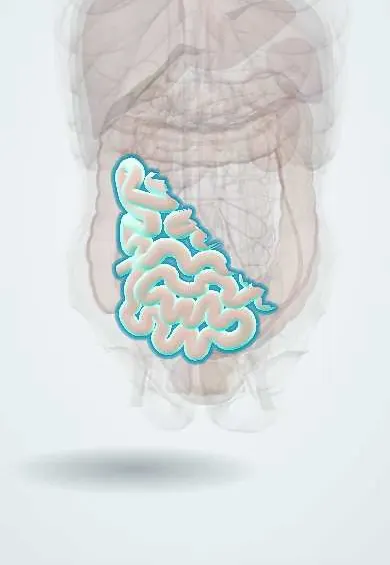
Crohn disease !
Crohn disease is a chronic inflammatory bowel disease that can affect any part of the gut in patches; it causes pain, diarrhoea, narrowing and fistulas.
Updated 2026-10-29
Structures involved
Tap one to see what it is and open it in 3D.
In biochemistry
In immunology
- Mucosa-associated lymphoid tissue (tonsils, Peyer patches)
- Type IV hypersensitivity (delayed, T cells)
- HLA associations with disease
- Lymphocyte recirculation and homing
- Monoclonal antibodies and biologics: naming and targets
- Pattern recognition: PAMPs, DAMPs, Toll-like receptors
- Granulomatous inflammation
- Cytokines: the table to know
- IL-10 and TGF-β (the brakes)
- IL-12 and IL-23
- Interleukin-17
- TNF-α
- Adhesion molecules: selectins and integrins
In histology
- Small intestine: villi, crypts, enterocytes, Paneth cells; duodenum vs jejunum vs ileum
- Large intestine, appendix and anal canal
In physiology
- Bile and the enterohepatic circulation
- Fat digestion and absorption
- Absorption of iron, calcium and vitamin B12
- Patterns of malabsorption
Why it happens
- Autophagy
- Chronic inflammation: causes, cells and features
- Granulomatous inflammation: caseating vs non-caseating, the causes to know
- Precancerous conditions: when chronic inflammation, metaplasia or hyperplasia raise the risk
- Tobacco: how smoking injures tissue
- Enteroendocrine cells and GALT
What it is
Chronic, relapsing inflammatory bowel disease that can affect any part of the digestive tract from mouth to anus, with patchy (skip) lesions and transmural inflammation that leads to strictures and fistulas.
Who gets it
Usually starts between the teens and the thirties, with a second smaller peak later in life. Incidence is rising in Latin America, including Colombia, although ulcerative colitis is generally reported more often in the region.
Causes
- Abnormal immune response to gut bacteria in genetically susceptible people
- Susceptibility genes such as NOD2
- Environmental triggers and changes in the gut microbiome
Risk factors
- Smoking (raises risk and worsens the course)
- Family history of inflammatory bowel disease
- Urban, industrialised lifestyle
- Frequent antibiotic use (proposed)
Pathophysiology
Inflammation involves the full thickness of the wall (transmural) and appears in skip lesions separated by normal bowel. The terminal ileum and caecum are most often affected. Deep ulcers give a cobblestone mucosa, non-caseating granulomas may form, and wall damage leads to strictures, fistulas and abscesses.
Classification
- Montreal: age at diagnosis, location (ileal, colonic, ileocolonic, upper GI) and behaviour (inflammatory, stricturing, penetrating), plus perianal disease
- Activity scores (for example CDAI, Harvey-Bradshaw)
Symptoms and signs
- Chronic diarrhoea, usually without visible blood
- Abdominal pain, often in the right lower quadrant, with a possible mass
- Weight loss, fatigue, fever; growth delay in children
- Perianal disease: fistulas, abscesses, fissures, skin tags
- Mouth ulcers
- Extraintestinal: arthritis, sacroiliitis, erythema nodosum, pyoderma gangrenosum, episcleritis, uveitis
Diagnosis
- Clinical
- Based on history, examination including the perianal area, and combined endoscopic, histological and imaging findings; no single test is diagnostic.
- Tests
- Full blood count, CRP, albumin, iron, vitamin B12 and folate. Faecal calprotectin. Stool tests to exclude infection, including Clostridioides difficile. Ileocolonoscopy with biopsies (non-caseating granulomas). Tuberculosis is excluded before immunosuppression.
- Imaging
- MR or CT enterography for small bowel disease, strictures and fistulas; pelvic MRI for perianal fistulas; intestinal ultrasound; capsule endoscopy when strictures are excluded.
Differential diagnosis
- Ulcerative colitis
- Intestinal tuberculosis (important in Colombia)
- Infectious enterocolitis (Yersinia, amoebiasis)
- Acute appendicitis
- Intestinal lymphoma
- Irritable bowel syndrome
Goal of treatment
Induce and keep remission with healing of the mucosa, prevent strictures, fistulas and surgery, and keep growth, nutrition and quality of life normal.
Treatment
- Medical
- Corticosteroids (including locally acting forms for ileocaecal disease) for short-term induction; not used for maintenance.
- Medical
- Immunomodulators (thiopurines, methotrexate) for maintenance and with biologics.
- Medical
- Biologic therapy (anti-TNF, anti-integrin, anti-interleukin 12/23 or 23 agents) for moderate to severe disease; small-molecule (JAK inhibitor) options in some cases.
- Procedure
- Antibiotics and drainage (seton) for perianal abscesses and fistulas.
- Surgical
- Surgery for strictures, fistulas or failure of medical treatment: bowel-sparing resection or strictureplasty.
- Lifestyle
- Stopping smoking; nutritional support, including exclusive enteral nutrition in children.
- Follow-up
- Monitoring with calprotectin, endoscopy and imaging; vaccination and cancer screening while on immunosuppression.
Drugs for this condition
- Prednisone
- Mesalazine
- Sulfasalazine
- Ciclosporin
- Tacrolimus
- Azathioprine
- Mycophenolate mofetil
- Adalimumab
- Infliximab
- Certolizumab pegol
- Ustekinumab
Complications
- Strictures and bowel obstruction
- Fistulas (enteroenteric, enterovesical, enterocutaneous, perianal) and abscesses
- Malabsorption, vitamin B12 deficiency, anaemia
- Gallstones and oxalate kidney stones after ileal disease
- Colorectal cancer in long-standing colonic disease
- Venous thromboembolism, osteoporosis
Prognosis
A lifelong, relapsing disease. Many patients need surgery at some point and the disease can recur after resection. Early effective therapy and stopping smoking improve the course; life expectancy is close to normal.
Prevention
- Not smoking, to lower flares and relapse after surgery
- Colonoscopic surveillance in long-standing colonic disease
Test yourself
Think of the answer, then tap the question to see it.
How do the lesions of Crohn disease differ from those of ulcerative colitis?
Crohn has skip lesions anywhere from mouth to anus with transmural inflammation; ulcerative colitis is continuous from the rectum and limited to the mucosa.
Which part of the bowel is most often affected in Crohn disease?
The terminal ileum and caecum (ileocolonic disease).
Which histological finding supports Crohn disease?
Non-caseating granulomas, together with transmural inflammation.
How does smoking affect Crohn disease?
It raises the risk of developing it and worsens the course, with more flares and more recurrence after surgery.
Which infection must be excluded before diagnosing Crohn disease in Colombia?
Intestinal tuberculosis, which also affects the ileocaecal region; it must also be excluded before biologic therapy.
Related conditions
- Ulcerative colitis
- Small bowel obstruction
- Colorectal cancer
- Kidney stones (urolithiasis)
- Tuberculosis
- Ankylosing spondylitis
- Acute appendicitis
- Irritable bowel syndrome
Educational information, not medical advice. For any symptom, see a health professional.
Sources: Crohn Disease (StatPearls (NCBI Bookshelf), 2025).
Spotted a mistake?We are always improving for the community. Tell us what is wrong and our team will review it.Report a mistake
Representative model, for educational purposes only.