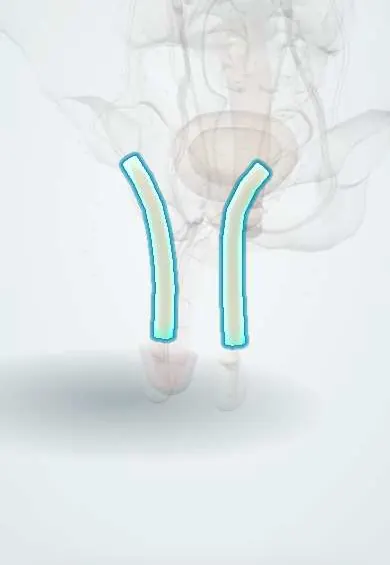
Testicular torsion !
Testicular torsion is a twist of the spermatic cord that cuts off blood to the testis; it causes sudden severe pain and the testis can be lost within hours.
Updated 2026-10-29
Structures involved
Tap one to see what it is and open it in 3D.
- Spermatic cord
- Testes
- Epididymis
- Scrotum
- Testicular arteries
- Testicular veins and pampiniform plexus
- Ductus deferens
In embryology
In the clinical exam
Why it happens
- Hypoxia, ischemia and reperfusion injury
- Infarction: red vs white, and what decides the damage
- Testis: seminiferous tubules, Sertoli and Leydig cells, spermatogenesis
What it is
Twisting of the spermatic cord that cuts off blood flow to the testis. It is a surgical emergency: the testis can be lost within hours.
Who gets it
Peaks in adolescence, with a smaller peak in newborns, but can happen at any age. A leading cause of acute scrotal pain in boys and teenagers.
Causes
- Bell-clapper deformity: a high attachment of the tunica vaginalis lets the testis rotate freely
- Intravaginal torsion in children and adolescents
- Extravaginal torsion in newborns (whole cord and tunica)
- Triggers: sleep, exercise, minor trauma, cold
Risk factors
- Adolescence
- Bell-clapper deformity (often on both sides)
- Previous self-resolving episodes
- Undescended testis
- Family history
Pathophysiology
The twisted cord first blocks venous outflow and then arterial inflow, causing congestion, ischaemia and infarction. Salvage depends on time since onset and the degree of twisting; the chance of saving the testis falls steeply after about six hours (a widely cited window).
Classification
- Intravaginal (most; children and adolescents) or extravaginal (newborns)
- Complete, partial or intermittent torsion
Symptoms and signs
- Sudden severe pain in one side of the scrotum, often waking the patient
- Nausea and vomiting
- Swollen, very tender testis, high-riding with a horizontal lie
- Absent cremasteric reflex on the affected side
- Sometimes felt as lower abdominal or groin pain (the scrotum must be examined)
Diagnosis
- Clinical
- A clinical diagnosis: sudden pain, high-riding horizontal testis and absent cremasteric reflex; scores such as TWIST help stratify. With high suspicion, the patient goes straight to surgery.
- Tests
- Urinalysis is usually normal (helps against epididymitis).
- Imaging
- Colour Doppler ultrasound shows reduced or absent flow and may show a twisted cord (whirlpool sign); it must not delay surgical exploration.
Differential diagnosis
- Torsion of a testicular appendage («blue dot» sign)
- Epididymitis or epididymo-orchitis
- Incarcerated inguinal hernia
- Trauma or haematoma
- Testicular tumour
- IgA vasculitis (Henoch–Schönlein purpura)
Goal of treatment
Restore blood flow as fast as possible to save the testis, and prevent recurrence on both sides.
Treatment
- Surgical
- Emergency scrotal exploration with detorsion; orchidopexy of a viable testis and of the other testis; orchiectomy if the testis is necrotic.
- Acute
- Manual detorsion (usually rotating outwards, «opening the book») can be tried while surgery is arranged; it does not replace exploration.
- Medical
- Analgesics and antiemetics.
Complications
- Loss of the testis (orchiectomy)
- Testicular atrophy
- Reduced fertility
- Recurrence if the testes are not fixed
- Psychological impact
Prognosis
Salvage rates are high when surgery happens within the first hours and low after a day. One healthy testis usually keeps normal hormone levels and fertility.
Test yourself
Think of the answer, then tap the question to see it.
Which anatomical variant predisposes to testicular torsion?
The bell-clapper deformity: a high tunica vaginalis attachment that lets the testis rotate.
Which reflex is typically absent in testicular torsion?
The cremasteric reflex on the affected side.
Should Doppler ultrasound be done before surgery when suspicion is high?
No. Imaging must not delay surgical exploration.
Why is the other testis also fixed during surgery?
The bell-clapper deformity is often bilateral, so contralateral orchidopexy prevents future torsion.
What is the time window for saving the testis?
Best within about six hours of pain onset; the salvage rate falls steeply afterwards.
Related conditions
- Epididymitis
- Kidney stones (urolithiasis)
- Hydrocele
- Testicular cancer
- Cryptorchidism (undescended testis)
Educational information, not medical advice. For any symptom, see a health professional.
Sources: Testicular Torsion (StatPearls (NCBI Bookshelf), 2023).
Spotted a mistake?We are always improving for the community. Tell us what is wrong and our team will review it.Report a mistake
Representative model, for educational purposes only.