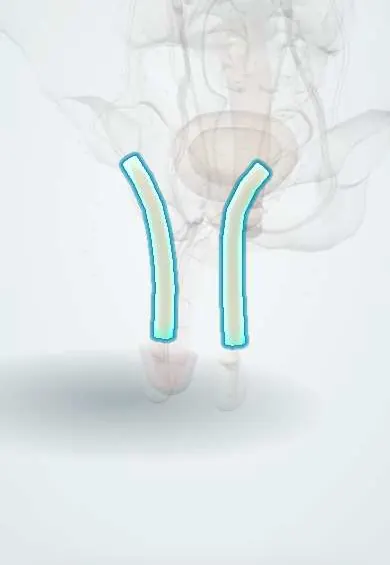
Reproductive system · Pelvis · Male
Spermatic cord !
The spermatic cord is the bundle that hangs each testis from the groin; it holds the ductus deferens and the testicular artery, veins and nerves.
Opens in the Durgical app, no sign-up needed.
What it is
The bundle that suspends each testis, from the deep inguinal ring to the top of the testis. It holds the ductus deferens, the testicular artery, the pampiniform venous plexus, nerves and lymph vessels, wrapped in layers that include the cremaster muscle.
What it does
Carries the blood supply of the testis and its sperm duct; the cremaster lifts the testis.
Key facts
- Where
- From deep inguinal ring through inguinal canal and superficial ring to posterior border of testis
- Attaches
- Coverings: external spermatic fascia (external oblique), cremaster muscle and fascia (internal oblique), internal spermatic fascia (transversalis fascia)
- Function
- Contains ductus deferens, testicular artery, pampiniform plexus, artery to ductus, cremasteric artery, genital branch of genitofemoral nerve, lymphatics
Relations
- Superficial
- In the inguinal canal, the aponeurosis of the external oblique; in the scrotum, dartos and skin. The ilioinguinal nerve runs on the cord, not inside it
- Below
- Inguinal ligament, the floor of the inguinal canal
- Behind
- Transversalis fascia and the conjoint tendon, the back wall of the inguinal canal
- Medial
- Pubic tubercle: the cord leaves the superficial ring just above and lateral to it
How to find it
Felt at the neck of the scrotum and over the pubic tubercle by rolling it between finger and thumb; the ductus deferens is its firmest strand.
Examination
- Cough impulse: a finger invaginating the scrotal skin up to the superficial ring feels an impulse on coughing when an inguinal hernia runs along the cord
On imaging
Color Doppler ultrasound is the first study. It shows the vessels, the vas and the pampiniform veins in the inguinal canal and above the testis. Classic findings: torsion, with a twisted cord (whirlpool sign) and absent testicular flow; varicocele, with dilated veins that enlarge on Valsalva; and an indirect inguinal hernia or a cord hydrocele. CT or MRI is seldom needed, mainly for cord tumors.
Common problems
- Torsion: the cord twists and cuts off the blood supply of the testis; sudden severe scrotal pain, an emergency.
- Varicocele: widened veins of the pampiniform plexus, usually on the left, felt like a 'bag of worms'; it can affect fertility.
- An inguinal hernia can come down along it.
How it is diagnosed
Examination; Doppler ultrasound shows the blood flow (torsion) and widened veins (varicocele).
Treatment
- Emergency surgery for torsion.
- Surgery or embolisation for a varicocele that causes pain or infertility.
Clinical notes
- Spermatic cord block: local anaesthetic placed around the cord near the pubic tubercle numbs the testis for scrotal procedures
- In inguinal hernia repair the ductus deferens and testicular vessels are separated from the sac; injury to them can cause testicular atrophy
Development
Its coverings are abdominal wall layers drawn down by the testis as it passes into the scrotum around the seventh month: external spermatic fascia from the external oblique aponeurosis, cremaster from the internal oblique, internal spermatic fascia from the transversalis fascia. A processus vaginalis that stays open allows an indirect hernia or a communicating hydrocele.
Memory aid
Rule of threes: three coverings (external spermatic fascia, cremaster, internal spermatic fascia), three arteries (testicular, cremasteric, artery to the ductus deferens), three nerves (genital branch of the genitofemoral, autonomic fibres, ilioinguinal on the outside), plus the ductus deferens, pampiniform plexus and lymphatics.
Related conditions
Test yourself
Think of the answer, then tap the question to see it.
What are the three coverings of the spermatic cord, and from which layers do they derive?
External spermatic fascia (external oblique), cremaster (internal oblique) and internal spermatic fascia (transversalis fascia).
What are the three arteries of the spermatic cord?
The testicular artery, the cremasteric artery and the artery to the ductus deferens.
Does the ilioinguinal nerve run inside the spermatic cord?
No; it runs on the cord, outside its coverings, in the inguinal canal.
In torsion of the spermatic cord, which flow stops first, and what is the ultrasound sign?
Venous outflow first, then arterial inflow; the twisted cord gives the «whirlpool» sign.
Where does an indirect inguinal hernia run relative to the spermatic cord?
Inside the cord, within the internal spermatic fascia, through an open processus vaginalis.
Educational information, not medical advice. For any symptom, see a health professional.
Its names
- Official Latin (TA2)
- funiculus spermaticus; cremaster TA2 3615
- Official Spanish (DeCS)
- Cordón espermático DeCS D013085
- English (TA2)
- Spermatic cord
- Also called
- cremaster muscle
Related
Sources: Terminologia Anatomica (TA2); DeCS; Anatomy, Abdomen and Pelvis: Inguinal Region (Inguinal Canal); Anatomy, Abdomen and Pelvis: Testes; 27.1 Anatomy and Physiology of the Testicular Reproductive System (OpenStax (Rice University), 2022) · adapted, CC BY 4.0.
Spotted a mistake?We are always improving for the community. Tell us what is wrong and our team will review it.Report a mistake
Representative model, for educational purposes only.